With European defense budgets surging and drone warfare reshaping the front lines, the decisive edge in future warfare will not necessarily come from a larger stockpile of missiles. Instead, it will come from superior data processing, smarter sensors, and artificial intelligence (AI) pushed to the tactical edge. Bill Guyan, a senior executive at Leonardo DRS, explains how technology is redefining survival on the modern battlefield and why Europe must adapt its modernization strategy.
European investment at an inflection point: Beyond the 2% NATO spending floor
For many years, European defense spending hovered near or below the two percent NATO requirement. Driven by a rapidly changing threat environment, we are now seeing dramatic spending increases and a widespread modernization of forces across the continent. While some areas of defense focus on shipbuilding or aircraft, European land forces are prioritizing air and missile defense, counter-UAS, and next-generation command and control. However, the industrial capacity of many nations remains a bottleneck in fulfilling these enlarged budgets and updating legacy systems.
The drone revolution and the demand for a common operational picture
The rapid proliferation of Class 1 drones has ensured they are a threat to every soldier and every vehicle. Battle management systems (BMS), which began as simple GPS tracking tools, have evolved into essential messaging and coordination hubs. These systems allow commanders to build and share a Common Operational Picture (COP), which is more necessary than ever given the saturation of unmanned systems. Passing information from sensors to the rest of the force in real-time is no longer a luxury, but a requirement for survival.
Resilience through sensor meshes: Why low-cost radars are the future of counter-UAS
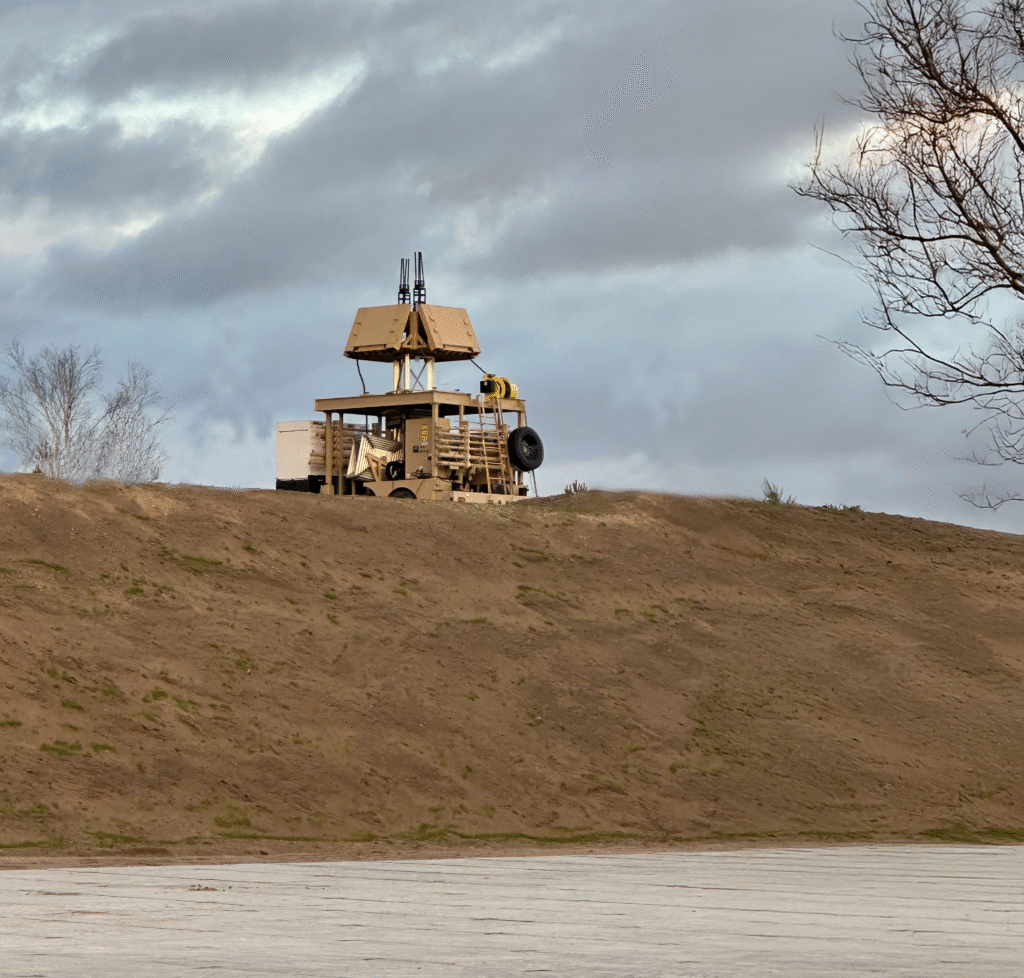
Recent conflicts in Ukraine and Israel have proven that sophisticated, fixed-site radars are high-priority targets that can be successfully taken out by cheap drones. The solution lies in a networked assembly of lower-cost, mobile, and transportable radars that act as gap fillers. This „mosaic” approach, utilizing systems like those from DRS RADA Technologies, provides built-in resilience. When these smaller radars are networked together, they provide an accurate and meaningful picture that can withstand the loss of individual exquisite sensors.
Artificial intelligence at the edge: Critical decisions inside the armored platforms
A major shift in modern warfare involves pushing AI capabilities down from the headquarters and cloud level to the platform level—inside tanks and infantry fighting vehicles. Since adversaries will prioritize disrupting networks, relying on a stable cloud connection is a risk. By embedding AI-enabled tactical computing, such as SAGEcore™ software, directly into the vehicle, commanders can synthesize sensor data even when communications are broken. This allows for automated target prioritization and better fire distribution, ensuring that resources are used with maximum efficiency in high-intensity combat.