Adapting to Evolving Global Threats
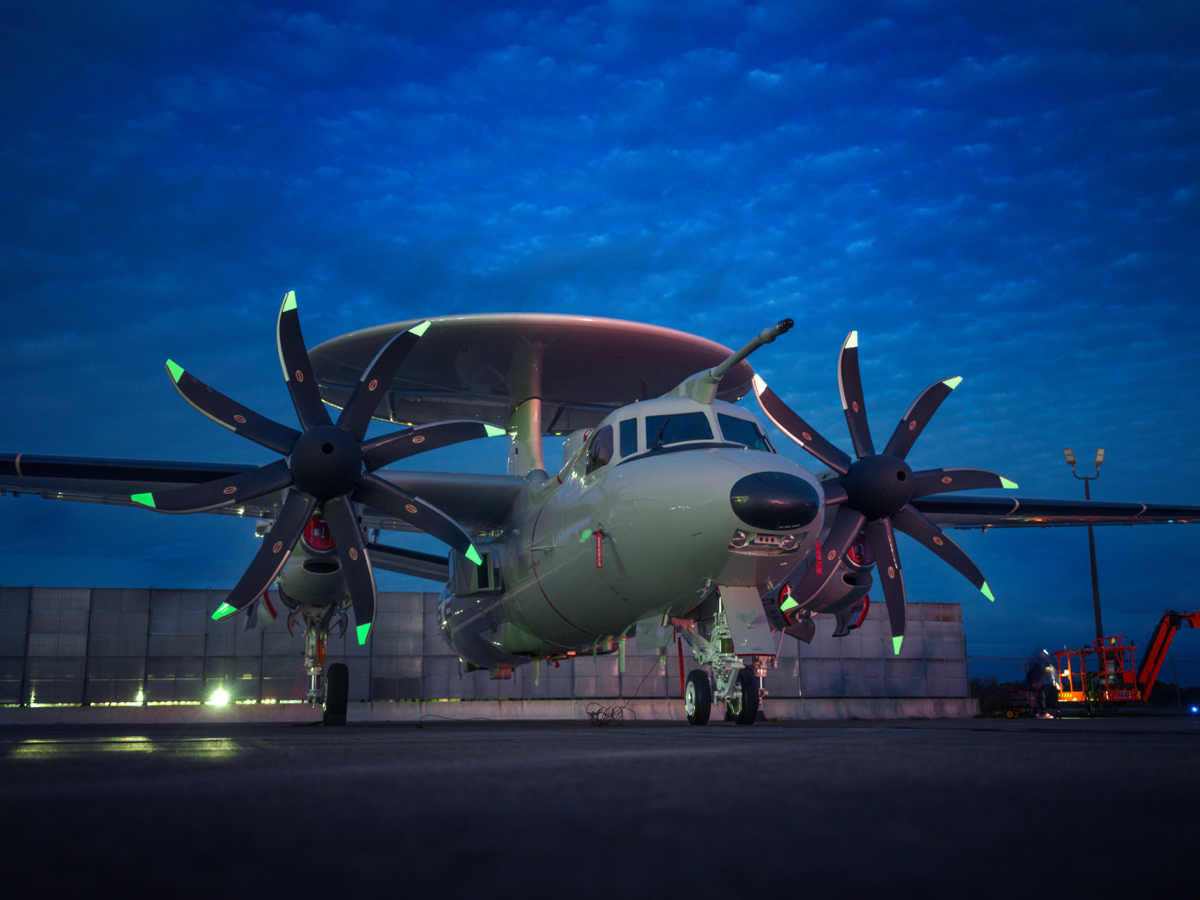
How many aircraft can withstand the test of time while adapting to meet the ever-changing global threats? At Northrop Grumman, the E-2D Advanced Hawkeye is setting a new standard for mission excellence, continuously evolving with modernized capabilities to maintain an edge in an increasingly complex battlespace.
The E-2D Advanced Hawkeye is the latest in a lineage of airborne early warning and command-and-control aircraft that extends over 60 years. It has redefined its mission scope by providing strategic oversight, flexibility, and advanced operational capabilities. This aircraft has become so essential that every U.S. Navy aircraft carrier embarks with either an E-2C or an E-2D, with additional operators including Japan, France, Egypt, and Taiwan. With 70 E-2D aircraft currently engaged in global operations, the Advanced Hawkeye delivers decision dominance to allied forces.
Modernization for Enhanced Mission Capabilities
The E-2D’s ongoing relevance is rooted in Northrop Grumman’s unwavering commitment to modernization. Over the aircraft’s 17-year lifecycle, the company has implemented five major updates that have expanded its capabilities to include integrated air and missile defense, electronic warfare, air traffic control, combat search and rescue, humanitarian relief, border security, and counter-drug operations.
Equipped with a 360-degree surveillance capability, the E-2D provides comprehensive monitoring of all targets within its operational area, whether over land or sea. Its advanced radar system, enhanced by digital computing and electronic scanning techniques, allows for powerful detection capabilities and ensures a unified Common Operating Picture that seamlessly connects all command levels.
Automation advancements have also transformed E-2D operations. Tasks such as target tracking, radar fine-tuning, and reporting are increasingly automated, allowing crews to concentrate on mission-critical objectives. Furthermore, pilots can engage with a full range of mission functions directly from the cockpit, significantly streamlining manpower requirements in contrast to previous aircraft models.
A noteworthy enhancement includes the aerial refueling capability, which boosts the E-2D’s flight endurance to over eight hours, improving both fleet protection and operational efficiency.
Collaborating for Future Innovations
By building on a legacy of innovation, Northrop Grumman is ensuring that the E-2D remains a vital asset for global defense forces well into the future. “Northrop Grumman collaborated with the U.S. Navy on the E-2D Advanced Hawkeye program to ensure that this fleet modernization allows us to outpace evolving threats through the 2040s and beyond,” stated Janice Zilch, vice president of Multi-Domain Command and Control programs.
The upcoming Delta System Software Configuration 6 (DSSC 6) upgrade promises to enhance operational availability, software resiliency, and security, ensuring a seamless command and control experience. In pursuit of these objectives, Northrop Grumman is investing in model-based systems engineering and transitioning legacy systems to modern digital environments. The new mission computers and displays adopt an agile, open-mission-systems approach, facilitating rapid technology integration and guaranteeing that the E-2D adapts to future threats.
As Zyad Hajo, Northrop Grumman airborne systems operator, noted, “Threats advance. You have to change things and constantly think of the next incremental leap to keep ahead – always advancing the technology.” The E-2D’s open architecture also mitigates integration risks and supports third-party software, utilizing commercial off-the-shelf equipment to maximize operational flexibility.
Investing in Sustainability and New Capabilities
In addition to enhancing operational capabilities, Northrop Grumman is modernizing the E-2D’s maintenance and sustainability protocols to ensure its longevity. By leveraging machine learning and artificial intelligence, the company has introduced predictive maintenance technologies that optimize readiness and minimize downtime. Augmented reality solutions are expediting maintenance processes, while virtual reality platforms are transforming training, allowing sustainment teams to master aircraft systems well in advance of hands-on engagement.
From its origins as a specialized aircraft for the U.S. Navy, the E-2 has evolved into a cutting-edge airborne command-and-control system. With the E-2D recognized as one of the Navy’s top five acquisition programs by the Assistant Secretary of the Navy for Research, Development, and Acquisition, and multiple nations transitioning to this advanced platform, the E-2D’s superior technology exemplifies Northrop Grumman’s commitment to innovation, adaptability, and mission success.