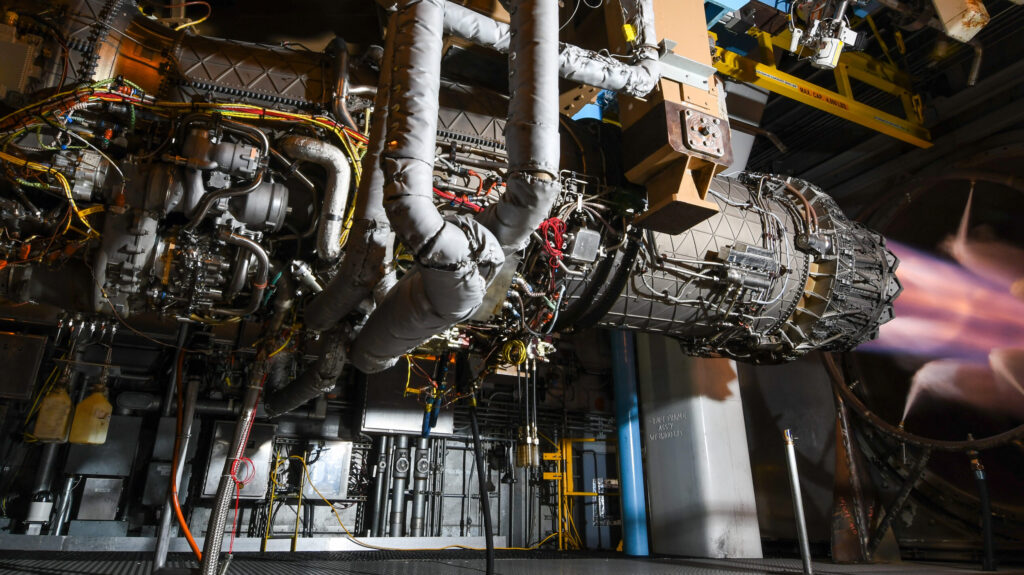
Pratt & Whitney’s F135 modernization program is moving toward further testing and eventual production
An upgrade for the F-35 stealth fighter’s engine has passed a major design assessment, clearing the way for additional testing and, eventually, series production.
Known as the Engine Core Upgrade, or ECU, the program focuses on Pratt & Whitney’s F135 engine and is intended to improve the performance of the powerplant used by all three F-35 variants.
Jill Albertelli, president of Pratt & Whitney’s military engines business, said the review confirmed that the design had reached the required level of maturity and was ready to move into the next phase.
Review confirms design maturity
The completed milestone was a risk reduction design review, an assessment intended to identify and reduce technical risks before the program advances further.
According to Pratt & Whitney, the review is essentially comparable to a critical design review, a Pentagon process used to determine whether a system is likely to perform as required and is ready for continued development.
The assessment covered the engine’s integration with the aircraft as well as the industrial base needed to support future production.
“It means that we’ve been working integration with the airframe. It means that the design is solid. It means that we’re ready to move forward from an industrial base as well,” Albertelli said.
First test engine is already being built
Approximately one-third of the unique hardware required for the first engine to undergo testing is currently in production.
The next major step will be the initial engine test. Pratt & Whitney did not provide a detailed schedule for the individual milestones and referred questions about the official test plan to the F-35 Joint Program Office.
US Air Force officials have previously said that ground testing is expected to begin in 2027, followed by flight testing around 2030.
Entry into service pushed back
When Pratt & Whitney first promoted the ECU program, company officials projected that the upgrade could enter service by 2028.
A later review by the Government Accountability Office indicated, however, that ECU production is not scheduled to begin until 2031.
Pratt & Whitney emphasized that the program’s pace depends on government priorities and available funding.
“Funding isn’t unlimited, so we have to balance those equations based on what the need is,” Albertelli said, adding that the company is meeting the milestones established by the government.
More thrust and improved fuel efficiency
Military officials say the upgrade will provide greater thrust and better fuel efficiency.
The ECU is also intended to restore the engine’s expected service life and support a series of future improvements associated with the F-35’s Block 4 configuration.
The program was selected instead of developing an entirely new adaptive propulsion system for the F-35. Pratt & Whitney says upgrading the F135 will save tens of billions of dollars in maintenance costs compared with leaving the existing engine without a major enhancement.
Existing F-35s will also receive the upgrade
All three F-35 variants — the F-35A, F-35B and F-35C — are expected to benefit from the modernization.
The ECU is intended not only for newly produced aircraft but also for retrofit installation on F-35s already in service.
The Pentagon recently awarded approximately $240.8 million through a contract modification to continue ECU-related work. That funding follows a $1.3 billion base contract awarded in September 2024.