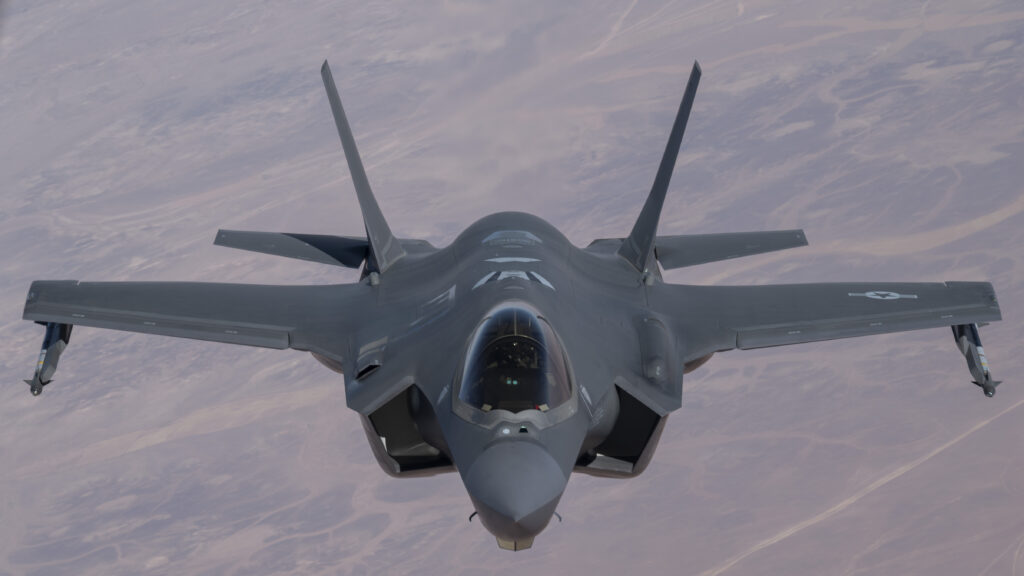
An alarming scenario is unfolding for the F-35 Joint Strike Fighter program. Starting this fall, all new F-35 aircraft delivered to the American military will arrive without essential radars, a problem that could stretch into the future and severely restrict these jets from participating in combat operations. This deficiency effectively relegates cutting-edge stealth aircraft to training platforms, significantly diminishing the fleet’s operational readiness.
The Missing Sensor: A Critical Component Gap
The root cause of this situation is the delayed delivery of the upgraded APG-85 radar. Unlike its predecessor, the APG-81, the new radar features a different size, necessitating a redesigned bulkhead within the aircraft. While the Pentagon aimed to synchronize the radar’s introduction with the current production batch, Lot 17, delays mean the jets will be ready before the APG-85. Due to the altered bulkhead design, the older APG-81 radar cannot be fitted into the space intended for the APG-85.
Officials familiar with the situation confirmed that aircraft delivered without a radar, while remaining airworthy, will be confined to training missions and barred from combat operations. While only a handful of jets might be affected if the new radar is ready next year, prolonged delays could see over a hundred aircraft delivered with a ballast in place of the crucial sensor. A congressional representative corroborated that new aircraft would indeed be delivered with ballasts to ensure flyability.
A Calculated Risk? Pentagon and Industry Weigh In
F-35 manufacturer Lockheed Martin stated that the APG-85 is government-furnished equipment, outside the scope of its production and sustainment contracts, affirming its readiness to support the government and radar supplier. The company directed further inquiries to the F-35 Joint Program Office (JPO).
A JPO spokesperson explained that US F-35s are being „built to accommodate” the APG-85, with initial fielding for some aircraft planned for Lot 17, aligning with Marine Corps deliveries. The spokesperson added that the decision for a „highly concurrent development and production program” for advanced capabilities was made with „full understanding of the risk” of production aircraft being ready ahead of the capabilities. The JPO has plans to accelerate APG-85 production, but specific details remain classified.
This issue will not impact foreign F-35 buyers, as the APG-85 has not been cleared for export; they are expected to receive jets with the incumbent APG-81. However, the US Marine Corps is expected to accept new F-35Bs without a radar in the coming months, with the US Air Force and Navy following suit with their F-35A and F-35C variants later this year.
Long-Term Fallout and Criticisms: A Vulnerable Fleet?
Mitigating the radar delays with a new bulkhead capable of accommodating both APG-81 and APG-85 is unlikely to be ready until Lot 20, with deliveries beginning in 2028. This leaves no interim option but to accept aircraft without the radar. If delays persist, aircraft produced over approximately the next two years will be unusable for combat operations until the new radar arrives, at which point a costly and time-consuming retrofit will be required, with unknown specifics.
Critics, including some officials, view this radar issue as another instance of poor planning for the F-35 program, already notorious for delays and cost overruns. Lengthy certification times are identified as the primary driver for APG-85 delays. The APG-81 could be certified in three days, while the newer radar requires „much, much longer.”
The impact on combat capability is substantial. An F-35 without a radar would be „very near-sighted,” according to a defense expert. While the aircraft possesses other sensors and can leverage off-board systems like ground-based radars via datalinks, this introduces latency and the risk of enemy jamming. Training with such aircraft would be „less relevant to the most demanding and critical missions.” Retrofitting a large number of F-35s later would be a „huge blow” to the tactical aircraft fleet, which is currently shrinking. Ultimately, the fleet’s numbers could „belie the real capability that is available at any moment in time.”