






„Reality Check” Needed in the Race for Uncrewed Combat Air Vehicles, Says GA-ASI President
In a landscape where the demand for uncrewed combat air vehicles (UCAVs) is soaring, General Atomics Aeronautical Systems, Inc. (GA-ASI) is asserting its leadership by delivering tangible operational capabilities now, according to President David R. Alexander. This comes on the heels of the U.S. Air Force’s recent announcement that flight operations have commenced with the YFQ-42A Collaborative Combat Aircraft (CCA), built by GA-ASI. Alexander emphasizes that the company is proving its ability to meet today’s urgent threat landscape.
Beyond Renderings: Real Capabilities Matter
While competitors tout impressive concepts and renderings, Alexander argues that these cannot replace real-world, flying capabilities. He states that there is growing recognition that unmanned systems will form a significant portion of future force structures to address the challenges of 21st-century warfare.
Alexander cautions against novel concepts that may look promising on paper but are years away from being field-ready, if ever. He also criticizes companies that present outdated technology as new or misrepresent unrelated work as relevant „legacy” experience. He emphasizes GA-ASI’s focus on demonstrating rather than just talking.
Expertise, Track Record, and Infrastructure: The Keys to Success
Alexander believes the conversation surrounding revolutionary capabilities should be grounded in practicality. He challenges the industry to a „reality check,” questioning whether competitors possess the necessary expertise, track record, and physical infrastructure to produce UCAVs at the required speed and scale.
He asserts that GA-ASI excels in all three areas, highlighting its advanced hardware, cutting-edge software, and extensive manufacturing capabilities.
GA-ASI’s UCAV Leadership: A Three-Pillar Approach
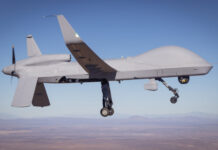
- Hardware: GA-ASI points to its MQ-20 Avenger®, first flown in 2009 and still used as a test platform, and the XQ-67A Off-Board Sensing Station (OBSS), developed with the Air Force Research Laboratory and first flown in 2024, as proof of its ability to deliver on UCAV requirements. The XQ-67A serves as a fully operational engineering model for the YFQ-42A unmanned fighter.
- Software: GA-ASI has invested heavily in advanced autonomy, employing over 1,000 software engineers specializing in artificial intelligence, machine learning, and autonomy. Notable achievements include a simulated shootdown of live and virtual test targets using the MQ-20 Avenger and an autonomous collaborative engagement demonstration using the Avenger and four CCA stand-in aircraft.
- Manufacturing: GA-ASI boasts over 5 million square feet of manufacturing space, including advanced additive manufacturing technology to increase output and reduce aircraft costs.
Integrating Hardware, Software, and Production
Alexander emphasizes the importance of seamlessly integrating hardware, software, and production processes to deliver tangible capabilities to warfighters. He stresses that the current global security landscape demands urgent deployment at scale.
GA-ASI has leveraged its decades of UCAV development expertise, investing early in the YFQ-42A to ensure rapid production in high numbers. This includes mitigating hardware design risks and leveraging existing company facilities. Software advancements are continuously being refined through demonstrations using the Avenger and XQ-67A.
Real Aircraft, Flying Today
Alexander concludes that GA-ASI’s focus on real aircraft, flying today, that advance the capabilities needed by the U.S. and its partners on the 21st-century battlefield is what truly sets it apart. He believes the future of UCAVs like the CCA is about delivering operational capabilities today, not just concepts or promises.