From the MQ-9B to the FQ-42A and Wildfire
General Atomics Aeronautical Systems Inc. (GA-ASI) is reshaping its uncrewed aircraft portfolio to meet the demands of modern warfare, defined by technologically advanced adversaries, sophisticated air defenses and the need to conduct operations at extended ranges.
The company believes future conflicts will require uncrewed aircraft capable of combining autonomy, long-range reach, persistence, payload, survivability in contested environments and mass production.
In addition to upgrades for the MQ-9B SkyGuardian, MQ-9B SeaGuardian and Mojave STOL, GA-ASI has introduced two new systems: the FQ-42A Collaborative Combat Aircraft (CCA) and the Wildfire Massed Modular Aircraft (MMA).
“We’ve never been a company that rested on its laurels,” said GA-ASI President David Alexander. “The battlefield has evolved, threats have evolved, and so have we.”
Large UAS remain relevant
Losses suffered by large drones in contested environments have sometimes prompted calls to move away from platforms such as the MQ-9. Alexander argues that these experiences demonstrate the need to modernize large aircraft rather than eliminate them.
According to Alexander, the MQ-9 Reaper was designed for persistent surveillance, long-endurance missions and precision strike. It delivers those capabilities at a lower cost than crewed aircraft while avoiding the risk to human aircrews.
Alexander rejected the idea that small drones can fully replace larger platforms. Quadcopters, gliders and short-range rockets cannot simultaneously provide the range, payload and endurance required for extended missions.
“Long-range, high-payload, high-endurance missions require large, hefty airframes with significant wingspan, fuel capacity and payload volume,” he said.
MQ-9B: A platform for ISR and long-range strike
Long-range weapons
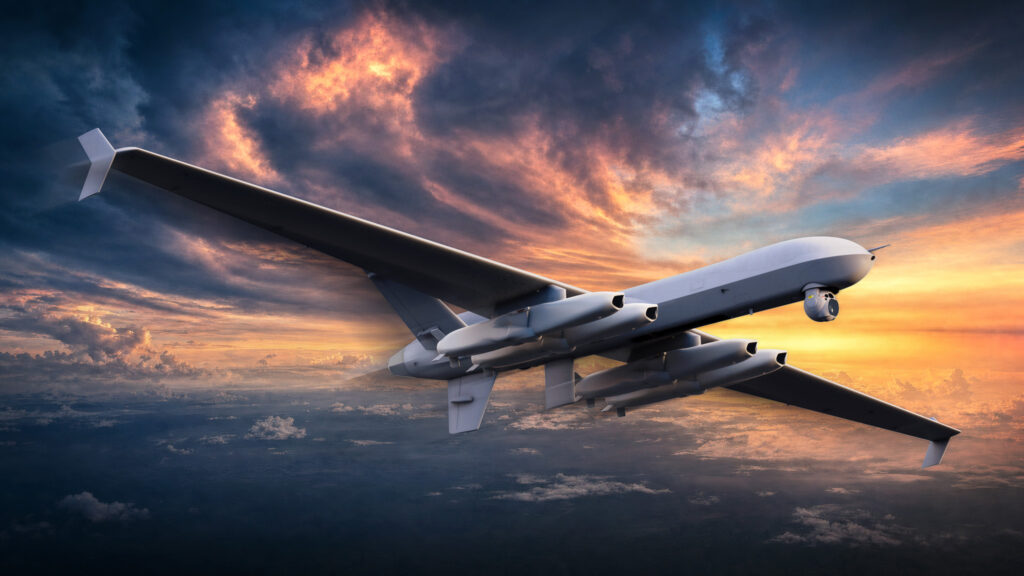
The MQ-9B SkyGuardian and SeaGuardian remain GA-ASI’s flagship multi-mission platforms for intelligence, surveillance and reconnaissance (ISR), as well as precision strike.
New pylons with 30-inch lug spacing allow the integration of larger weapons, including:
- the Long Range Anti-Ship Missile (LRASM);
- the Joint Strike Missile (JSM).
GA-ASI and Kongsberg are working together to integrate the JSM onto the MQ-9B. Equipped with ISR sensors and long-range weapons, the aircraft could conduct strike and maritime-interdiction missions from outside the range of adversary systems.
Resilient pLEO communications
The MQ-9B will also benefit from connectivity through proliferated low Earth orbit satellite constellations, known as pLEO. This integration is intended to provide low-latency, high-bandwidth communications with increased resistance to jamming.
Combined with Department of Defense-standard cybersecurity measures, the system should be able to maintain command-and-control links and sensor data connections even under electronic attack.
Mojave STOL: Expeditionary airpower without conventional runways
Short takeoff and landing from improvised locations
The Mojave STOL is designed for short takeoffs and landings. The aircraft can operate from austere, unprepared locations such as open fields, dry riverbeds and the decks of amphibious assault ships.
This capability allows uncrewed airpower to be generated from locations that are difficult for an adversary to identify and target.
Sensors for distributed operations
Mojave STOL can carry radar, electro-optical and infrared sensors, as well as signals-intelligence payloads. The system is controlled through portable, laptop-based ground-control equipment.
In an environment where conventional runways and air bases are vulnerable, the platform can provide persistent ISR and strike capabilities from improvised launch and recovery sites.
Gambit and FQ-42A: Uncrewed fighters for peer conflict
A common family of autonomous aircraft
The Gambit Series is GA-ASI’s family of autonomous jet aircraft designed for operations in contested airspace.
Approximately 70 percent of the key components are common across the variants, helping reduce costs and simplify production, logistics and sustainment.
Selected by the U.S. Air Force for its CCA program, the FQ-42A is the Air Force’s first uncrewed fighter and a member of the Gambit family.
Six operational roles
Across six missionized variants, Gambit aircraft can support:
- long-endurance ISR in contested airspace;
- air-to-air combat and escort missions;
- adversary training;
- low-signature reconnaissance;
- carrier-based operations;
- penetrating air-to-ground missions and suppression of enemy air defenses.
The systems are designed for human-machine teaming with crewed fighters and other uncrewed aircraft. They can extend sensor coverage, increase weapons capacity and force adversaries to manage multiple threats simultaneously.
Wildfire: Theater-level attritable mass
Weapons and range
The Wildfire Massed Modular Aircraft is designed as a high-production uncrewed platform for operations in high-threat environments.
The aircraft can carry:
- two LRASM missiles;
- four JSM missiles.
Its ferry range exceeds 8,000 nautical miles, allowing it to deliver weapons, sensors, electronic-warfare payloads or communications-relay equipment deep into contested battlespace.
Modular design and rapid production
Open interfaces and hardpoints support rapid payload changes, allowing the aircraft to be adapted to changing missions and threats.
GA-ASI says Wildfire is designed for large-scale production using the company’s industrial infrastructure, which covers more than 5 million square feet. The goal is to field enough aircraft to absorb attrition while maintaining pressure across the theater.
Together, Wildfire and Gambit are intended to provide what defense officials call attritable mass: large numbers of capable systems that are uncrewed, affordable and replaceable.
GA-ASI draws on extensive operational experience
David Alexander said the company’s portfolio reflects its intention to remain the leading provider of uncrewed aircraft systems to the United States and its allies.
“We’ve got nearly 10 million flight hours under our belts, and the vast majority of those were in combat operations,” Alexander said. He added that GA-ASI already has the personnel, infrastructure and capacity required to deliver these systems at scale.