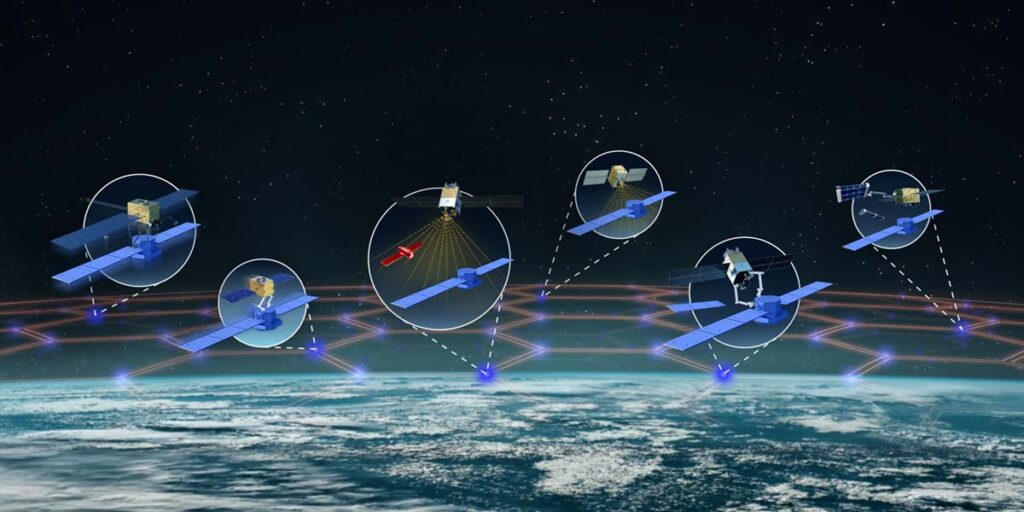
The US missile-defense architecture must now contend with a broader range of threats than it did when Henry “Trey” Obering led the Missile Defense Agency (MDA). Ballistic missiles remain a central concern, but the threat set also includes hypersonic weapons, maneuvering warheads, drones and potential fractional orbital bombardment systems.
In an interview, the retired lieutenant general—now a senior executive adviser at Booz Allen and a board director at Astroscale U.S.—discussed the architectural challenges facing Golden Dome and the role of on-orbit logistics.
A More Diverse—and Destabilizing—Threat
Obering identified three major changes. The first is the evolution of the threat. He said Russia and, to some extent, China may be moving away from deterrence based on the threat of an all-out attack toward an “escalate to deescalate” strategy: launching a limited strike intended to shock the United States and deter it from intervening in a crisis, such as a possible attack on Taiwan.
The second change is the range of weapons. Alongside ballistic missiles, arsenals now include hypersonic missiles, maneuvering warheads and systems that could place a warhead in orbit before deorbiting it at an unexpected location. Obering also pointed to the spread of drone attacks in the Middle East and the Russia-Ukraine war.
The third change is technological. Advances in sensors, processing power, algorithms, mesh communications, artificial intelligence and manufacturing—combined with lower space-launch costs—have brought space-based elements back into consideration for missile-defense architectures.
Command and Control Is a Major Golden Dome Challenge
Golden Dome is envisioned as a layered architecture connecting terrestrial and space-based sensors and interceptors. For Obering, integrating command and control, battle management and fire control is the architecture’s central risk.
He recalled that, during his time leading MDA, connecting an Aegis SPY radar to the Ground-Based Midcourse Defense fire-control system was a significant challenge. Golden Dome will need to integrate many more sensors and interceptors, including space-based systems.
Space-based interceptors could enable earlier engagements and globally tailored coverage, Obering said. The challenge will be scaling that capability affordably.
On-Orbit Logistics Could Extend Constellation Lifespans
Refueling, servicing, repositioning, resupply and deorbiting could improve the viability of satellite constellations, Obering said. In the past, the high cost of launches made on-orbit servicing difficult to justify. Lower launch costs have changed the economics.
Not every satellite should be serviced. Extending the life of some spacecraft may cost less than replacing them, while replenishing smaller satellites in low Earth orbit may be more practical than refueling or repairing them. The decision depends on the mission, orbit and pace of technological change.
Spacecraft Interfaces Must Be Designed in From the Start
For satellites to be refueled or repaired, their interfaces must be planned and standardized from the outset. Obering compared the idea to aerial refueling: very different aircraft can use the same tanker infrastructure if they have compatible receptacles.
In space, standards should cover mechanical, electrical, data and refueling connections, as well as replaceable components and accessible servicing locations. The International Space Station is one example of infrastructure designed to accommodate visiting spacecraft through agreed interfaces.
Obering said the government should communicate requirements and demand, while industry develops the technical solutions. He sees a similar approach emerging within Golden Dome.
Space-Based Interceptors and Magazine Depth
Space-based interceptors could help manage larger attacks by engaging missiles shortly after launch or during midcourse flight. Reducing the number of threats that reach later stages would complement terrestrial systems such as SM-3, THAAD, Arrow and Patriot, increasing the defense’s ability to handle larger salvos.
Obering also cited Astroscale U.S.’s plan to launch its Provisioner® refueling spacecraft in 2026, with the goal of demonstrating an operational on-orbit refueling capability in support of the US Space Force.
In his view, logistics should not be treated merely as a commercial service. Just as tankers support air operations and replenishment ships support naval forces, on-orbit logistics could become a warfighting enabler—helping space systems remain resilient and operational through conflict.