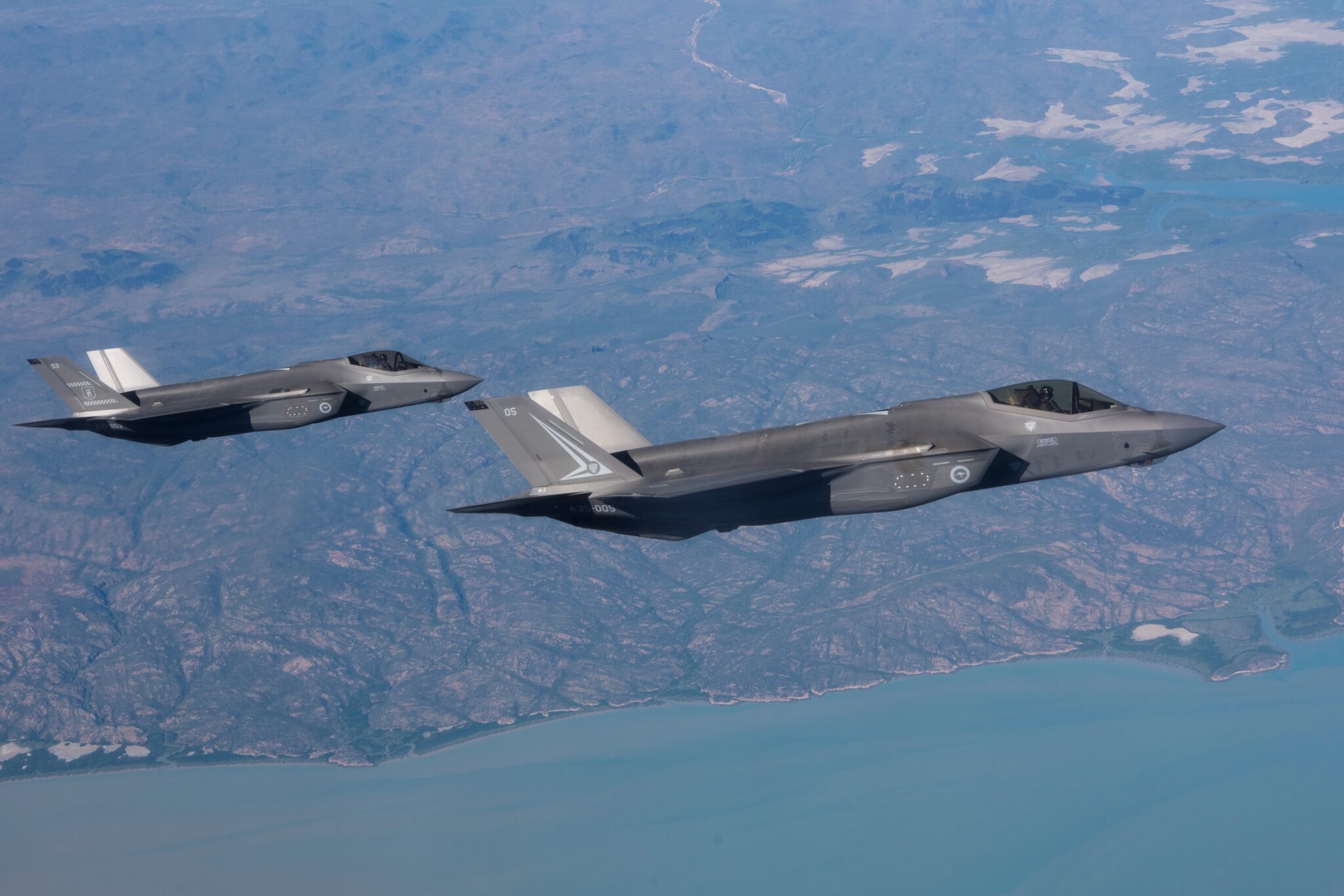
Strategic Focus on F-35 Sustainment
Australia is expanding its defense ambitions beyond submarines and missiles, turning significant attention towards the global F-35 fleet, which is in urgent need of enhanced cooling systems for next-generation technologies. Positioned to become the premier hub for F-35 sustainment and upgrades in the Indo-Pacific, Australia stands ready for substantial defense transformations.
In an exclusive interview with Breaking Defense, Matt Milas, President of Defense and Space at Honeywell Aerospace Technologies, discussed the substantial opportunities in upgrading the Power Thermal Management System (PTMS) for the worldwide F-35 fleet.
A 60-Year Partnership Built on Trust
Breaking Defense: Honeywell has been collaborating with the Australian government and industry for over six decades. What has contributed to this successful partnership?
Milas: Our long-standing relationship is founded on trust and proven performance. With more than 1,700 employees across Australia, Honeywell’s technology is integral to critical defense assets such as the F-35 Joint Strike Fighter, M1 Abrams Main Battle Tank, and CH-47 Chinook Helicopter.
We are amplifying our commitment to AUKUS Pillar 1 and Guided Weapons and Explosive Ordnance (GWEO) through strategic investments in defense technologies, enhanced industrial partnerships, and accelerated capability transfers to better integrate Australia into global defense supply chains.
The Evolution of Australia’s Defense Industrial Base
How is Australia’s defense industrial base evolving under AUKUS?
This shift is monumental. Australia is transforming from merely a purchaser of defense technology to a significant global producer and sustainment hub. The Australian government is backing this change with major investments in locations like Adelaide, Geelong, Brisbane, and Western Australia to enhance submarine and maritime capabilities.
However, ambition alone won’t suffice. The readiness of the workforce poses a critical challenge. Meeting the demands for nuclear-powered submarines and advanced missile systems necessitates a highly skilled labor pool. Australia has demonstrated its capability in the resource sector; now it’s time to channel that ingenuity into defense.
The F-35 Fleet’s PTMS Upgrade: A Clear Choice
Why should the U.S. and its allies opt for Honeywell’s Power Thermal Management System upgrade?
Choosing an alternative could introduce unnecessary risks, elevation in costs, and operational disruptions. Honeywell’s PTMS has proven itself over one million flight hours across more than 1,100 aircraft, delivering vital functions such as environmental controls, emergency power, oxygen generation, and advanced cooling.
Our upgrade plan is straightforward: enhancing cooling capacity from 32 kW to a range of 62-80 kW to meet future operational needs. Notably, our solution reuses 95% of existing hardware and 80% of software, minimizing risk and ensuring seamless integration without the need for costly airframe redesigns.
The alternative—a brand-new, untested system—presents massive development costs, potential delays, and unpredictable compatibility issues. The F-35 program simply cannot afford such risks. Our upgrade path stands as the lowest-risk and highest-performance option going forward.
Establishing PTMS Depot Capabilities in Australia
What is the strategy for establishing PTMS depot capabilities in Australia and the broader Indo-Pacific?
The strategy focuses on speed and scale. We have already established depot capabilities for PTMS in the U.S. and Europe, and Australia is next in line.
We are partnering with Rosebank, a trusted collaborator, to develop in-country PTMS sustainment capabilities. Our goal is clear: to ensure a fully operational depot network wherever the F-35 is deployed, which will prevent costly delays and enhance regional readiness.
AUKUS Pillar 1: Australia’s Role in Nuclear Submarine Sustainment
What role will the Australian defense industrial base play in AUKUS Pillar 1?
Australia is on a fast track to becoming a global leader in nuclear-powered submarine sustainment. The U.S. Navy’s transfer of Virginia-class submarines represents a generational transformation for Australian defense that necessitates a comprehensive shift in its industrial base and workforce.
With the recent arrival of the USS Minnesota at HMAS Stirling in Perth, Australia is taking its first steps towards supporting and eventually manufacturing Virginia-class submarines. The U.S. cannot produce these submarines quickly enough for its fleet, making it imperative for Australia to enhance its manufacturing capacity and integrate into the global supply chain.
Honeywell is leading the charge in this effort, recently securing a contract with the BlueForge Alliance to activate the AUKUS Submarine Industrial Base in Australia. This initiative extends beyond technology transfer; it aims to establish a sovereign industrial base capable of sustaining and building next-generation underwater warfare capabilities.
AUKUS Pillar 2: Establishing a Sovereign Missile Capability
How does missile production fit into the AUKUS transformation?
Australia must develop sovereign sustainment capabilities for its missile arsenal to reduce vulnerabilities, as critical missile components often need to be sent back to the