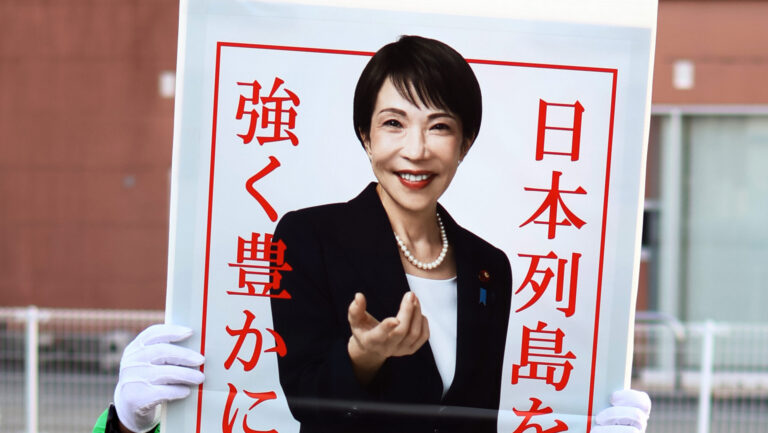
Japan’s latest general election has sent shockwaves through the global political landscape. Early tallies flashing across screens in Tokyo revealed a truly historic outcome: the Liberal Democratic Party (LDP), under Prime Minister Sanae Takaichi, secured 316 of the 465 seats in the House of Representatives. Alongside coalition partners, Takaichi now commands a two-thirds supermajority, an unprecedented mandate and the most decisive victory in the LDP’s seven-decade history. This electoral triumph unequivocally marks the end of Japan’s prolonged era of political caution.
An Unprecedented Mandate: End of Political Caution
This landslide victory was fueled by a potent confluence of public yearning for strong leadership and a highly effective digital campaign. Takaichi, widely regarded as the most faithful ideological heir to the late Shinzo Abe, successfully tapped into nationalist sentiment among younger voters through her compelling „Japan First” narrative. Electoral data clearly indicates that voters under 30 formed the backbone of the LDP’s surge, dwarfing opposition support that appeared increasingly incoherent and directionless. Equally critical was the opposition’s palpable failure to articulate a compelling alternative vision for the nation.
With two-thirds of parliament firmly under her control, Takaichi now holds what amounts to a blank cheque to reshape Japan’s national trajectory. Legislative obstacles to major strategic shifts have largely evaporated. The world is now poised to witness the emergence of the most assertive Japan since the end of World War II. Washington, perhaps unsurprisingly, stands to benefit from this convergence, as the strategic narratives of both governments now align almost seamlessly. However, this new reality will also compel every Southeast Asian capital, Jakarta foremost among them, to urgently recalibrate its diplomatic posture toward a far more muscular Japan – a shift that could accelerate the proliferation of military technologies across ASEAN nations.
Article 9: From Taboo to Tangible Threat
Domestically, the supermajority unequivocally opens the door to what has long been Japan’s most sensitive political taboo: amending Article 9 of the constitution. Takaichi has previously stated, with clear intent, „Constitutional revision is the LDP party line. I hope that concrete amendment proposals can be fully discussed in the Diet Commission on the Constitution.”
The pacifist clause, which legally constrains Japan’s ability to maintain warfighting forces, is now under existential threat. Armed with a two-thirds majority, Takaichi possesses the procedural power to initiate a national referendum to dismantle these military restrictions. Her long-held ambition to transform Japan into a „normal” state, economically powerful yet also militarily capable of defending its sovereignty, has never been more attainable. Military normalization would empower Tokyo to openly develop long-range missile systems and aircraft carrier fleets without resorting to euphemisms. Japan would no longer be a passive observer but an active player, ready to intervene should its vital sea lanes come under threat. Japan’s defense posture would shift permanently from a protective shield to an offensive sword, explicitly embracing counter-strike capabilities.
From Shield to Sword: Japan’s Military Reawakening
At home, Takaichi is widely expected to overhaul Japan’s defense industry to foster global competitiveness. Freed from constitutional constraints, major firms such as Mitsubishi Heavy Industries would receive a green light to export advanced military technologies, potentially creating new dependencies among partner states. Takaichi appears acutely aware that military autonomy is a fundamental prerequisite for political autonomy, particularly in navigating a sometimes unpredictable alliance with the United States.
In Japan’s backyard, a more militarized Japan likely jeopardizes decades of painstaking historical reconciliation with China and South Korea. Wartime grievances risk resurfacing, fueling diplomatic confrontations with potentially destabilizing effects on regional investment and broader economic confidence. For Beijing, this heralds a strategic alarm bell: the demise of a pacifist Japan that long served China’s interests. Takaichi is poised to deepen Japan’s role in the Quad and actively seek entry into AUKUS’s second pillar. Such bold moves would inevitably create a new security pole challenging China’s dominance along the critical First Island Chain. Yet, the reverberations will be felt throughout the entire Pacific, extending far into its southern waters.
Strategic Ripples Across Southeast Asia: ASEAN’s Thorny Offer
One of the clearest policy shifts under a Takaichi supermajority will be the significant expansion of Japan’s Official Security Assistance (OSA). For decades, Tokyo supported ASEAN primarily through economic aid. OSA marks a decisive break, offering direct assistance to bolster the military capabilities of neighboring states. With an overwhelming parliamentary mandate, Takaichi is likely to dramatically increase OSA funding as part of a systematic effort to construct a strategic buffer around China’s burgeoning sphere of influence in the South China Sea, with ASEAN serving as its crucial anchor.
For Indonesia, the implications would be substantial. Japan has already initiated support for maritime radar upgrades in sensitive areas such as the Natuna waters. With virtually unlimited fiscal space, Tokyo is expected to present highly attractive defense packages, ranging from advanced undersea surveillance systems to cutting-edge reconnaissance drones. OSA will become Takaichi’s primary instrument of defense diplomacy, aimed at ensuring ASEAN can effectively resist pressure from Beijing without relying exclusively on an often conditional and politically fraught American security umbrella. Yet, behind OSA lies a broader geostrategic design. Japan seeks to constrain China’s military access through a sophisticated network of ASEAN states equipped with Japanese defense technology—a strategy strategists would aptly describe as “proximal deterrence.”
For ASEAN, this will be a difficult and inherently risky offer to refuse. Accepting Japanese military assistance will almost certainly be interpreted by Beijing as a political alignment. This is particularly sensitive as OSA is also projected to extend into cybersecurity, including Japan’s proposal to develop undersea cable infrastructure to reduce ASEAN’s dependence on Chinese telecommunications technology. The true objective of OSA is not merely assistance, but rather integration, binding ASEAN into Japan’s security and technological ecosystem. Backed by a supermajority, Takaichi possesses the budgetary flexibility to heavily subsidize these initiatives. For Tokyo, safeguarding ASEAN’s security is the most effective way to protect the vital maritime arteries that sustain Japan’s economy. Still, the policy’s ultimate success will hinge on Tokyo’s ability to meticulously navigate ASEAN’s inherent sovereignty sensitivities, lest OSA be perceived as a subtle form of “new imperialism.”
A Precarious Balance: Militarization and Diplomatic Fault Lines
Sanae Takaichi’s overwhelming victory presents ASEAN with a distinct double-edged sword. On the positive side, a more assertive Japan offers a compelling alternative strategic balancer beyond the United States. Countries such as the Philippines and Vietnam are likely to view Takaichi as a formidable new security guarantor against aggressive territorial claims in the South China Sea. Under her leadership, Japan could emerge as a more predictable security provider than the United States, whose foreign policy often fluctuates dramatically with domestic electoral cycles.
The risks, however, are equally profound. Takaichi’s stark, black-and-white approach toward China fundamentally threatens ASEAN centrality and Indonesia’s long-standing “free and active” foreign policy. Her aggressive promotion of a Free and Open Indo-Pacific will exert immense pressure on ASEAN to redefine its strategic position. If Japan pushes too hard for ASEAN to choose sides in a confrontation with China, internal fractures could deepen and become increasingly irreparable. Cambodia and Laos, economically dependent on Beijing, would drift further to the margins, while maritime states such as Indonesia would be forced into exhausting diplomatic balancing acts. The most dangerous scenario is a bifurcated ASEAN: a mainland bloc leaning towards China and a maritime bloc aligned with Japan and the United States. Should this occur, ASEAN’s relevance as a neutral regional institution would significantly erode, effectively transforming Southeast Asia into a fragile buffer zone for competing external ambitions.
Looking ahead, Southeast Asian politics may be entering a phase best described as an “equilibrium of tension.” As Takaichi realizes her ambitious goals, ASEAN is likely to become more militarized. Defense cooperation with Japan will extend beyond joint exercises to include critical logistical facilities at key maritime chokepoints. Indonesia, in particular, will need to judiciously leverage OSA to strengthen national sovereignty without inadvertently becoming a pawn in an overt anti-China alliance.