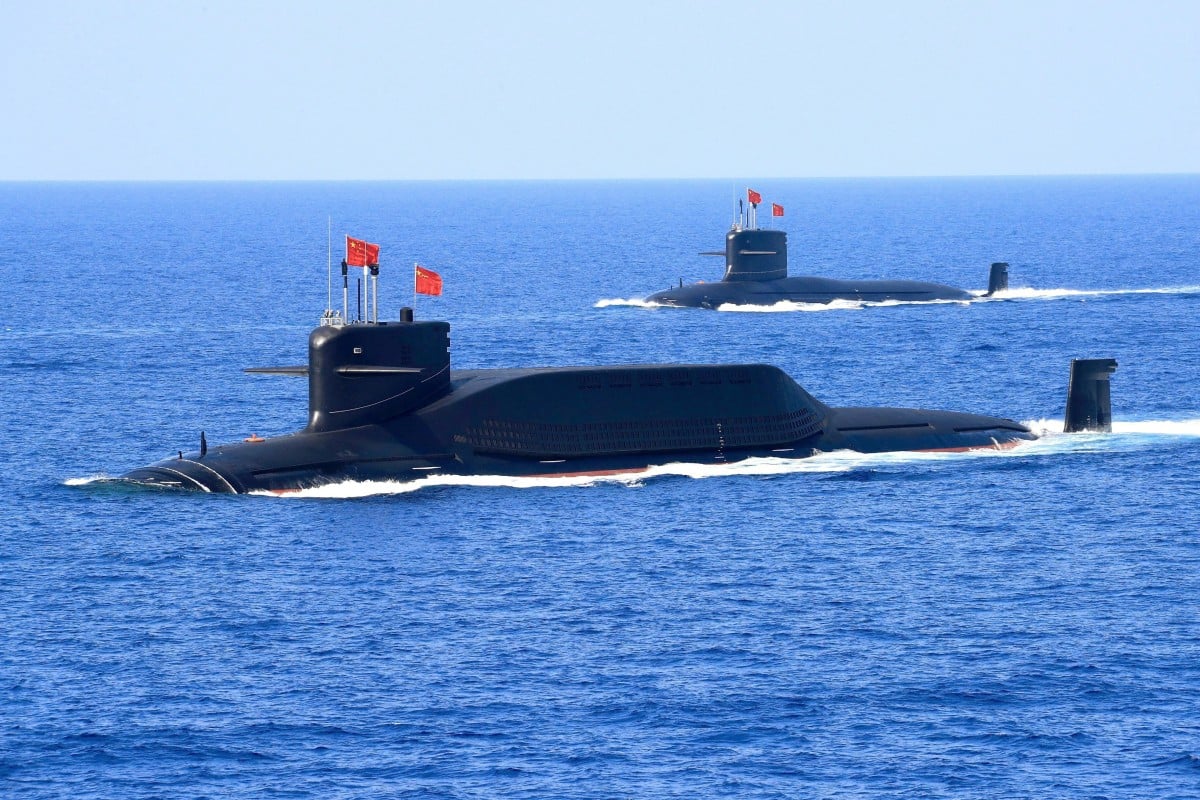
China has dramatically ramped up its nuclear-powered submarine production, now outstripping the United States in its build rate, according to a recent analysis by a prominent London-based think tank. This rapid expansion signals a growing challenge for Western navies, despite persistent qualitative differences between Chinese and advanced U.S. and European submarine designs.
A Startling Production Gap Emerges
Between 2021 and 2025, China launched an estimated 10 submarines with a combined displacement of 79,000 tonnes, a rate that surpasses that of the U.S. During the same period, the United States commissioned seven boats, totaling 55,000 tonnes. This burgeoning pace indicates a significant shift in the global underwater power balance.
Bolstering the Nuclear Triad
Most notably, this surge includes the seventh and eighth Type 094 (Jin) nuclear-armed ballistic-missile submarines (SSBNs). These additions are critical to the ongoing emergence of Beijing’s formidable nuclear triad, providing a robust sea-based deterrent. Satellite imagery from early 2026 reportedly identified six Type 094s distributed across key naval facilities, suggesting the recent launches have substantially expanded this crucial component of China’s strategic forces.
The Industrial Engine: Shipyard Expansion Fuels Growth
The acceleration in Chinese submarine construction capacity is a direct result of a major expansion project at the Bohai Shipbuilding Heavy Industry Co (BSHIC) shipyard in Huludao. Between 2019 and 2022, the state-owned facility, responsible for all of China’s nuclear-powered submarines, saw the construction of a second submarine manufacturing hall and other state-of-the-art facilities, dramatically increasing its output potential.
Strategic Shift: Guided-Missile Subs and Regional Focus
Beyond the SSBNs, BSHIC is also actively producing nuclear-powered guided-missile submarines (SSGNs) for the People’s Liberation Army Navy (PLAN). Reports suggest that nine Type 093B (Shang III) boats have been launched since 2022. These upgraded variants are believed to be fitted with vertical launch systems (VLS) for guided missiles, marking a significant advancement. Furthermore, a new class of SSGN, designated Type 09V, reportedly entered service this month, signaling continuous innovation.
Crucially, the VLS on these PLAN SSGNs are likely configured to carry anti-ship missiles, such as the hypersonic YJ-19, rather than the land-attack missiles typically deployed by U.S. Navy SSGNs. This difference underscores the PLAN’s primary strategic focus on peer-level naval combat in the Western Pacific, contrasting with the U.S. Navy’s broader expeditionary power-projection mission.
The Noise Factor: A Key Operational Limitation
Despite the impressive production numbers, a critical limiting factor for PLAN submarine operations remains their relative noise levels. Both the Type-093 and Type-094 hulls are understood to be noisier than their Western counterparts, making them easier to track once deployed. Consequently, the Type-094 SSBNs are thought to primarily operate in the comparatively protected waters of the South China Sea, where other PLA assets can offer a defensive umbrella.
However, this assessment comes with an important caveat: the understanding of Chinese submarine noise levels largely stems from a 2009 U.S. Office of Naval Intelligence (ONI) report, which likened their acoustic signature to late Cold War Soviet designs. Whether subsequent technological advancements have significantly mitigated this disadvantage remains a subject of ongoing speculation and intelligence gathering.
A Qualitative Discrepancy Amidst Quantitative Gains
While China’s quantitative lead in submarine production is undeniable, the qualitative gap with U.S. and European designs persists. Nonetheless, the sheer volume of new Chinese submarines presents an escalating strategic challenge, forcing Western navies to reassess their operational doctrines and investment priorities in an increasingly contested underwater battlespace. The implications of this rapid expansion will undoubtedly shape naval strategies for decades to come.