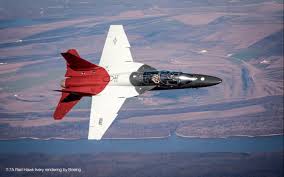
After years of persistent delays, the U.S. Air Force is reportedly on the verge of declaring its T-7 Red Hawk training jet ready for production, a crucial milestone in modernizing pilot training for the future. This decision, known as Milestone C, marks a significant step forward for a program designed to replace the venerable T-38 Talon, which has served since 1961.
The Long-Awaited Green Light
The declaration of production readiness comes more than two years later than initially projected, a timeline extended by both design challenges at manufacturer Boeing and a deliberate service strategy to accelerate the program despite these hurdles.
„Milestone C is monumental,” stated Rodney Stevens, the Air Force’s program executive officer for training. „Essentially, what we’re saying is, we’re confident in the design of the aircraft that we have, and that we’re ready to start proving that we can produce the aircraft at rate to meet the inventory needs of Air Education and Training Command.” However, Stevens cautioned that the program cannot „rest on its laurels,” as substantial work remains.
Navigating Design Woes and Concurrency
To mitigate the inherent risks of concurrency—the overlap between development and production—the Air Force is adopting a phased approach. Production will be approved in at least three separate lots, with each batch individually greenlit „until we can close out all the associated test activities that remain,” Stevens explained. This strategy aims to prevent unwelcome discoveries during testing from necessitating costly and time-consuming design changes mid-production.
Boeing, despite previous design issues, remains a committed partner. Stevens affirmed that the Air Force and the industry team share „a clear understanding that we are driving towards our North Star together.” Their collective goal is to achieve initial operational capability (IOC)—meaning 14 aircraft are ready to train new pilots—no later than November 2027, with full pilot training commencing in 2028.
Dan Gillian, vice president and general manager of Boeing’s Air Dominance unit, echoed this sentiment. „We continue to make good progress on the program in close collaboration with the U.S. Air Force,” Gillian said, adding that the T-7’s „active management approach has allowed us to provide a production-ready configuration to the Air Force prior to low-rate initial production, further reducing future risk and accelerating the path to delivering this critical capability.”
Tackling Persistent Challenges: Escape Systems and Software
A 2023 Government Accountability Office report had highlighted concerns regarding the T-7’s escape system and flight control software, suggesting these could further delay fielding. Addressing these specific issues, Stevens maintained that changes to the escape system will not impede the impending production decision, expressing confidence in the „trajectory for a safe escape system.”
While refining the flight control software remains a key focus, it is not currently seen as jeopardizing the schedule. Stevens acknowledged that future flight tests, particularly those involving high angle of attack maneuvers, could still uncover issues, requiring ongoing vigilance. Nevertheless, he asserted that once pilots begin flying in 2028, the T-7 will offer comparable or superior flight performance to the aging T-38, with capabilities expanding iteratively through software updates until the engineering and manufacturing development (EMD) phase concludes around 2029.
Despite the inherent risks of overlapping development and production, Stevens stated he is „not concerned about concurrency,” emphasizing proactive management with Air Education and Training Command (AETC) and Boeing.
Fixed-Price Contract: A Double-Edged Sword
The T-7 program’s fixed-price contract has meant that Boeing has already absorbed approximately $3.2 billion in losses. However, this structure also serves to ameliorate some financial risk for the Air Force. Boeing is contractually obligated to fix any „safety-critical items” discovered during flight tests or any issues preventing the T-7 from meeting AETC’s training requirements. For non-critical problems, decisions will be made in consultation with AETC.
Notably, Boeing has reportedly offered „at no cost, look at opportunities to improve certain aspects of the T-7,” such as extending the aircraft’s range. The Air Force is also incentivizing Boeing financially for achieving specific targets across EMD completion, production readiness, and fielding the ground-based training system. Stevens confirmed Boeing has met 17 out of 19 targets to date, reflecting approximately 90 percent success.
This „active management strategy,” initially championed by former Air Force acquisition boss Andrew Hunter, aligns with Secretary of Defense Pete Hegseth’s broader directives to accelerate capability delivery. „We have our challenges. It is difficult,” Stevens noted, „But it allows us to really robustly and actively manage the program through a mission-outcome lens.”
Red Hawk’s Arrival: Paving the Way for Future Pilots
Two T-7 Red Hawks have already been delivered to Joint Base San Antonio-Randolph, Texas. The 99th Flying Training Squadron, the first Air Force unit to receive the jet in a January 9 ceremony, is using one aircraft (APT-5) for „familiarization training” with Boeing test pilots and Air Force instructors. The other (APT-3) is dedicated to maintainer training.
Currently restricted to test pilots and specific test airspace, an upcoming update in March will allow 99th pilots to begin familiarization flights. This Type 1 aircrew training is expected to continue into „early 2027,” followed by the initial operational test and evaluation phase in spring or summer 2027, where the jet’s operational effectiveness will be rigorously assessed.
Three additional T-7s are slated for delivery this year: two production-representative test jets for expanded testing capacity, and one developmental jet that will be converted to a test aircraft after electromagnetic testing and delivered to Randolph.
Stevens is confident that once new trainees begin flying the T-7, the Red Hawk will be significantly more effective in preparing them for modern combat aircraft. „The T-7 postures you… to more easily become a fourth-, fifth- or sixth-generation fighter pilot or bomber pilot,” he asserted. „The T-7 today will offer so much more as it relates to what type of pilot [it] is going to produce starting in 2028, compared to the type of pilot that the T-38 produces today.”
With plans to acquire over 300 copies of the jet, the T-7 Red Hawk program, despite its tumultuous journey, is poised to profoundly transform the future of Air Force pilot training.