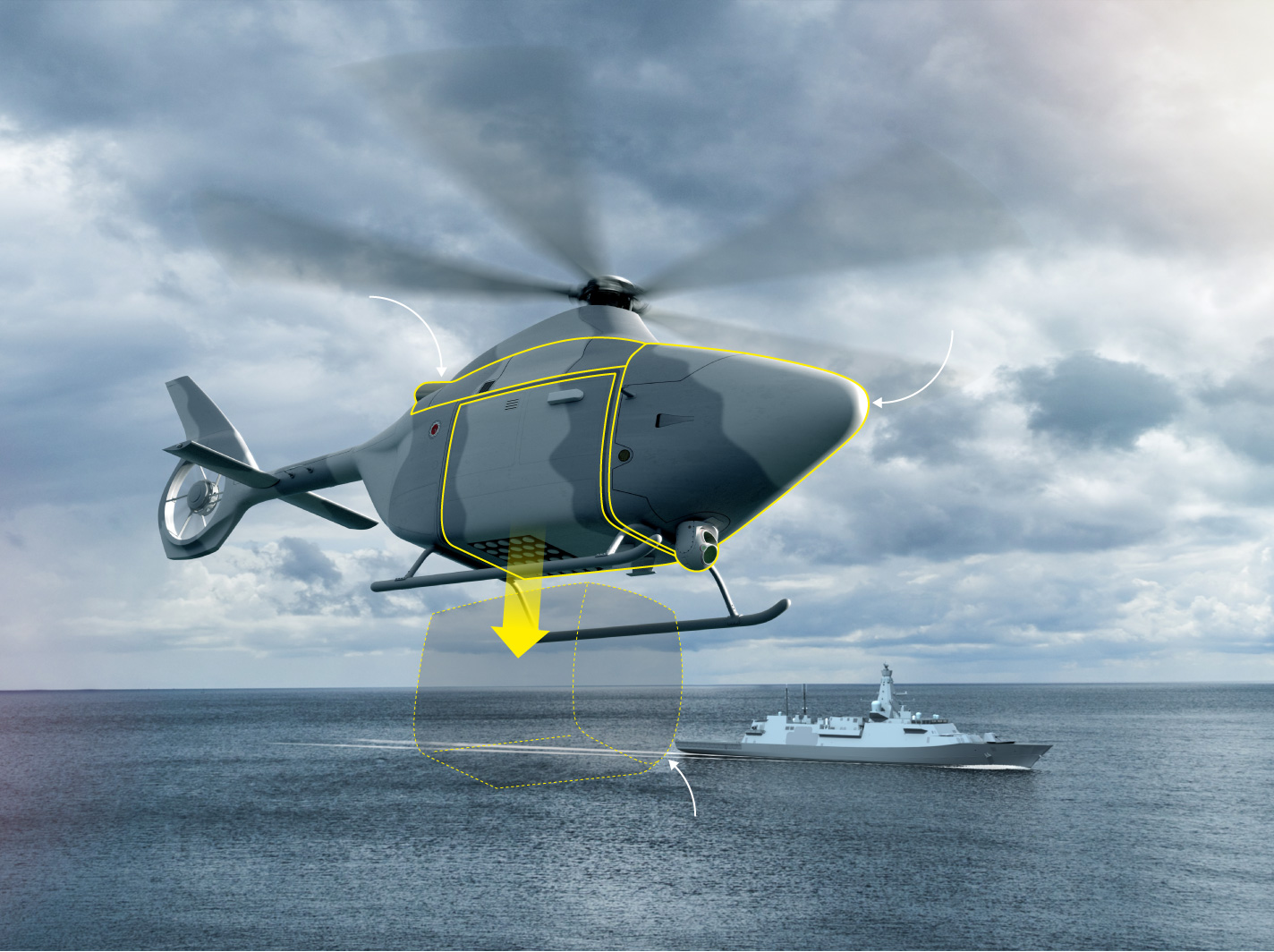
Leonardo has announced the final design of the Proteus Rotary Wing Uncrewed Air System (RWUAS) demonstrator, which is under development for the UK Royal Navy, ahead of its first flight expected later this year.
The three-ton aircraft shares a resemblance with the manufacturer’s AW09 light single-engine helicopter, featuring a five-blade main rotor system and a modular payload bay.
Advances in Autonomy and Modular Payloads
In a company statement, Leonardo stated that Proteus “will be used to demonstrate advances in autonomy and payload modularity and interchangeability, while developing cutting-edge new rotorcraft technologies including design and manufacturing techniques.”
Proteus is part of a four-year RWUAS Technology Demonstration Programme (TDP) contract, valued at £60 million ($75 million), awarded to Leonardo by the UK Ministry of Defence in July 2022.
Alignment with Royal Navy’s Strategy
The demonstrator aligns with the Royal Navy’s Maritime Aviation Transformation (MATx) strategy—a long-term Fleet Air Arm evolution plan that extends to 2040. Leonardo noted that the strategy includes “building mass at sea and supporting future anti-submarine warfare missions.”
To reduce design costs and accelerate the development of the Proteus aircraft, the manufacturer has utilized “components” from its helicopter and UAS portfolio.
Testing and Autonomy Development
“This design will demonstrate the viability of large UAS in the maritime environment and will serve as a test bed for the development and demonstration of autonomous capability,” the statement added. “This includes flight control laws and algorithms for large autonomous Vertical Take-Off and Landing (VTOL) aircraft.”
Leonardo describes its production facility in Yeovil, southwest England, as the “Home of British Helicopters,” emphasizing that the site “maintains an aggressive autonomy development roadmap, which covers the capabilities required to conduct autonomous flight and deliver mission capability.”
Innovative Technologies and Digital Engineering
The manufacturer has leveraged autonomy and innovative technology in developing Proteus, which includes a digital twin and “more than 40 components manufactured with advanced composite materials and the use of AI in its control software.”
As previously reported by Breaking Defense, Leonardo assessed “potential systems” for integration before finalizing the aircraft design, with a model displayed at DSEI in 2023 that primarily focuses on intelligence, surveillance, target acquisition, reconnaissance, and maritime logistics supply missions.
While Leonardo did not provide specifics on key subsystems to be integrated into Proteus, including engine type, it is noteworthy that France’s Safran Arriel 2K engine, also the AW09 powerplant, stands out as a likely candidate.
Preparations for First Flight
Phil Bartlett, head of future programs at Leonardo Helicopters UK, stated that preparations for Proteus’s first flight—a milestone target set for mid-2025—are “progressing at pace.”
“We’re pulling together a range of exciting new technologies for the Proteus demonstrator, so there’s a lot to do and many moving parts to get in place before that happens, but the team is highly motivated to deliver this key milestone, and we’re really seeing the benefits of our use of digital engineering techniques such as digital twinning,” he added.