As the U.S. military demands more from unmanned systems, available energy is becoming a key constraint on range, mission duration and payload. For drones, heavier batteries can create a compounding problem: the aircraft needs more energy to carry them, potentially requiring still larger batteries.
Job Rijssenbeek, chief technology officer at Sion Power, argues that higher-energy-density batteries could change that trade-off. In his view, the next performance leap will depend not only on battery chemistry, but on designing batteries and unmanned platforms together.
More energy without added weight
Lithium-ion batteries will remain the right choice for many applications, but their performance is approaching its current limits, Rijssenbeek said. Several advanced chemistries are emerging, each offering a different balance of energy, power, cycle life, safety and cost. No single chemistry is best for every mission.
For platforms where weight and endurance matter most, lithium-metal batteries may offer an advantage. Replacing a graphite anode with lithium metal can reduce weight and volume while increasing energy density.
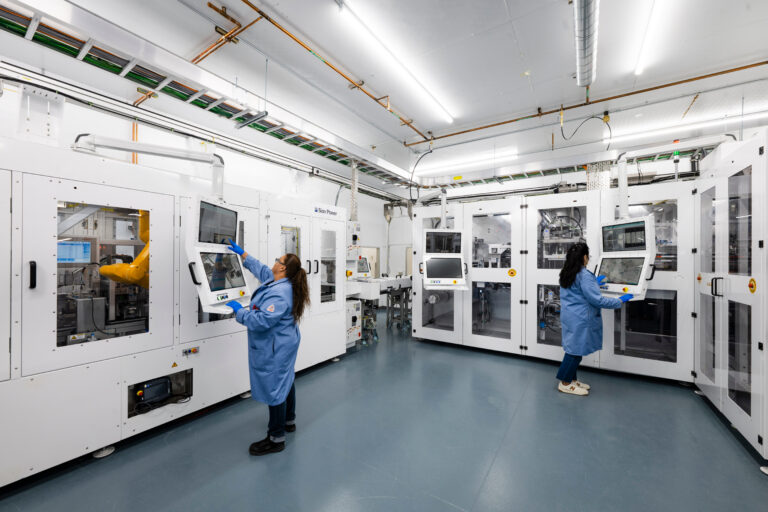
Sion Power says it is producing large-format cells in Tucson, Arizona, with roughly twice the energy density of conventional lithium-ion batteries at both the cell and pack level.
Longer missions and more onboard electronics
The company says its Licerion Strike cell, designed for applications that prioritize maximum energy, can deliver up to 500 Wh/kg at the cell level, compared with roughly 250 Wh/kg for standard drone batteries used today.
More energy at the same weight can mean longer flights or additional payload. That matters as drones carry increasingly power-hungry electronic systems for communications, jamming and autonomous guidance, which can require hundreds of watts continuously.
Testing under demanding conditions
Higher energy density is valuable only if a battery remains safe and reliable under mission conditions. Sion Power says it tests cells at extreme temperatures and under vibration, as well as through nail-penetration and forced-discharge tests.
According to Rijssenbeek, the company’s Tucson facility has approximately 2,000 test channels and a 5,300-square-foot laboratory dedicated to safety and abuse testing.
Drone test: from 33 to 60 minutes
To evaluate the technology outside the lab, Sion Power installed a Licerion Strike demonstration pack on a commercial Freefly Astro Max drone, replacing its two standard lithium-ion batteries.
The company says the pack increased onboard energy by more than 50% and reduced battery-pack weight by nearly 30%, while using the same mechanical footprint. In the test described by Sion Power, flight time rose from 33 to 60 minutes.
The increase could substantially extend the time a drone can spend over an area of interest. In Rijssenbeek’s example, a drone that takes 15 minutes to reach its target and has 33 minutes of total endurance would have about three minutes on station before needing to return. With 60 minutes of endurance, it could spend about 30 minutes there under the same scenario.
U.S. production and plans to scale
Sion Power says it is already shipping cells from Tucson and is increasing pilot-line capacity to 10–20 MWh. The company plans to expand to 100–200 MWh or more as demand grows.
Rijssenbeek said many battery components remain the same as those used in commercial lithium-ion products, allowing the company to draw on established supply chains to manage costs. He also said Sion Power batteries are manufactured entirely in the United States and that the company is qualifying alternative material sources to strengthen supply-chain resilience and meet U.S. defense sourcing requirements.
Using a lithium-metal anode eliminates graphite from that component, reducing one potential supply-chain dependency. Rijssenbeek cautioned, however, that China’s dominance in global battery-material supply chains cannot be reversed quickly and that no single chemistry removes every vulnerability.
From one-way drones to rechargeable systems
Sion Power identifies heavier Group 1 and Group 2 drones as strong candidates for its batteries, given the potential gains in range and payload. Group 3 drones often rely on internal-combustion engines today, but the company says they could benefit from electrification and reduced noise.
Lithium-metal technology is not limited to one-way systems. Rijssenbeek said the batteries are rechargeable, citing the company’s 400 Wh/kg Licerion pouch cells, which Sion Power says have achieved 800 charge-discharge cycles and support fast charging. The company’s rechargeable Licerion Echo product is designed to combine high energy density with more than 150 cycles.
Sion Power expects its cells could also support robotics, automotive and space applications in the future.
Designing the battery and drone as one system
Rijssenbeek argues that future drone performance will not hinge on a single battery chemistry, but on selecting the right chemistry for each mission. For drones where endurance and weight are critical, lithium-metal could represent a significant advance.
The broader shift, he said, will come from co-designing batteries and unmanned platforms—optimizing range, payload, power, cycle life and cost together. Instead of improving the battery and the drone separately, designers could optimize the complete system as a whole.