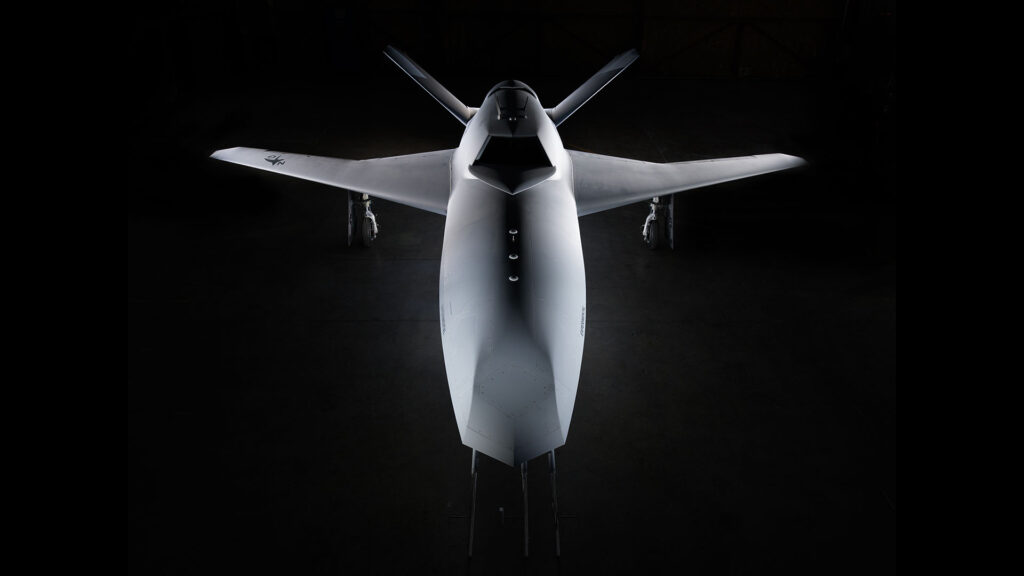
Northrop Grumman has recently unveiled “Project Talon,” a new autonomous combat drone designed with an ambitious goal: to dramatically lower the price point and accelerate the development and manufacture of large uncrewed aircraft. This initiative marks a significant step in the pursuit of more affordable and rapidly deployable defense solutions.
From Setback to Innovation: The CCA Increment 1 Lesson
The first iteration of the Air Force’s Collaborative Combat Aircraft (CCA) program proved challenging for Northrop Grumman. While the company’s design proposal received high marks for technical performance, it garnered lower scores in affordability and price, leading to its failure to win one of the two contract awards, explained Tom Jones, president of Northrop’s aeronautics systems division, during the aircraft’s media reveal.
With “Project Talon,” the objective was clear: to rectify those mistakes. „The idea was to see if we could build an aircraft that had all the same capability of our original offering, and do it faster,” Jones stated. „So the outcome was an aircraft, but the [more important] outcome we’re shooting for was the process. How do we design and build things that perform at a high level, but that we can build quickly now and can do affordably?”
The Recipe for Success: Speed, Lightweight Design, and Minimal Costs
An indicator of the project’s efficiency is its short development timeline: it took just 15 months for Northrop and its Scaled Composites subsidiary to go from project authorization to “weight on wheels”—the milestone where an aircraft is fully supported by its landing gear for the first time. The aircraft’s first flight is targeted to occur within two years of Project Talon’s inception, roughly next fall. Company officials emphasized that not only did the team beat affordability targets, but the aircraft also boasts improved performance in several key areas compared to their original offering.
The secret behind this efficiency lies in reducing weight and the number of parts. “Project Talon” is approximately 1,000 pounds lighter, featuring a fully composite structure and 50 percent fewer parts than its CCA increment one offering. This also translated to a 30 percent faster construction time. Another critical factor was bringing in a joint team of Northrop and Scaled Composites engineers, which enabled a more flexible design methodology capable of making smart performance tradeoffs to stay on cost and schedule.
Jones explained that this approach is essential for the CCA concept, which aims for „affordable mass.” „You need that exquisiteness in some things. But the whole concept behind collaborative combat aircraft, it’s all about affordable mass, which means you need to keep the cost down,” he said. „And then the other thing is, because you would use affordable mass ostensibly in a war of attrition, you’re going to lose these. So not only do you want it to be affordable, you want to be able to replenish that mass at rate. So, the ability to rapidly manufacture something” becomes important.
Beyond CCA: The Future of Combat Drones and Public Scrutiny
While “Project Talon” was not specifically designed to be the company’s offering for the second iteration of the Air Force’s CCA program, officials did not rule out this possibility. There is already interest in the drone from multiple US military services, as well as some international customers, with some having already traveled to Mojave to see the aircraft in person.
The aviation community has been abuzz with speculation about this aircraft since October, when its existence was first disclosed under its former name, “Project Lotus.” Initial reports described design elements such as a “long, slender fuselage positioned forward of the leading edges of the wings” and an “inlet [that] sits high atop of the extreme aft section of its fuselage,” along with “sharply canted tails.”
The Autonomous Drone Race: Competition Intensifies
As the Air Force looks to the second round of its CCA competition – with the intent to award “concept refinement contracts” in early fiscal year 2026 – Northrop Grumman is not the only defense aerospace firm developing new drones. Lockheed Martin, through its secretive Skunk Works advanced development division, announced in September that it is building the first prototype of a stealthy combat drone called Vectis, with a first flight planned for 2027. General Atomics, with its „Longshot” drone developed under a DARPA contract, and Shield AI, with its X-BAT concept for a stealthy, vertical takeoff and landing (VTOL) drone, are also in the running, indicating an intensifying competition in the autonomous combat drone domain.