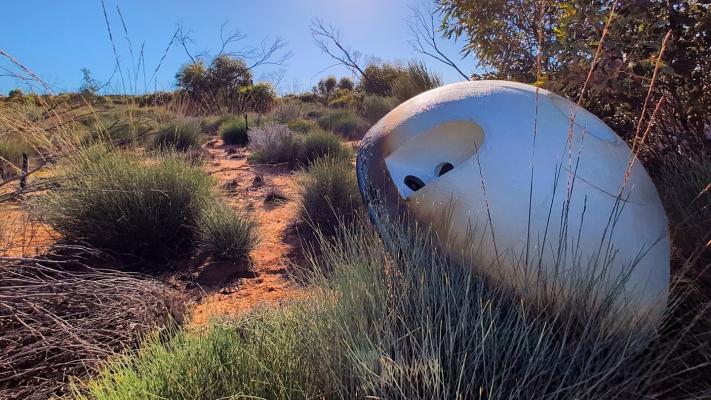
From reusable rockets to smaller reentry capsules
The U.S. Air Force and Space Force are accelerating research into a concept that appears to come straight from science fiction: rapidly delivering military equipment and supplies to conflict zones by launching them through space.
While the Pentagon initially focused on using large, reusable rockets to transport cargo, the military is now shifting its attention toward smaller reentry capsules capable of delivering supplies to isolated bases and hard-to-reach battlefields.
The joint effort is difficult to track because it involves several programs funded through different budget lines. Some receive joint funding, while others are financed separately by the Air Force or the Space Force.
Rocket Cargo laid the foundation
The effort began with Rocket Cargo Vanguard, a high-priority Air Force Research Laboratory program launched in June 2021.
Its objective was to use rockets capable of transporting approximately 30 tons of logistical supplies from the United States, through space, to distant bases and battlefields.
The program is now being scaled back. The Air Force allocated no funding for Rocket Cargo in its fiscal 2026 budget, while the Space Force provided only a few million dollars for fiscal years 2026 and 2027.
The program’s successors, however, remain active, with research increasingly focused on smaller reentry capsules.
Why the Pentagon is turning to capsules
According to the Air Force Research Laboratory, reentry capsules offer several operational advantages:
- faster unloading at the delivery site;
- access to a wider range of austere locations and terrain;
- the ability to deploy multiple capsules in a single launch;
- broader participation by commercial vendors and launch providers.
Instead of relying on one large rocket, a single launch could distribute capsules to several destinations. That flexibility could be particularly valuable when conventional infrastructure has been destroyed or is unavailable.
Payload Delivery System becomes the central capsule effort
The current development of reentry capsules is being carried out through the Payload Delivery System, an Air Force Research Laboratory program jointly funded by the Air Force and Space Force.
The Space Force is the lead service, but the project addresses challenges shared by both services, including cargo transportation through space, atmospheric reentry and delivery to austere land or maritime sites.
For fiscal 2026, the Air Force allocated $30.6 million to the program, while the Space Force allocated $21.2 million. For fiscal 2027, the Air Force requested $32.3 million and the Space Force requested $16.5 million.
Researchers are seeking a solution that combines low operating costs, significant cargo capacity and rapid global deployment.
Commercial industry enters the competition
Reentry capsules are not a new technology. NASA has used them for decades to recover experiments and return astronauts to Earth. Those vehicles, however, are generally large and expensive.
In recent years, companies such as Varda Space Industries and Inversion Space have begun testing smaller reentry vehicles for commercial applications. These systems can be used to manufacture pharmaceuticals or electronic components in space and return them to Earth.
According to the Factories in Space market-tracking platform, 65 companies worldwide were working at various stages of development on cargo reentry vehicles as of last September.
The list includes SpaceX, which launched its first Starfall pod demonstration on June 23, and Blue Origin, which has yet to launch such a vehicle.
The Air Force has confirmed discussions with SpaceX, Blue Origin, Rocket Lab, Sierra Space, Varda, Inversion Space, Outpost Space and several smaller companies.
The goal is to establish a broad vendor base capable of providing low-cost capsules with enough capacity to deliver cargo rapidly to locations without conventional infrastructure.
Point-to-Point Delivery targets orbital logistics
Another major effort is Point-to-Point Delivery, managed by the Space Force’s Servicing, Mobility, and Logistics program.
The program focuses on:
- prepositioning supplies in orbit;
- transporting cargo from orbit back to Earth;
- developing suborbital and orbital delivery missions between two points;
- providing rapid support for military operations.
The Space Force began funding the program in fiscal 2025 with $3.9 million. It allocated $19.3 million for fiscal 2026 and requested $9.7 million for fiscal 2027. Similar annual funding is projected through 2031.
In the near term, the program will use technologies developed through commercial research and development and the Rocket Cargo Vanguard program to assess reference missions and determine the feasibility of such operations.
REGAL supports demonstrations and related technologies
A third effort is Rocket Experimentation for Global Agile Logistics, or REGAL.
First launched in 2021 and updated in 2024, REGAL does not directly fund the development of commercial rockets. Instead, it supports technologies associated with point-to-point delivery and funds experimental demonstrations.
Some agreements are structured on a no-cost basis, making it difficult to determine the total value of the work being conducted.
Sierra Space announced an undisclosed REGAL contract in October 2024, while Rocket Lab announced a similar award in May 2025.
In September 2025, the Air Force Research Laboratory awarded $1.3 million to Blue Origin and $1 million to Anduril. In July, the laboratory added $11.7 million to Blue Origin’s contract, bringing its total value to $13 million.
A new architecture for military logistics
Although the programs remain in the research and experimentation phase, the direction is clear: the U.S. military is seeking to turn space into a rapid logistics route for global operations.
Moving from large reusable rockets to smaller capsules could reduce costs, increase flexibility and allow cargo to be distributed to multiple destinations in a single mission.
If the technology proves viable, supplying U.S. forces in remote locations would no longer depend solely on ports, airports, roads or conventional logistics corridors.