Performance-based agreement runs through 2031
The US Department of Defense has awarded GE Aerospace a contract worth up to nearly $2.9 billion to provide parts and support services for the company’s F414 engines.
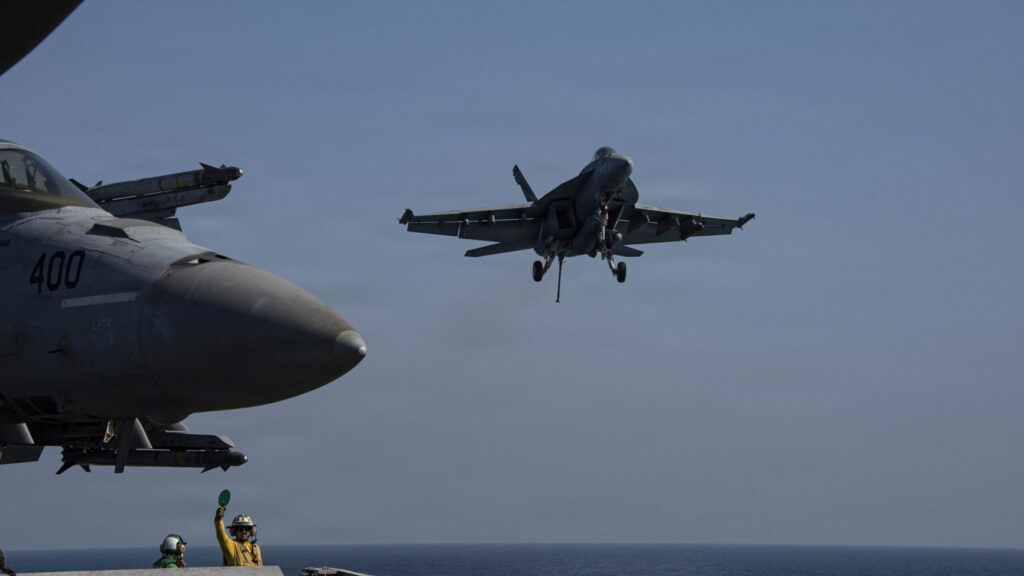
The engines power the US Navy’s F/A-18E/F Super Hornet fighters and EA-18G Growler electronic warfare aircraft. The agreement is structured as a performance-based logistics contract, linking payments to measurable results and the quality of the services delivered.
The contract will remain in effect through August 2031 and includes no option periods.
Supporting an aging Super Hornet fleet
GE Aerospace said its F414 engines have powered Super Hornet and Growler aircraft for more than two decades and that maintaining their availability is essential to the readiness of the US Navy’s fleet.
The award comes as GE reorganizes its industrial capacity to address several competing demands. The company must continue producing the larger F414 engines for the Navy’s aging aircraft fleet while also increasing output of its F404 engine.
F404 becomes the factory’s main production priority
The F404 will be used, among other platforms, on the US Air Force’s T-7 Red Hawk trainer. GE expects production of the engine to roughly double over the next five years, although the company has not disclosed exact production figures.
The company’s facility in Lynn, Massachusetts, is therefore shifting from a production model centered largely on the F414 to one increasingly focused on the F404. The change reflects evolving demand and the need to adapt assembly operations quickly.
New suppliers and expanded use of 3D printing
To increase production rates, GE is examining ways to broaden its supplier base and incorporate commercially available components manufactured under standards suited to higher production volumes.
The company is also considering wider use of additive manufacturing. 3D printing could allow critical components to be produced faster and at lower cost while reducing weight and simplifying selected manufacturing processes.
The technology is being evaluated for legacy engines such as the F404. Engineers are reviewing which parts could be redesigned or manufactured through additive methods without compromising engine reliability or performance.
F-15EX demand and unmanned aircraft drive expansion
GE is expanding production across several engine designs as orders increase for Boeing’s F-15EX fighter, which is powered by two F110 engines.
The company is also pursuing opportunities involving unmanned aircraft and future military platforms. Persistent supply-chain difficulties, however, continue to complicate efforts to increase production quickly.
GE officials acknowledge that scaling up manufacturing amid rising demand remains difficult, but they say internal investments and process changes can help the company respond to the pressure.
GE enters the race to test hypersonic systems
The F414 award follows GE Aerospace’s selection by the Pentagon’s Defense Innovation Unit to provide a liquid-fueled hypersonic test vehicle.
The agreement is part of the Hypersonic and High-Cadence Airborne Testing Capabilities, or HyCAT, program, which is intended to expand flight-test opportunities for high-speed systems.
The next phase is expected to last approximately 24 months and will include flight testing. The vehicle will be boosted by a solid rocket motor, while GE will serve as the prime integrator and provide propulsion technologies, including a dual-mode ramjet.
The system is designed to operate at both subsonic and supersonic speeds.
Company focuses on propulsion rather than missile production
GE Aerospace will lead integration of the test vehicle and work with several specialized partners supplying different components. The identities of those partners have not yet been disclosed.
Although experience gained through HyCAT could eventually support the development of hypersonic weapons, GE says becoming a hypersonic missile manufacturer is not currently part of its strategy.
Instead, the company aims to establish itself as a propulsion solutions provider for a broad range of high-speed systems, from experimental test vehicles to future advanced military platforms.