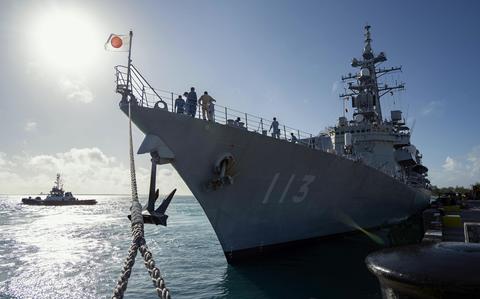
Seasats, a California-based autonomous surface vessel producer, had an unexpected encounter with a Chinese warship while one of its USVs was transiting the Indo-Pacific earlier this year, CEO Mike Flanigan exclusively told Breaking Defense.
Transpacific Voyage:
The company conducted a publicly tracked transit of its Lightfish USV from San Diego to Japan, a 7,500 nautical mile journey that took six months.
Close Proximity:
In June, while operating approximately 330 miles northwest of Guam, the USV came within meters of the Chinese destroyer Nanchang, according to Flanigan and imagery taken by the USV.
„Shadowed” by Warship:
„It’s pretty common to pass within five or 10 miles of a tanker — in the middle of ocean, there’s really not much traffic going on,” Flanigan said. But „for 20 minutes, we basically were shadowed by a Chinese destroyer very closely.”
Safety Measures:
The Chinese ship „approached” the USV, but Lightfish was broadcasting its position through the Automatic Identification System (AIS). The USV did not trigger any warnings, but reported spotting another vessel. The company discovered the interaction after the fact.
Questions Raised:
Flanigan said the encounter raises questions about how crews at sea approach autonomous drones, given the use of USVs in attacks in the Black Sea and Middle East.
Risk Assessment:
„You’ve got a [Russian] ship with a handful of sailors on it dealing with a remotely controlled or autonomous [drone], but there’s just no Ukrainian personnel at all on that vessel,” he said. „… We have a $250,000 USV coming within meters of a $900 million Chinese destroyer with close to 100 sailors on it. … Their risk posture is just insanely skewed with these autonomous robots.”
Commercial and Defense Purposes:
Lightfish, a 12-foot fiberglass drone, is Seasats’ main product for data collection for commercial and defense purposes. The company has worked with the US Navy and Marine Corps, including during the Baltic Operations 2025 exercise.
Echoes of Saildrone Incident:
The incident echoes a 2022 encounter in which Iranian paramilitary forces briefly seized two Saildrone USVs in the Middle East. The US Navy recovered the drones, which were part of Task Force 59.
Implications for Armed Drones:
While both Saildrone and Seasats were conducting innocuous missions, the question of how a US Navy drone, possibly armed or holding classified technologies, would act in the same circumstance is a growing concern as the service relies more on unmanned technologies.
Balancing Protection and Practicality:
Analysts have said that protecting valuable drones within the proximity of a carrier strike group would be manageable. However, requiring drones to stay close to strike groups limits their potential and practicality due to the absence of sailors onboard.