Revolutionizing ISR in Modern Warfare
As modern warfare evolves, the challenge of detecting active ISR (Intelligence, Surveillance, and Reconnaissance) sensors has grown, heightening the risk of losing valuable aerial platforms. Addressing this issue, Shield AI is broadening access to its ViDAR technology, a passive, multi-domain ISR solution initially developed by Sentient Vision Systems, known for its operational success in maritime missions. Following its acquisition of the Australia-based company in spring 2024, Shield AI aims to enhance the capabilities of military platforms while minimizing detection risks.
ViDAR, short for Visual Detection and Ranging, operates as a passive system, capturing and storing data without emitting detectable signals. Utilizing a blend of traditional computer vision techniques and advanced deep learning AI, ViDAR can identify, geolocate, track, and classify both moving and stationary targets, even under challenging visibility conditions.
Expanding Capabilities with the ViDAR Pod
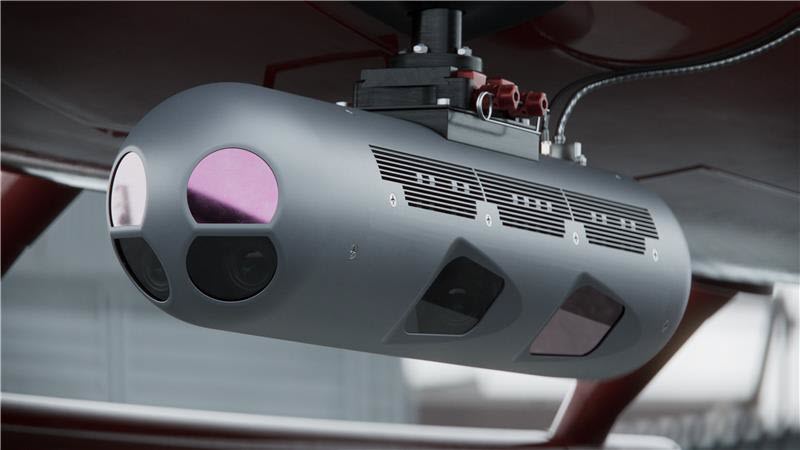
Now, Shield AI is introducing the ViDAR Pod, a compact payload designed to extend this sophisticated technology to a wider variety of platforms. The pod’s 60-centimeter tube form features multi-spectral cameras, an integrated processor, and a separate inertial measurement unit, along with industry-standard mounting options. This innovative design allows for operational use across land, littoral, and maritime environments, providing comprehensive day-and-night surveillance capabilities for diverse mission requirements.
In an interview with Breaking Defense, Mark Palmer, Vice President for Vision Systems at Shield AI, elucidated the pressing threat scenarios the ViDAR Pod addresses. He emphasized that the prevalence of easily detectable active sensors can expose warfighters to significant risks, often leading to the loss of high-value drones and assets. The ViDAR Pod’s passive operation allows it to gather crucial information covertly, process the data, and transmit it only when necessary, maintaining operational security even in contested environments.
A Unique Configuration for Persistent Surveillance
Palmer explained the ViDAR Pod’s sophisticated sensor array, which incorporates multiple EO/IR (Electro-Optical/Infrared) cameras to achieve continuous surveillance. This „constant stare” capability ensures persistent coverage of an area, overcoming challenges such as inclement weather or variable environmental conditions that may cause targets to appear and disappear.
The configuration enables the integration of both maritime and land detection requirements within a single payload, streamlining the ISR process. By combining several cost-effective EO cameras within the pod, Shield AI can provide robust surveillance capabilities at a lower operational cost compared to traditional mechanical gimbal systems, extending their reach to Group 3 UAS, helicopters, and small fixed-wing aircraft.
Integrating Traditional and Deep Learning AI
One of the distinct advantages of the ViDAR Pod lies in its artificial intelligence framework, which blends traditional computer vision techniques with modern deep learning capabilities. Palmer highlighted the historical evolution of AI in this domain, noting the importance of retaining older analytical methods that can efficiently detect partially obscured or camouflaged targets.
This dual approach allows the ViDAR system to detect potential threats with minimal visual data—sometimes just one or two pixels—enabling earlier detection at greater distances compared to reliance solely on deep learning, which typically requires more substantial image data.
Furthermore, the extensive dataset accumulated through years of operational deployment in varying conditions and environments enhances the system’s effectiveness in real-world scenarios, ensuring it remains reliable even in adverse weather or challenging terrain.
Conclusion: A Step Forward in Covert ISR Operations
By deploying the ViDAR Pod, Shield AI is addressing a critical need for covert ISR capabilities in modern conflict zones. The combination of passive sensing, persistent surveillance, and advanced AI offers military operators a powerful tool to conduct missions without revealing their presence to adversaries. As the technology matures, it promises to reshape the landscape of intelligence operations, ensuring that warfighters can operate effectively and discreetly in an increasingly complex battleground.