The fight against transborder drug trafficking networks is entering a new technological era. The United States Navy has authorized a new funding tranche worth $16.3 million to maintain and expand the fleet of maritime drones patrolling the waters of Central and South America. This decision marks the consolidation of a partnership that is transforming oceanic surveillance from a costly human operation into a precision autonomous hunt, scheduled to continue through at least 2027.
A Strategic Investment in Autonomy: $16 Million Boost for Maritime Border Security
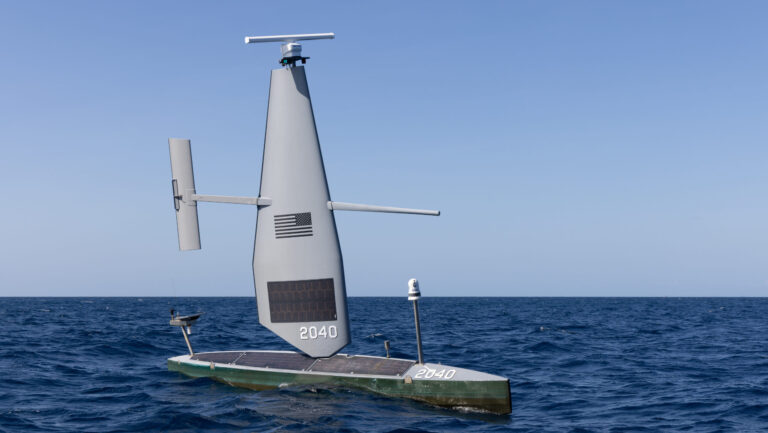
The new task order focuses on extending operations involving Voyager unmanned surface vehicles (USVs). These drones, which have been operating in the U.S. Southern Command (SOUTHCOM) region since 2023, have proven to be fundamental assets in detecting and monitoring narcotics traffickers. With this investment, U.S. authorities confirm that the future of maritime security no longer depends solely on heavy-tonnage ships, but on an agile network of robots capable of operating uninterrupted in extreme conditions.
The efficiency of these systems was spectacularly demonstrated in the fall of 2025, when a Voyager drone played a decisive role in identifying a suspicious vessel in the Caribbean. The operation culminated in the ship’s interdiction and the seizure of a record amount of cocaine, valued at $81 million.
Voyager: The Drones Turning Counter-Narcotics Operations into Data Science
The Voyager model represents the spearhead of autonomous surveillance. Capable of remaining at sea for 100 days without human intervention, this drone is equipped with advanced intelligence, surveillance, and reconnaissance (ISR) systems. Beyond the fight against cartels, the fleet is utilized for near-shore mapping and seabed surveys, providing a comprehensive operational picture that no conventional patrol could previously achieve.
The continuous presence of these drones along the southern border serves as a strategic deterrent. The ability to remain on mission for months at a time, without the need for refueling or crew rotation, provides an unmatched tactical advantage against „bad actors” who exploit the vastness of the ocean to hide their illegal activities.
The „Hedge Strategy”: Washington’s New Naval Architecture Powered by AI
The expansion of this program is part of a broader U.S. Navy vision known as the „hedge strategy.” This involves adapting to dynamic adversaries by investing heavily in autonomous systems for seabed control and maritime interdiction. Instead of relying solely on traditional carrier strike groups, Washington is now betting on customized „force packages” tailored for specific missions.
The SOUTHCOM region has thus become a testing ground for the future of maritime warfare. The success of these drones has also caught the attention of other agencies, such as the Coast Guard, which has already begun deploying similar units in the Great Lakes for border security and in the North Atlantic to combat illegal fishing. The message is clear: the era of global maritime surveillance belongs to the robots that never sleep.