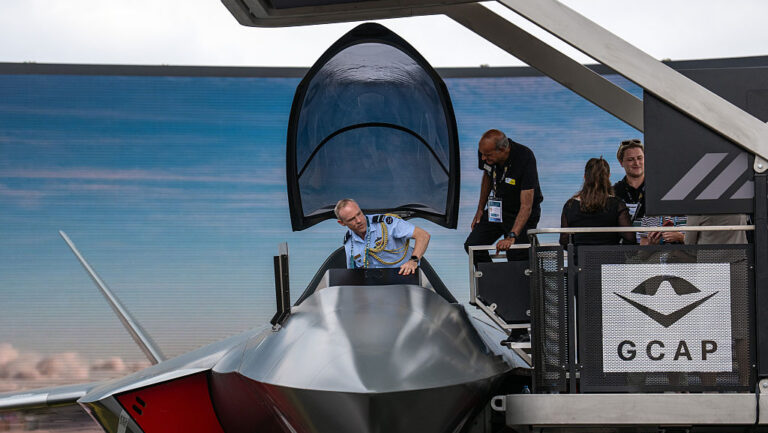
Canada’s recent decision to join the Global Combat Air Programme (GCAP)—the ambitious British-Italian-Japanese project for a sixth-generation fighter jet—as an observer has sparked a wave of both excitement and pressure within Ottawa’s defense sector. CAE, Canada’s leading flight simulation and training firm, warns that a mere observer status is insufficient and is urging the government for a firm commitment to unlock the vast potential of the local industry.
Beyond „Watching from the Sidelines”: The Industrial Stakes
While the official announcement of observer status was met with optimism, it remains vague regarding concrete benefits. Currently, Canada’s position offers only enhanced insight into the program’s governance and industrial framework, without guaranteeing a direct role for Canadian companies. The Italian Ministry of Defense has already clarified the situation: at this stage, observer status does not entail any industrial responsibility for Ottawa.
However, Pascal Grenier, President of Defense and Security at CAE, believes otherwise. He emphasizes that the simulation and training sector—an area where Canada is a recognized global leader—could be the engine that transforms Canada from a simple observer into an indispensable strategic partner. “We sure hope that Canada will bring us onboard but also go more than just be an observer,” he stated, noting that the final decision rests at the political level.
Training as a Form of Sovereignty: The Lesson of Billions in Exports
Canada’s defense industry generated approximately $17.3 billion in revenue in 2024, with the aerospace sector serving as the primary export driver. For giants like CAE, participation in GCAP is not just about selling another aircraft; it is about creating jobs, expertise, and long-term economic stability.
Grenier issued a critical warning: acquiring advanced combat platforms from abroad does not guarantee operational success without a domestic training infrastructure. “Receiving these platforms doesn’t make you ready to operate them—you need proper training and servicing. As you buy platforms that are done outside the country, the sovereignty aspect is often found in the training,” the CAE executive explained.
A Maturity Test for Canada’s Defense Strategy
The stakes are enormous. Recent studies show that Canada’s industrial strengths are concentrated in advanced subsystems, sensors, electronics, and mission simulation systems. Aligning with GCAP goals could propel these technologies onto the global stage for decades to come.
As the major powers within GCAP define their next steps, Canada stands at a turning point. It remains to be seen whether Ottawa will have the courage to transform “exploratory opportunities” into full industrial participation, ensuring that its industry doesn’t just watch the future of combat aviation but actively builds it.