In response to rising Chinese aggression in the region, the United States, Japan, and Australia announced this weekend the establishment of closer military ties, including, for the first time, regular deployments of Japanese marines to Australia.
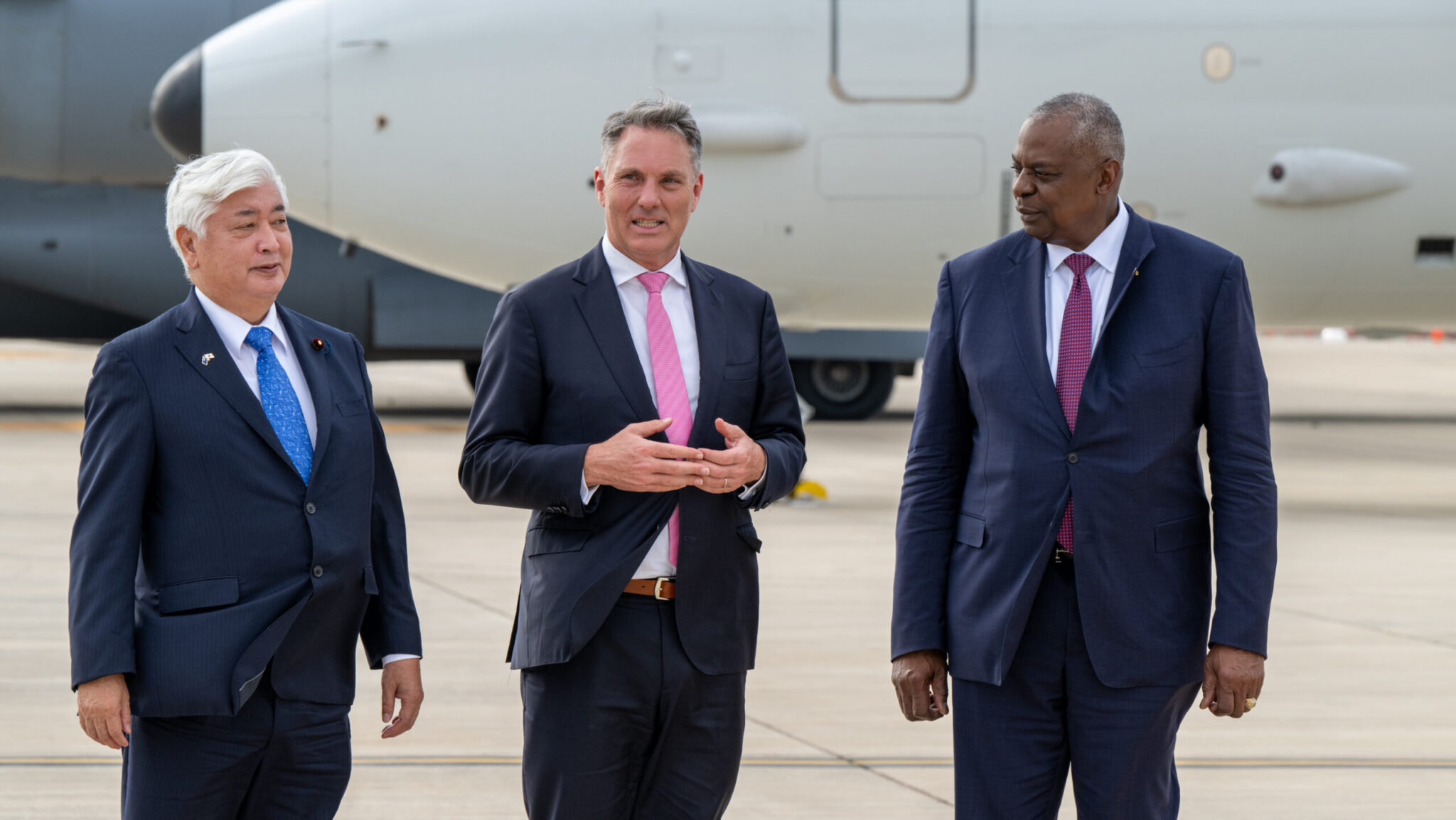
During a press conference held in Darwin, Australian Defense Minister Richard Marles stated, “Today, we are announcing that there will be regular deployments of Japan’s amphibious Rapid Deployment Brigade to Australia.”
U.S. Defense Secretary Lloyd Austin, who appeared alongside Marles and Japanese Defense Minister Gen Nakatani, emphasized the importance of expanding exercises and training, stating, “Japan’s commitment to annual trilateral amphibious training in the Indo-Pacific demonstrates our momentum, including with the [U.S.] Marine Rotational Force Darwin here in Northern Australia. We’re also elevating key bilateral exercises into trilateral exercises.”
Austin’s visit marks his first stop on a four-nation tour of the Indo-Pacific theater, which includes stops in the Philippines, participation in a meeting of ASEAN defense ministers in Laos, and a historic visit to Fiji—the first by an American defense secretary.
As part of the new agreement, Japanese forces will regularly participate in Australia’s annual Talisman Sabre exercise next year and will enhance their role in Exercise Southern Jackaroo by engaging in more complex scenarios that promote trilateral interoperability. Local reports indicate that a rotation of approximately 600 Japanese Marines will occur alongside the U.S. Marines already stationed in Darwin.
Additionally, Australian forces will begin participating in Exercise Orient Shield next year and will increase involvement in traditionally bilateral exercises such as Yama Sakura, Keen Edge, and Keen Sword. Last year, these exercises saw the participation of 7,000 troops from the three countries.
Marles had previously hinted at this commitment in September, when he and Foreign Minister Penny Wong held talks with their Japanese counterparts near Geelong before traveling north to Darwin, with Marles representing Geelong’s district.
In conjunction with the increased military exercises and the regular rotation of Japanese troops, a trilateral statement highlighted a commitment to expanding intelligence, surveillance, and reconnaissance cooperation in the Indo-Pacific region, prioritizing collaboration between the Australian personnel and the Japan-United States Bilateral Information Analysis Cell (BIAC). Established two years ago at Japan’s Yokota Air Base, the BIAC facilitates the analysis and exchange of highly classified intelligence between the two militaries, enabling more effective intelligence sharing among Australia, Japan, and the U.S.
Austin also stated that “we expect Japan will join AUKUS Pillar Two at some point in the not-too-distant future to work on specific projects that have yet to be named,” identifying potential areas of research and development cooperation between the three nations, including quantum technology, autonomy, Collaborative Combat Aircraft, and Long Range Strike capabilities.