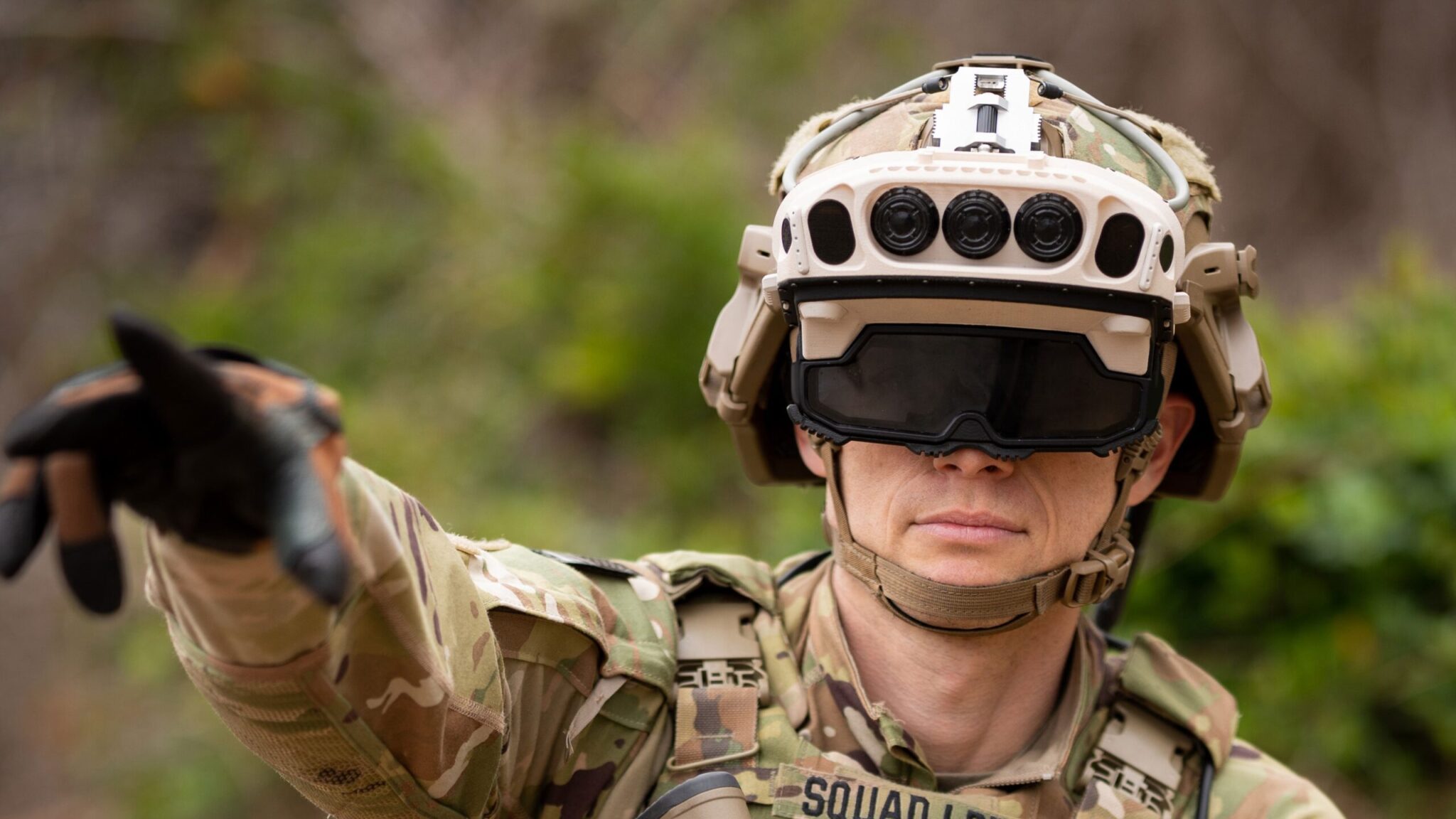
Tech companies are gearing up to participate in the US Army’s IVAS Next competition, following briefings from the Army regarding its decision to recompete the prime contractor position for its next-generation mixed-reality goggles.
For the past year, Army leaders have hinted at the “IVAS Next” initiative, aimed at addressing issues within the Integrated Visual Augmentation System (IVAS). However, it remained unclear how extensive the recompete would be, whether focusing on minor adjustments or the development of an entirely new system with fresh headsets.
After attending Army-led industry days and one-on-one meetings with government representatives in recent months, several industry insiders have indicated to Breaking Defense that they anticipate a new open competition to decide the winner of the lucrative contract for a combat-ready headset. As they await a formal solicitation from the Army, companies are lining up their technological offerings to position themselves as prime contractors or to partner with those that will.
A spokesperson for the Program Executive Office Soldier, which oversees the IVAS program, did not respond to Breaking Defense’s request for comment at the time of publication.
The current IVAS version is based on a military adaptation of Microsoft’s HoloLens 2 heads-up display. However, the program has faced numerous challenges over the past five years, with Army leaders threatening to cancel it—initially valued at $22 billion—if the issues were not rectified. While Microsoft has managed to keep the effort afloat, the Army’s signal that it is open to new prime contractors is warning sign for the tech giant and its high-value production agreement.
Microsoft has expressed its commitment to the new competition despite reducing its mixed-reality department, which includes work on the HoloLens 2 heads-up display. A company spokesperson stated, “Microsoft fully intends and is prepared to compete for IVAS Next,” emphasizing its dedication to providing the best capabilities for US service members.
Microsoft is not alone in this venture; around 80 companies attended an Army industry day in December to learn more about the IVAS Next plans. Notable participants included defense technology firms like Anduril, Palantir, L3 Harris, as well as the US divisions of Israeli company Elbit and British firm BAE Systems. Interestingly, augmented reality company Magic Leap has since announced a shift away from manufacturing its own headsets.
Kopin, based in Massachusetts and known for its display technology used in F-35 helmets, is preparing to bid for the revised program, according to CEO Michael Murray. He believes Microsoft will remain a significant player in IVAS due to its ownership of critical software assets. However, he and his team plan to outbid Microsoft for hardware production, including display systems and heads-up goggles. Their proposal features a “NeuralDisplay”—a bidirectional display with built-in imaging pixels aimed at tracking eye movement for better user experience.
Murray acknowledged that this technology is not yet ready for widespread use, currently at a technology readiness level of four, but they are hopeful that it evolves for the IVAS heads-up display to address past criticisms of cyber sickness and to eventually reduce the display’s size to that of sunglasses.
Initially promoted as a groundbreaking tool for soldiers, IVAS was intended to function as a versatile device for both combat and virtual training scenarios. However, problems have surfaced since 2021, leading to serious complaints from soldiers, including discomfort, dizziness, and reliability concerns, which were echoed in a critical Pentagon inspector general’s report.
Although Army leaders initially supported the program, they have tempered expectations and decided to break it into three versions—1.0, 1.1, and 1.2. The Army has acquired 5,000 units of 1.0, with plans for an additional 5,000 1.1 units for limited use.
The forthcoming 1.2 version is viewed as a crucial upgrade intended to address previous problems, such as transitioning from a helmet-like display with a 70-degree field of view to a hinged, flat design with a 60-degree field of view. Modifications also include relocating a computer puck on soldiers’ chests to the back of the helmet, shortening its connection to the heads-up display, and incorporating a new low-light sensor from Canon.
The assessment of the new setup is underway, with an Army spokesperson noting in February that “design objectives” have been achieved. Testing for the 1.2 goggles will continue throughout 2024, leading to a company-level user evaluation in 2025, which will inform whether the Army will proceed with a large-scale purchase of the 1.2 models.
General James Rainey, head of Army Futures Command, emphasized: “As a former infantryman, I realize the potential [of IVAS] … if it works; It is a legitimate 10 times upgrade to our most important formations,” but cautioned that if it fails, funding could be redirected towards other critical night-vision needs.
It remains unclear what impact, if any, the potential success of the 1.2 version will have on the Army’s envisioned IVAS Next project, as the service appears to be in the early stages of exploring this initiative. Industry sources expect a solicitation for IVAS Next later this year, which may clarify the Army’s goals for the next generation of these systems.