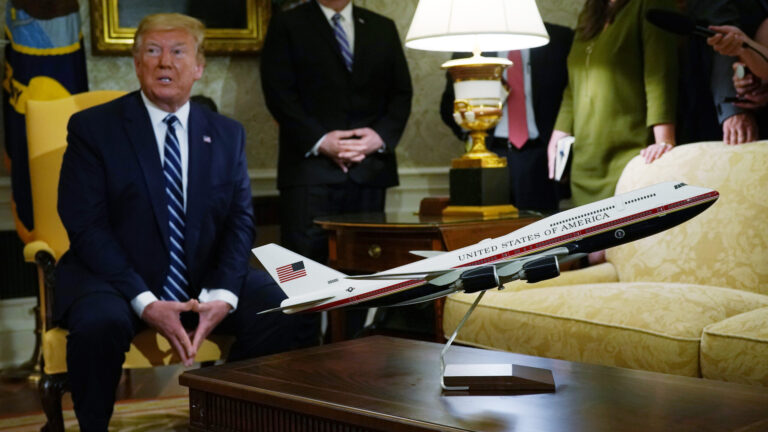
The global aerospace leader has hit another significant financial snag. The VC-25B program, designed to replace the iconic presidential fleet, has incurred a new $280 million charge, pushing total losses north of the $3 billion mark for the first time.
A Financial Sinkhole for the Presidential Fleet
During its second-quarter earnings report, Boeing revealed that the highly anticipated Air Force One replacement program continues to drain resources. The latest $280 million charge reflects the steep price of „additional production and certification resources,” a move CEO Kelly Ortberg claims is vital to mitigating risks as the aircraft advances toward flight testing.
Despite the disappointing figures, Ortberg emphasized the company’s commitment to the 2028 delivery schedule. While the defense unit’s operating margins turned negative this quarter due to the VC-25B hit, leadership insists that the organization is in a much stronger position today than it was two years ago, focusing heavily on reducing risks across its entire defense portfolio.
The Fixed-Price Trap: A Costly Legacy
The financial bleeding stems from a 2018 deal brokered during the Trump administration. The firm, fixed-price contract set a $3.9 billion ceiling for the project, placing the entire burden of cost overruns on Boeing. Originally slated for a 2024 delivery, the program has been plagued by technical setbacks and workforce challenges that have repeatedly delayed progress.
This „aggressive bidding” strategy, once seen as a way to secure major government contracts, has become a double-edged sword. With the Air Force recently awarding a $15.5 million modification for communications equipment—bringing the total contract value to $4.3 billion—the pressure to deliver two fully upgraded aircraft without further hemorrhaging cash is higher than ever.
Broader Portfolio Pressures: Beyond Air Force One
The VC-25B is not the only program under the microscope. Boeing’s defense sector is navigating a series of challenging fixed-price efforts. While the KC-46 tanker is now viewed as a „low risk” for future overruns as contract terms are renegotiated, other projects like the T-7 trainer jet and the MQ-25 tanker drone maintain a baseline of „normal” development risk.
The most significant concern remains NASA’s Starliner vehicle. Leadership acknowledged that further work is required to align with NASA on launch schedules to prevent future financial charges. As Boeing works to stabilize its defense unit, the success of these high-stakes programs will determine whether the manufacturer can return to high single-digit margins by the end of the decade.