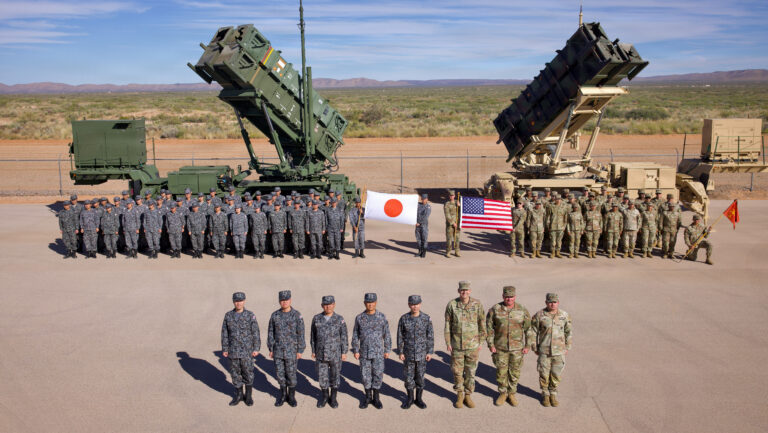
The missile defense cooperative relationship between the United States and Japan is facing a defining moment. As Tokyo prepares its landmark security strategy, a technical standoff over Patriot modernization threatens to undermine the alliance’s defense against the increasingly sophisticated arsenals of China and North Korea.
A High-Stakes Alliance: From Patriot Missiles to Hypersonic Defense
The partnership between Washington and Tokyo stands as the bedrock of stability in the Indo-Pacific. Since the 1980s, when Japan became the first non-NATO adopter of the Patriot system, cooperation has surged to include Aegis destroyers, space-based sensors, and the joint development of interceptors for hypersonic threats.
With defense spending hitting $58 billion this year, Japan is moving with unprecedented urgency. However, the upcoming strategic documents under Prime Minister Takaichi Sanae’s government will „determine the country’s fate,” especially as global interceptor stocks are depleted by conflicts in Ukraine and the Middle East.
LTAMDS vs. IBCS: The Battle for the „Brain” of Missile Defense
The deadlock centers on a vital component: the LTAMDS radar, capable of 360-degree coverage. Without this sensor, modern threats—kamikaze drones, cruise missiles, and hypersonic gliders—can maneuver undetected. The friction arises because the U.S. Army designed this radar to function exclusively with the new IBCS command-and-control system.
Tokyo now faces a difficult trilemma. The option to acquire both IBCS and LTAMDS is the most operationally effective but also the most expensive. The second path—integrating the radar into Japan’s existing structure via the domestic „Smart ICC”—risks lacking official U.S. Army support, potentially turning the procurement into a logistical and engineering nightmare.
The Ghost of Aegis Ashore and Tokyo’s Urgent Choice
The most dangerous path is inaction: quietly removing LTAMDS from budgetary plans due to the technological impasse. Such a scenario would leave Japanese forces „blind” to attacks from the eastern and southeastern flanks, echoing the resounding failure of the Aegis Ashore project in 2020, which resulted in years of lost security readiness.
Recent conflicts have proven that missiles are the weapon of choice for aggressors, and the ability of adversaries like Iran or China to target command nodes and radars is a real and imminent threat. The burden does not rest on Japan alone; Washington must facilitate a transition that respects its ally’s sovereignty. The time for cautious diplomacy has passed; for Japan, the moment to choose between compatibility and vulnerability is now.