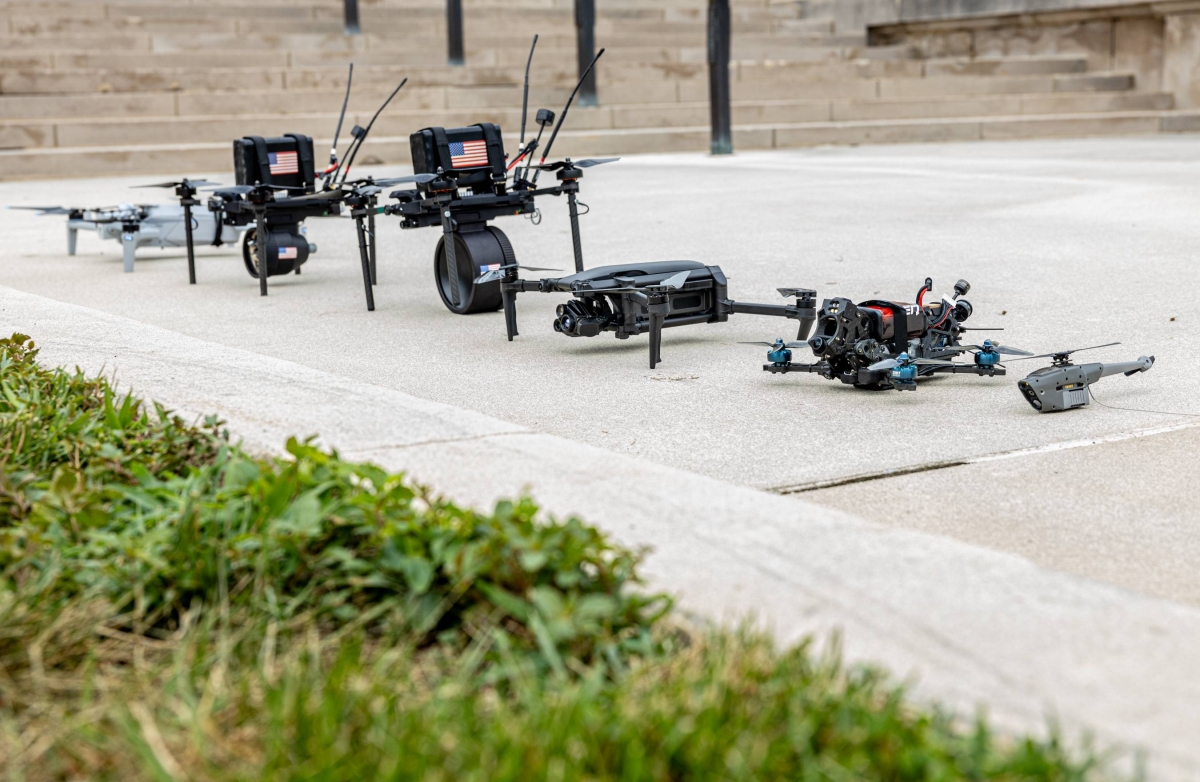
The United States military is accelerating its push towards a new era of autonomous warfare, launching a high-stakes competition with up to $100 million in prizes for companies to develop groundbreaking „orchestrator” software. This ambitious project, spearheaded by the Pentagon’s Defense Innovation Unit (DIU), seeks to transform how entire formations of unmanned air, ground, and water vehicles are commanded, moving from labor-intensive manual control to a seamless, AI-driven interface.
The New Paradigm of Command
At the core of this initiative is the vision of an Autonomous Vehicle Orchestrator – an intelligent mediator designed to bridge the gap between human intent and machine execution. Currently, military operations often require at least one trained operator for each drone, a model deemed inefficient and unsustainable for future large-scale engagements. The DIU envisions a future where a single servicemember, even without specialized training, can issue broad, plain-language commands—via text or voice—to an entire squadron of robots.
Marine Lt. Gen. Frank Donovan, director of the Defense Autonomous Warfare Group (DAWG), articulated this transformative goal: „We want orchestrator technologies that allow humans to work the way they already command — through plain language that expresses desired effects, constraints, timing, and priorities — not by clicking through menus or programming behaviors.” The proposed prototypes must grasp and execute common military directives, such as „place crafts 1-5 in echelon left” or „hold position, conserve battery, and wait for further tasking unless a threat crosses Line Bravo.”
Rapid Deployment: Speed is of the Essence
With submissions due by January 25, the pace of this program reflects a critical urgency within the Pentagon. Selected developers face an intensely brisk timeline, required to commence Sprint 1 testing within a mere ten days of notification, with increasingly complex stages to follow rapidly over the subsequent six months. This initiative, backed by the US Navy and DAWG, builds upon the foundational work of the original Replicator initiative, underscoring a strategic commitment to quickly integrate advanced autonomous capabilities.
Navigating the Technical Minefield: Voice and Connectivity
While the explosion of Large Language Models has revolutionized AI’s ability to process and generate human-like text, the realm of voice communication presents a formidable challenge. The DIU’s ambition for voice control, particularly amidst the chaos and sensory overload of a battlefield, pushes the boundaries of current AI capabilities. Yet, the strategic value is undeniable: troops in combat situations need their hands free for weapons and their eyes scanning for threats, making voice commands an invaluable asset. Companies like Primordial are already demonstrating breakthroughs in this area, field-testing voice-operated drones for special operators, suggesting that the DIU’s $100 million prize money could draw more innovators out of stealth.
Another critical hurdle lies in the AI’s ability to act as a truly intelligent orchestrator – coordinating diverse drone types (e.g., air cover for ground robots), adapting plans dynamically based on new information, and critically, operating reliably even with intermittent or completely severed communication links. The system must also present operators with „realistic representations of communications availability and autonomous behavior,” preventing dangerous false assumptions of control in a contested environment.
A Glimpse into Tomorrow: The Swarm Forge Experiment
The urgency and potential of these AI-driven systems were vividly demonstrated shortly after the orchestrator project’s announcement. On January 14, the Pentagon’s Research and Engineering branch released footage from the military’s first „Swarm Forge” experiment, conducted just days prior on January 8. The video showcased a four-drone formation – one „brain” drone leading three expendable kamikazes – obliterating three simulated tanks almost simultaneously in mere seconds. Defense contractor Auterion confirmed its software coordinated the swarm, with a single human operator designating targets before the AI took over the intricate attack choreography. This experiment offers a tangible preview of the formidable capabilities the DIU’s orchestrator software aims to unleash across the modern battlespace.