Copenhagen has announced an immediate increase in its defense forces in and around Greenland, in partnership with NATO allies. The decision, justified by Denmark as a response to „security tensions” spreading to the Arctic region, comes swiftly after intense rhetoric from the US administration, centered on the acquisition of the semi-autonomous island, part of the Kingdom of Denmark.
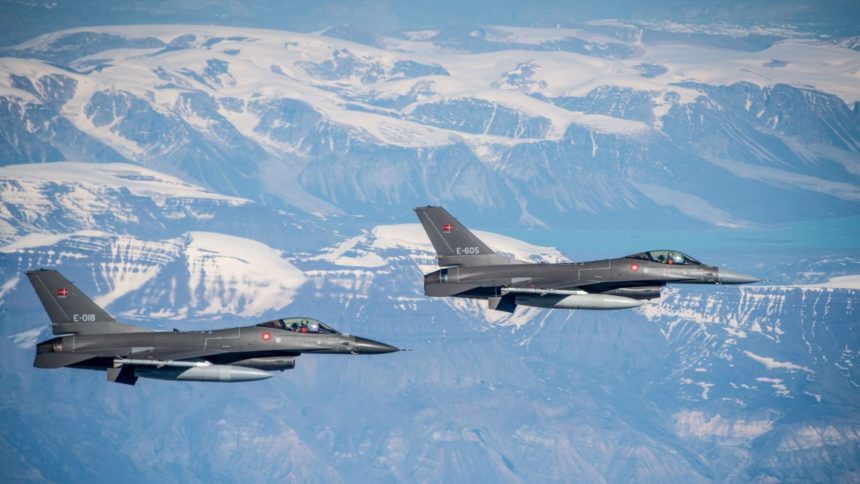
Fortifying the Northern Flank: A Response to Geopolitical Threats The Danish Ministry of Defense underscored that the primary purpose of this heightened troop deployment is „to train the ability to operate under the unique Arctic conditions and to strengthen the alliance’s footprint in the Arctic for the benefit of both European and transatlantic security.” Effective today, the Danish Armed Forces will deploy capacities and units in connection with exercise activities, which will result in an increased military presence of aircraft, ships, and soldiers, including from NATO allies, in and around Greenland in the coming period.
European Allies Join the Initiative Denmark’s move has elicited a swift response from European partners. Finland’s foreign minister, Elina Valtonen, confirmed that the Nordic nation is assessing a request from Denmark to send troops to Greenland. Additionally, Germany has already agreed to deploy 13 troops to the island, highlighting the collective nature of this defensive reinforcement.
High-Level Diplomatic Talks: Divergent Views on Greenland’s Future Following the Danish announcement, Greenland’s foreign minister, Vivian Motzfeldt, and her Danish counterpart, Lars Lokke Rasmussen, met at the White House with Secretary of State Marco Rubio and Vice President JD Vance. The discussions, deemed critical, addressed the Greenland issue. „The discussions focused on how to ensure the long-term security in Greenland and here, our perspectives continue to differ,” Rasmussen told reporters. „The President has made his view clear, and we have a different position. We, the Kingdom of Denmark, continue to believe that the long-term security of Greenland can be ensured inside the current framework, the 1951 agreement on the defense of Greenland, as well as the NATO treaty.”
Rasmussen also insisted that „ideas that would not respect the territorial integrity of the Kingdom of Denmark and the right of self-determination of the Greenlandic people are, of course, totally unacceptable.” He added that should Washington seek to increase its presence in Greenland, as set out in the 1951 defense treaty, „we would examine any such request.” The Danish minister reiterated Copenhagen’s commitment: „We have been [for] a while in NATO, [calling] for a stronger collective role in Greenland, together with a number of allies. And we are eager to work with the US on advancing this agenda.”
Greenland: A Clear Identity in Geopolitical Waters Ahead of the meeting, Vivian Motzfeldt unequivocally reaffirmed Greenland’s stance: „Greenland does not want to be owned by, governed by or part of the United States. We choose the Greenland we know today – as part of the Kingdom of Denmark.”
The Price of Sovereignty and Unlikely Scenarios In a broader context, analysts have estimated that a potential US acquisition of Greenland would involve a cost of approximately $700 billion. Despite Washington not ruling out potential military action to take the territory by force, European analysts consider such a scenario „unlikely” as diplomatic efforts continue. Danish Prime Minister Mette Frederiksen recently warned that a US attack on a NATO ally would lead to the dissolution of the alliance. NATO Secretary General Mark Rutte declined to comment on whether any allied country would support a potential takeover of Greenland by force but emphasized that „when we talk about the security of the Arctic there is no disagreement within the alliance when it comes to that issue, and that is not only pertaining to the seven [countries] who border the Arctic.”