In a technology market rife with doubts about the real-world benefits of chatbots and speculation about a potential artificial intelligence bubble, a prominent voice offers an optimistic counter-narrative. The president of a significant information technology and government services company expresses her unwavering confidence in AI, not merely as a product to sell to government clients, but as a powerful tool designed to empower (not replace) her own employees.
Beyond the Hype: AI – A Partner, Not an Adversary
The company is already leveraging artificial intelligence to assist its personnel in finding new job opportunities within its internal structures and is enthusiastically exploring AI’s potential to write code and process complex proposals. This approach signals a paradigm shift: AI is not viewed as a threat to jobs, but as a catalyst for professional growth and efficiency.
Investing in the Future: Education and Adaptation, Not Just Immediate ROI
Addressing recent studies indicating „zero return” on generative AI investments for most surveyed companies, the company’s leader argues that it is far too early in the adoption process to apply a strict „return on investment” framework. „It’s early days,” she told reporters during a recent media roundtable. „Right now, the battle that we are waging is education: It is about understanding what AI can do for you.” The real investment, she explained, lies in tailoring Large Language Models (LLMs) to their specific operational environment, identifying relevant use cases, and training employees to utilize AI tools to perform their jobs more efficiently. Evidence of this commitment is a tenfold increase in the number of AI training courses taken by staff in 2025 compared to the previous year.
From Coding to Proposals: Maximizing Efficiency Through Artificial Intelligence
Employees show increasing enthusiasm for using AI to handle repetitive tasks, such as writing long stretches of routine code that demand significant labor but little creativity. The hope is that LLMs can take over this „gruntwork,” allowing humans to focus on more intellectually challenging and interesting assignments. „They don’t want to eat the broccoli, they just want to have dessert,” the leader quipped. LLMs are also anticipated to assist in drafting proposals, identifying key points buried in voluminous government solicitation documents and finding comparable past projects. Even if „some human will probably touch every page of that,” AI can at least perform a rapid initial pass, accelerating the process. „I’m not replacing those employees,” the president emphasized. „I am helping those employees say, ‘Okay, these are the things that I need to focus on’.” An AI tool for „internal mobility” is already implemented, helping match employees with new opportunities and temporary assignments within the company.
Mission Emerge: A Fast Bridge Between Innovation and the Public Sector
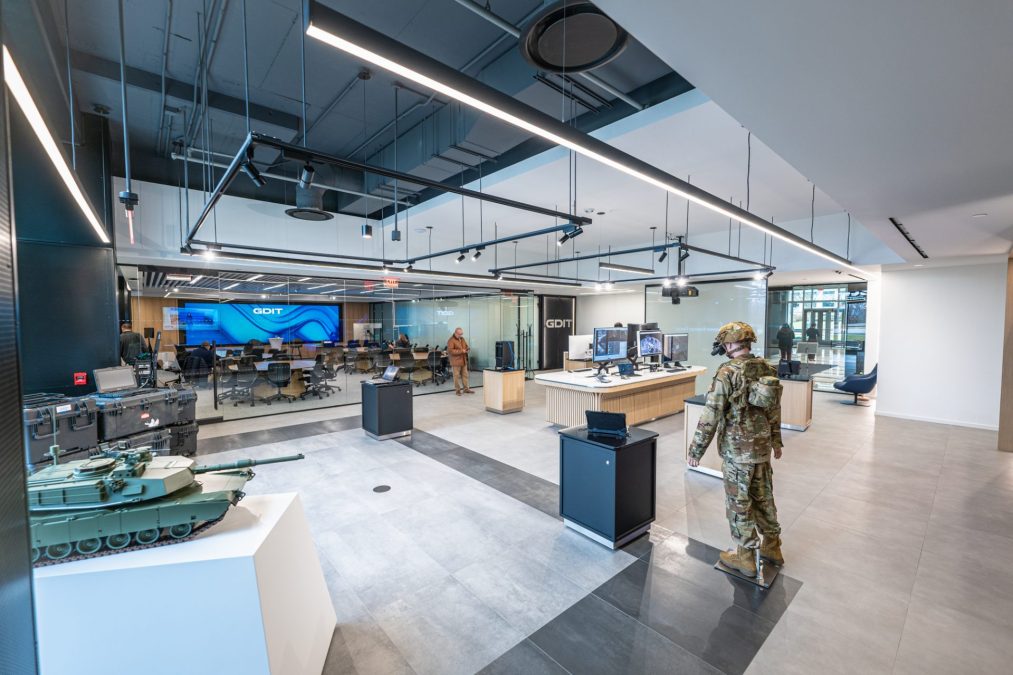
The recent unveiling of the company’s „Mission Emerge Center,” a 5,000-square-foot space strategically located near a major geospatial intelligence agency, marks another significant step. This center serves as a showroom and meeting space where executives and tech experts can demonstrate new AI products and other technologies to potential government customers. Here, AI analysis of surveillance video, 3D mapping software, and chatbots designed to help non-experts use sophisticated geospatial intelligence tools are presented in unclassified „sandboxes,” allowing for rapid feedback before integration into the government’s highly secure networks.
The Speed of Light: Lessons from Conflict and the Era of Agile Sprints
The new reality of modern warfare, exemplified by the conflict in Ukraine, where troops are using technology in novel and dynamic ways, underscores the need for speed. The company’s leader notes that the response from military and intelligence clients is no longer „come back in a year,” but „I’d like to have you back here in six weeks from now, because I want to do Agile sprints and see how this is working and evolving.” This shift represents a massive leap from traditional deployment times. The former Navy officer recalled times when, upon a ship’s return from deployment, „they would literally cut a hole in the side of the ship to take the last deployment of software out of the ship, and put the next deployment of encryption and software on.” Today, the objective is to get these updates „while I’m underway,” a vision essential for maintaining strategic advantage.