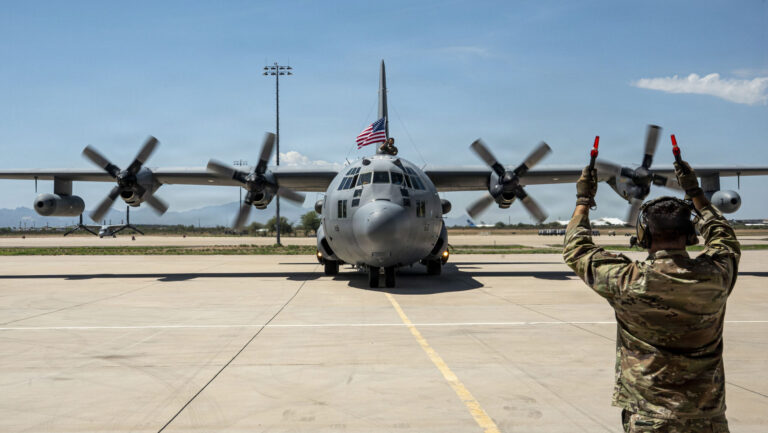
The U.S. Air Force has formally retired the EC-130H Compass Call, bringing to an end more than 40 years of service for one of its primary electronic warfare platforms.
A retirement ceremony was held on Sept. 18 at Davis-Monthan Air Force Base in Arizona. The turboprop aircraft conducted its final operational taxi during the event. The base is home to the 55th Electronic Combat Group, which operated the Compass Call fleet, as well as the famous “Boneyard,” where the aircraft is scheduled to be stored permanently.
The end of an era for Compass Call crews
The retirement of the EC-130H marks not only the end of an aircraft’s operational career, but also the conclusion of an important chapter for the personnel who maintained and operated it.
“This closes the door not just on my time in our squadron, but on an entire chapter of my life,” said Staff Sgt. Justin Franko, a dedicated crew chief with the 755th Aircraft Maintenance Squadron, referring to the aircraft’s final taxi.
An aircraft built for electromagnetic warfare
The EC-130H was developed from Lockheed Martin’s C-130 turboprop transport aircraft. The platform was modified for electronic attack missions by incorporating specialized systems supplied by BAE Systems and L3Harris.
The aircraft entered service in 1983 and was designed to disrupt enemy communications, jam radars and reduce the effectiveness of opposing command-and-control systems.
According to information released by the Pentagon, the EC-130H also took part in the initial stages of combat operations against Iran earlier this year as part of Operation Epic Fury.
The EA-37B takes over the mission
The EC-130H will be replaced by the EA-37B, which will retain the Compass Call name. Unlike its predecessor, the new aircraft is based on the Gulfstream G550 business jet.
The EA-37B will also carry electronic warfare systems developed by BAE Systems and integrated by L3Harris.
“We are retiring the EC-130; we are not retiring Compass Call. The mission continues with the EA-37B,” said Col. Aaron Gray, commander of the 55th Wing at Offutt Air Force Base in Nebraska.
Double the speed and altitude
The Air Force says the new Compass Call will fly at twice the altitude and twice the speed of the EC-130H. The EA-37B will also feature more powerful electronic systems designed to counter modern threats across the electromagnetic spectrum.
The first aircraft was delivered in August 2024.
The size of the future fleet had previously been uncertain. However, U.S. officials announced in April that the planned fleet would be expanded to 22 aircraft. Italy became the platform’s first foreign customer after signing for the aircraft last year.
Electronic warfare becomes critical against peer adversaries
Advanced electronic warfare has become a central element of modern conflict. The ability to protect friendly communications and sensors while disrupting or degrading an adversary’s systems can have a decisive impact on military operations.
In a potential conflict with a peer adversary such as China, operations in the electromagnetic spectrum would be as important as air, naval or ground operations.
The Air Force is not the only U.S. service operating a dedicated airborne electronic attack platform. The U.S. Navy operates the EA-18G Growler, an electronic attack aircraft launched from aircraft carriers.
The retirement of the EC-130H therefore marks the end of a legendary platform, but not the end of the mission for which it was designed. That role will continue through the EA-37B, a faster, more capable aircraft adapted to the demands of 21st-century electronic warfare.