The Air Force has announced that it has reached a long-standing goal of producing 1,500 pilots every year. The achievement is considered essential to reducing the current shortage, which is estimated at more than 2,000 aviators.
Even if the service maintains that pace in the coming years, however, eliminating the shortage entirely will take a considerable amount of time. According to senior training officials, closing the gap will require not only several years of sustained production, but in some categories, decades.
The pilot deficit cannot be solved quickly
Lt. Gen. Clark Quinn, head of Air Education and Training Command, said the shortage cannot be eliminated in a short period of time. Training output must be considered alongside the number of pilots who choose to remain in active service.
Retention rates are heavily influenced by economic conditions. When the civilian aviation market offers more attractive salaries and benefits, the Air Force may face additional losses of experienced personnel.
Most of the current shortage is concentrated in staff and senior positions, which are typically held by pilots well into their careers. Replacing personnel in those roles requires years of professional development and operational experience.
Rebuilding senior ranks may take 15 to 20 years
Officials estimate that it could take between 15 and 20 years for new generations of pilots to gain the experience required to fill senior positions.
Increasing annual production will not solve the problem immediately, but it is viewed as the essential first step toward reducing the deficit. Maintaining the 1,500-pilot annual target will be critical to staffing future squadrons and operating new combat aircraft.
A new training model is accelerating production
The Air Force credits a new training model introduced in 2024, known as the Future of Undergraduate Pilot Training, with helping it reach the annual target.
The system combines civilian and military instruction. During the initial phase, students take part in civilian-led programs, earn a private pilot license and learn the fundamentals of flight.
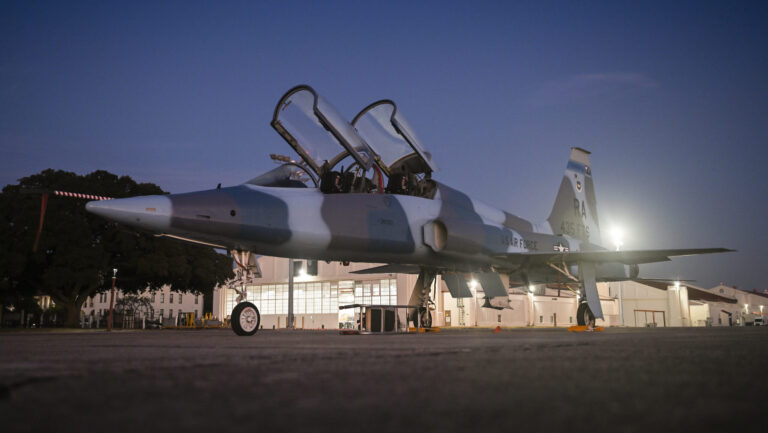
They then move into military training, where they fly the T-6A Texan II. Candidates selected for fighter and bomber assignments also receive training on the supersonic T-38 Talon.
According to Air Force Chief of Staff Gen. Ken Wilsbach, the new approach allows the service to produce the number of pilots needed to operate aircraft entering the force, including the F-47 fighter and the B-21 Raider stealth bomber.
Autonomous aircraft could reduce manpower requirements
Over the medium and long term, autonomous platforms could change the Air Force’s manpower requirements. Collaborative Combat Aircraft, designed to operate alongside crewed combat aircraft, could perform some missions that currently require a human pilot.
Senior officials do not expect any reduction in the number of pilots to occur immediately. Such a shift remains several years away. Until then, the Air Force intends to continue producing 1,500 pilots annually.
T-7 Red Hawk could become a single training platform
The Air Force is also considering whether to consolidate pilot training around a single aircraft: the T-7 Red Hawk.
The commander of Air Education and Training Command said he believes the aircraft could become a highly capable training platform and that the service is eager to receive it. No decision has yet been made on whether the T-7 should be used for every stage of pilot instruction.
A single-platform training system would reduce the logistical footprint and lower manpower requirements. Maintenance, supply chains and training infrastructure could all be streamlined.
The approach would also create a significant vulnerability. If a technical or operational problem grounded the T-7 fleet for an extended period, the Air Force would have no immediate backup platform available to sustain pilot training.
Instructor experience will determine the aircraft’s future role
Any decision to expand the T-7’s role will depend on instructors gaining sufficient experience with the aircraft.
So far, most T-7 flights have been conducted by developmental test pilots involved in evaluating the program. Military instructor pilots have only recently begun flying the jet, and their assessments will be central to determining which stages of training the aircraft can safely and effectively support.
For program leaders, the decisive factor will be establishing confidence among instructors that the T-7 can carry out the entire pilot-training process to the required standard.