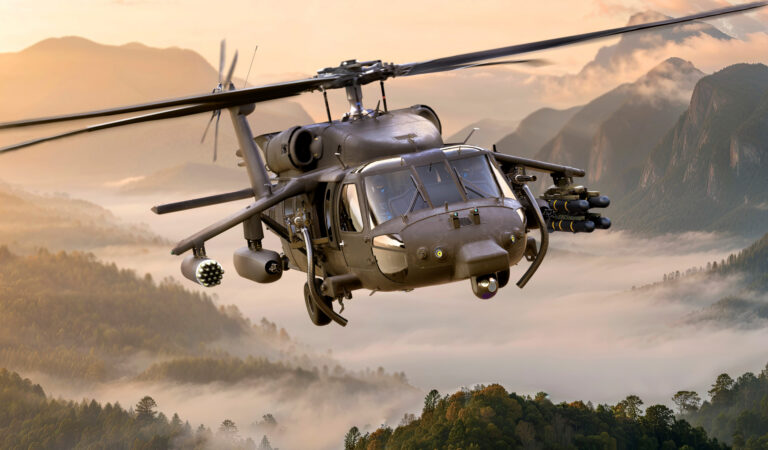
Amid rising geopolitical tensions and the reinforcement of NATO’s eastern flank, the Black Hawk helicopter is expanding its operational role. With the addition of modular weapon kits, the aircraft can be rapidly transformed from a transport and support platform into an asset capable of close-support missions and precision strikes.
From disaster response to combat operations
The platform demonstrated its operational flexibility during the floods that struck Poland in September 2024. Black Hawk helicopters transported equipment and personnel into affected areas and evacuated more than 100 people.
Meanwhile, production of Europe’s first S-70 Firehawk helicopters began in Mielec in July. The aircraft are being built for the Czech Republic. Twelve European countries currently operate different versions of the Black Hawk family, employing them in missions ranging from tactical transport and medical evacuation to surveillance and emergency response.
The new armed configuration allows a UH-60M or S-70i helicopter to be converted into an attack aircraft without sacrificing its transport and support functions. Once a combat mission is complete, the system can be removed and the aircraft returned to its utility configuration.
Modular weapons without major structural changes
The proposed systems can be configured with between two and six weapons stations. They are available both for new aircraft and as retrofit packages for UH-60 and S-70 helicopters already in service.
The available configurations include:
- a close-support kit designed to engage light armor and dismounted troops;
- a precision-strike kit for attacks against hardened targets, suppression of air defenses and strikes against high-value objectives;
- 7.62 mm machine guns;
- .50-caliber weapons;
- M261 rocket pods;
- Hellfire II, JAGM, APKWS and Spike NLOS missiles;
- a Modular Effects Launcher for additional air-launched effects.
Converting the helicopter to the attack configuration takes less than three hours. Removing the system can be completed in minutes, using tool-free latching mechanisms.
Transport capacity remains intact
The installation of the wing and weapons does not eliminate the helicopter’s transport capability. The aircraft can still carry 11 fully equipped troops or up to 3,000 pounds of internal cargo.
This enables a single airframe to perform airmobile assault, close support, medical evacuation, intelligence, surveillance and reconnaissance, as well as tactical transport missions. Combining these capabilities in one aircraft reduces the need to operate separate fleets for utility and attack roles.
One fleet, lower operating costs
A dedicated attack-helicopter fleet requires specially trained pilots and technicians, as well as a separate logistics structure. For military services that already operate Black Hawks, the modular solution offers a more flexible and cost-effective alternative.
The armed and unarmed configurations share approximately 95% of their components. Crews train on the same cockpit layout, while maintenance personnel service essentially the same aircraft family. This reduces the number of training pipelines, limits spare-parts inventories and lowers overall ownership costs.
The platform has accumulated approximately 15 million flight hours and incorporates a crashworthy airframe and redundant systems designed to improve survivability and operational resilience.
Designed for future upgrades
The weapons kit is designed to work alongside modernization programs already being developed for the Black Hawk. These include an improved turbine engine, larger fuel tanks, autonomous flight options and increased payload capacity.
The goal is to preserve the platform’s relevance over the long term by enabling the integration of next-generation sensors, modern weapons and autonomous flight-control systems without requiring major structural modifications.
Through this approach, the Black Hawk can continue to meet both traditional mission requirements and emerging operational demands across different theaters.
A European solution for European requirements
NATO’s decision to increase defense and security spending to 5% of gross domestic product by 2035 places emphasis not only on acquiring new equipment, but also on modernizing platforms already in service.
A significant part of the Black Hawk industrial and logistics network is already located in Europe. PZL Mielec in Poland, a Lockheed Martin company and one of the country’s largest aircraft manufacturers, has produced Black Hawk helicopters since 2010. Its aircraft have been delivered to customers in 11 countries.
In the Czech Republic, Česká letecká servis has been designated as a European distribution center for Black Hawk parts. The Czech Firehawk helicopters are also being built in cooperation with the company.
Romania acquired its S-70 fleet through a European Union-funded program and received an additional aircraft in December 2025 through rescEU, the bloc’s shared emergency reserve, which can be deployed to support member states.
The same platform, an additional mission
Introducing the armed configuration does not require an entirely new infrastructure. The aircraft is built in Europe, supported through logistics centers in Poland and the Czech Republic, and already operated by several European nations.
For current users, the key advantage is that the platform employed for flood response, firefighting, medical transport or border patrol can acquire a strike capability within a short period of time.
The Black Hawk is therefore no longer merely a utility helicopter. With modular weapons integrated, it becomes a multifunctional platform capable of moving from lifesaving operations to ground-force support and precision strikes—using the same airframe and an already established logistics network.