The Overlooked Tech That Wins Wars
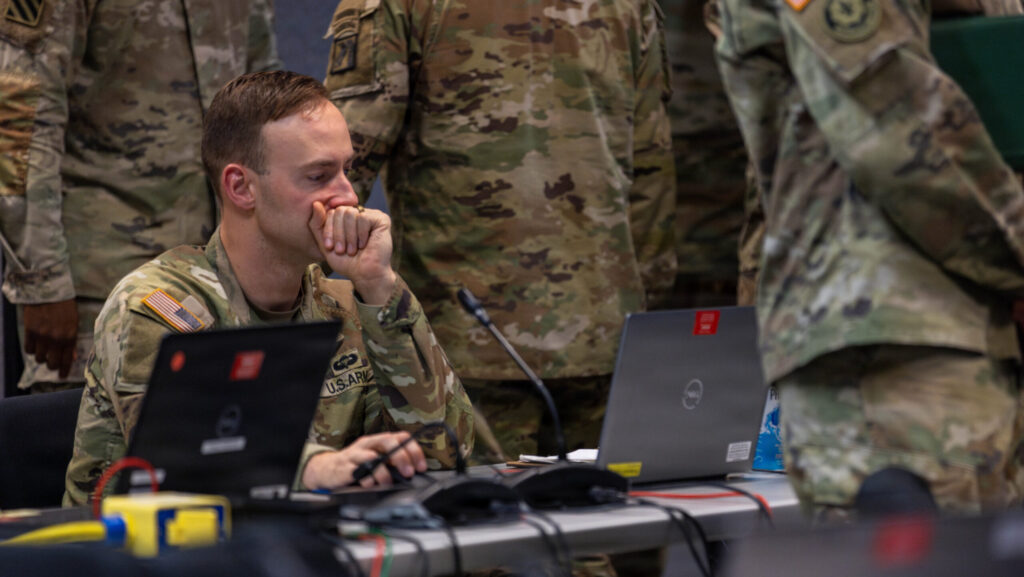
In modern warfare, the art of combat extends far beyond offensive strategies or brute firepower. An often-overlooked element, dubbed the „less sexy side” of conflict, is rapidly becoming critical: data transfer and management. Major Brandon Rose, G-3/5 at the XVIII Airborne Corps, emphatically states that these technicalities „are going to become the things that win or lose wars.” The ability to swiftly process and utilize information, moving past the inherent limitations of Excel spreadsheets and PowerPoint slides, to maintain mental agility, could be the decisive factor. This vision is being rigorously tested and refined through the XVIII Airborne Corps’ recurrent Scarlet Dragon exercises.
Forging Future Warriors: The Scarlet Dragon Exercises
Since 2020, the XVIII Airborne Corps has conducted quarterly Scarlet Dragon exercises, with each iteration aimed at refining operational capabilities and data-sharing processes. The focus is squarely on data-centric warfare, from intelligence gathering to targeting, to close kill chains efficiently. The latest version, which concluded in late March, experimented with incorporating commercial datasets, moving beyond military-only sources, and tasked soldiers with planning for sustaining combat operations for more than 14 days. „A lot of it is looking at the commercial data side and comparing that to some of the tools that are already available to the corps through existing platforms. What is the viability? Can this be incorporated? That’s a big one for us,” Major Rose explained.
Commercial Data Revolution and Ukraine’s Harsh Lessons
The XVIII Corps’ early experience with Ukraine during Russia’s invasion highlighted both a critical need and a significant gap in the use of commercial data. It became evident that the Army was behind the curve. Initially, internal policies and US code severely limited what a commander could do with purchased datasets. „Adjustments were made, observations were made and then the lawyers started having those dialogs about, well, what can we get away with and what’s legal and what’s not? Again, it just highlighted a lot of things that need to be changed with the architecture and the data structure,” stated Chief Warrant Officer 4 Sean Benson, senior GEOINT technical officer for the XVIII Airborne Corps. Rose and Benson could not share specific details due to the classified nature of the exercise, but stressed that each iteration presents an opportunity to solve new problems. The process is iterative, involving testing various pathways, Application Programming Interfaces (APIs), and cross-domain solutions to find the most reliable methods for integrating commercial data into real-time scenarios.
Navigating the Contested Spectrum: Data Under Adversary Scrutiny
Scarlet Dragon exercises not only test data-sharing methods but also how to execute them in an environment where an adversary is closely monitoring, seeking to target forces through their technical emissions. „We’ve harnessed and grabbed on to this idea of data centricity and data driven decisions, but we also have to recognize that cost of we potentially have a big footprint, so how do we minimize that, but still have access to the things that we want to do,” Rose questioned. The objective is to find ways to engage targets with a low probability of intercept/detection, acknowledging that the electromagnetic spectrum is a perpetually contested domain. Officials are exploring the best available paths, akin to a PACE (Primary, Alternate, Contingency, Emergency) plan for communications. „That’s exactly what I’m testing with the [Denied, Disrupted, Intermittent, and Limited] architecture is just that, is a PACE plan to pull in large streaming data sets,” Benson affirmed. This approach allows for the identification of gaps and informs investment decisions for future systems.
Towards a Single Pane of Glass: The Logistics Dashboard of Tomorrow
The Scarlet Dragon exercises have also rigorously tested one of the Army’s newest intelligence fusing systems, TITAN (Tactical Intelligence Targeting Access Node), to stress-test how it pushes data. Such events have pushed the XVIII Corps, and by extension the Army and joint partners, to address fundamental questions. A key goal is the creation of a predictive logistics dashboard and visualization for commanders to enhance combat power, but this critically depends on good quality data – a significant challenge today. Logistics reporting, Major Rose explained, originates from the lowest echelons of the battlefield, and by the time it reaches the corps or equivalent level, that data can be 18 to 24 hours old and inaccurate. The exercises are also exploring how information flows from „low-to-high” – from tactical units operating in somewhat unclassified environments all the way up to highly sensitive corps-level systems. The use of secure but unclassified-encrypted devices at the company level is being examined to feed systems like the Maven Smart System more rapidly, providing more accurate information and accountability. The persistent challenge remains sharing information and logistical data with host nation or partner forces who do not operate on the same networks, necessitating complex cross-domain solutions for bidirectional data flows.