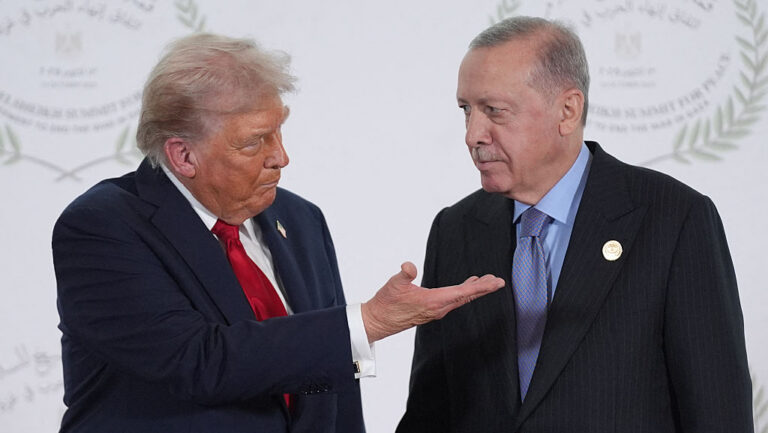
Turkish President Recep Tayyip Erdogan appears determined to use the upcoming NATO summit in Turkey to impress Washington and Brussels. Preparations are in full swing, and Ankara officials are increasingly banking on the personal ties between Erdogan and President Donald Trump. The primary objective is clear: reintegrating Turkey into the F-35 fighter jet program, a move that would mark a major victory for the Turkish defense industry.
Ambiguous signals from the White House: Donald Trump promises to make the Turkish leader „happy”
Ankara’s lobbying campaign seems to be already paying off. Recently, in the Oval Office, Donald Trump suggested he might „do something” to please Erdogan regarding the F-35s, while Vice President J.D. Vance confirmed that the Pentagon is reviewing legal avenues to unlock the situation. However, this sudden openness is sparking heated controversy among analysts who believe such a decision would be a major strategic error.
The reason for concern is simple: under Erdogan’s leadership, Turkey has cultivated close ties with America’s traditional adversaries, such as Russia, Hamas, and China. A state that oscillates between camps cannot be considered a trustworthy custodian for the United States’ most advanced aviation technology.
Technological danger: The shadow of the Russian S-400 system looms over NATO security
Turkey’s eviction from the F-35 program in 2019 was not an arbitrary decision, but a necessity following the purchase of the Russian S-400 missile system. The risks remain the same today. Simultaneously operating F-35 jets and S-400 systems on Turkish soil could allow Moscow to collect critical data on the vulnerabilities of American aircraft. In an era of close military cooperation between Russia, China, Iran, and North Korea, any compromised technological detail could endanger not only American pilots but the entire network of NATO partners.
Ties with Hamas and China: An agenda diverging from Western interests
Beyond the military dispute with Russia, Ankara’s political behavior raises serious questions. Erdogan’s declared support for Hamas, especially following the October 7 attacks on Israel, flagrantly contradicts the position of Western allies. Furthermore, the expansion of Chinese influence in Turkey’s digital infrastructure and its participation as a dialogue partner in the Shanghai Cooperation Organization demonstrate a desire for „strategic autonomy” that undermines alliance cohesion.
Legal barriers: The U.S. Congress could block the administration’s plans
Even if Donald Trump wishes to prioritize his personal relationship with the „respected” Turkish leader, U.S. law imposes strict obstacles. CAATSA regulations and defense budget rules prohibit the transfer of F-35 technology as long as Turkey possesses the S-400 system. In this context, members of Congress from both parties are expected to oppose any attempt to ignore these legal provisions, demanding instead rigorous monitoring of Turkey’s cooperation with the Moscow-Beijing axis.