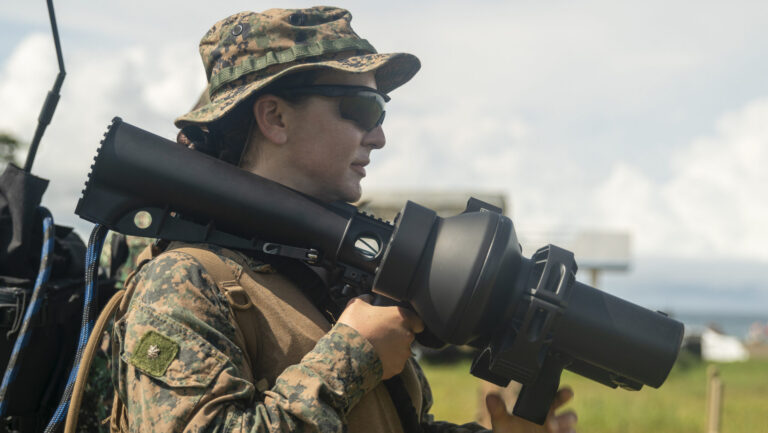
In a high-stakes race to reclaim the tactical airspace, the U.S. Marine Corps is set to formalize a new requirement for handheld counter-drone capabilities. This strategic pivot signals a move away from stop-gap measures toward a synchronized defense architecture designed to neutralize the persistent and evolving threat of small unmanned aerial systems (sUAS).
Beyond Urgent Needs: Formalizing the Infantry’s Defense
To date, Marines have relied on lightweight, wearable tools fielded under „urgent universal needs” statements. These systems, which prioritize non-kinetic solutions like passive sensing and electronic jamming, have been deployed to meet immediate battlefield demands. However, they have lacked a formal program of record—a gap the Corps intends to close within the coming months.
The formal requirement document is currently undergoing high-level review. Once approved, it will transition these portable tools from experimental status to a permanent fixture of the Marine’s arsenal, ensuring that small-unit leaders have the organic power to clear their own skies.
The Connectivity Gap: Linking Disparate Sensors
The primary flaw in current counter-drone efforts is not the hardware itself, but its lack of integration. Existing handheld systems operate in silos, unable to share data with one another or with larger command networks. The upcoming requirement is expected to mandate that all future wearable cUAS tech be networked, providing the „connective tissue” necessary to link individual Marines to the broader Integrated Missile Defense (IMD) umbrella.
In the modern combat environment, isolation is a vulnerability. The Corps’ vision is to transform every handheld sensor into a data point for the entire formation, ensuring that a threat detected by one Marine is immediately visible to the entire integrated defense network.
Scaling Down: Protecting the Maneuver Force
This strategic shift addresses a critical „shortfall” in ground fleet protection. While heavy, sophisticated air defense sensors are elite at intercepting large, high-altitude drones, they are often ill-suited for the „low and slow” threats posed by Group 1 and 2 drones. These small, agile systems have become ubiquitous on modern battlefields, outmaneuvering traditional defense perimeters.
Military leadership has been candid about the urgency: the Corps is „building the plane while flying it.” The traditional acquisition timeline of five to seven years is no longer viable when enemy technology evolves in a matter of weeks. By fielding networked, handheld kits to lower-level formations, the Marines aim to close the security gap at the ground combat and logistics levels, ensuring agility matches the speed of the modern threat.