From the depths of the ocean to the high skies, new one-way attack systems from industry giants Aselsan and Baykar are set to transform the battlefield through autonomy and cost-effective lethality.
The SAHA defense show in Turkey has become a definitive showcase for one-way attack drones, marking the exhibition debut of at least five sophisticated homegrown systems. In a series of high-profile reveals, Turkish defense leaders have unveiled a new generation of unmanned platforms designed for sacrifice missions capable of neutralizing strategic targets with clinical precision.
Naval Predation: Aselsan Dominates the Waves and the Depths
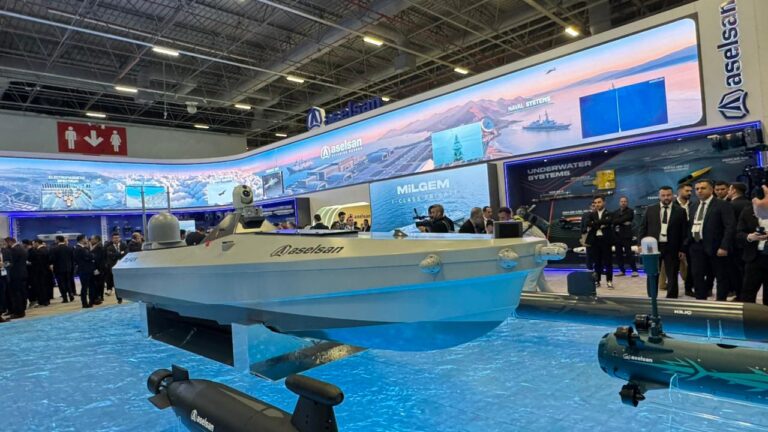
Electronics giant Aselsan stole the spotlight with two groundbreaking naval systems. The first, TUFAN, is an unmanned surface vessel (USV) primarily designed as a one-way attack craft, though it retains the versatility to perform intelligence, surveillance, and reconnaissance (ISR) missions. Complementing it is KILIC, an autonomous underwater strike system capable of operating solo or as part of a coordinated swarm.
Aselsan’s leadership emphasized that securing maritime boundaries now demands a superior level of autonomy and operational flexibility. By leveraging geographical advantages, these systems are engineered to meet the shifting requirements of modern maritime security environments.
Baykar’s Aerial Triad: From the „Mosquito” to the K2 Heavyweight
UAV powerhouse Baykar matched the momentum by revealing three distinct one-way aerial platforms. The Sivrisinek (Mosquito) is a compact, tube-launched drone designed for rapid reconnaissance and strike roles. Moving up the scale, the Mizrak (Spear) boasts a staggering range of over 1,000 kilometers (620 miles), featuring AI-assisted autonomy for beyond-line-of-sight operations.
The centerpiece of the display, however, was the full-sized model of the K2 Kamikaze. With a massive payload capacity of up to 200kg, the K2 represents the heavyweight tier of Turkey’s one-way attack capabilities, designed to deliver devastating strikes against high-value targets.
The Economics of Attrition: High-Tech Warfare on a Budget
The strategic pivot toward kamikaze drones and unmanned naval platforms is driven by a cold, tactical logic: cost-effectiveness. Analysts suggest that these systems provide Turkey with the ability to suppress or dismantle enemy air defenses and naval units at a fraction of the cost of traditional munitions.
By overwhelming enemy defenses through saturation tactics, these „suicide” drones pave the way for strategic, manned units to enter and establish air superiority. This shift not only minimizes risk to personnel but also introduces a scalable, lethal, and highly flexible doctrine to the modern theater of war.