When Secretary of Defense Pete Hegseth testified before the Senate last Tuesday, he came ready to defend his claim of a “historic and overwhelming victory” over Iran. His scorecard was impressive on paper: Iran’s navy sunk, its missiles buried, its defense industrial base almost completely destroyed, and Tehran’s military capability set back by decades.
However, senators raised an inevitable question: if the defeat was so decisive, why are Iranian forces still firing on US bases and commercial shipping? This gap is the puzzle at the heart of Operation Epic Fury. Although traditional airpower won the war at high altitudes, it failed to keep the Strait of Hormuz open, where cheap drones and missiles paralyzed maritime traffic.
The illusion of total control and the failure of classical doctrine
The central issue is the dismissal of a critical concept: the “air littoral.” Traditional military strategists, such as retired Lt. Gen. David Deptula, argue that there is no need to rethink Air Force concepts and that air superiority extends from the surface upward to the edge of space. However, the reality on the ground contradicts them brutally.
The air littoral is not just a matter of altitude, but a seam where militarized domains interact in a new way. The United States controlled the blue skies over Iran, but that control did not extend to the low-altitude zone, where swarms of drones and dispersed missiles do not form an integrated system that can be collapsed through surgical strikes. While the Air Force focused on the “blue skies,” it abdicated its responsibility to control the airspace immediately above the water and land.
Low-altitude attrition: A challenge that high-end technology cannot solve
Traditional air superiority relies on responsive presence—aircraft cannot stay overhead permanently, so speed substitutes for persistence. This logic only works if the enemy plays by the same rules. Instead, Iran’s cheap and expendable systems moved the fight downward into the air littoral, an area the Air Force treated as either unachievable or someone else’s problem.
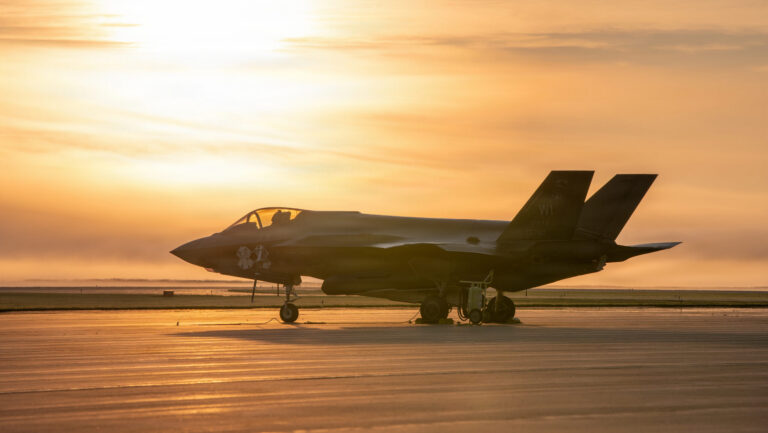
The failure was not due to a lack of fifth-generation aircraft, but to the flawed assumptions underlying the planning. Although US forces destroyed radars and command centers, the persistent threat of drones prevented the US Navy from escorting commercial shipping through the Strait of Hormuz. By the Air Force’s own definition, if you cannot enable freedom of action for the entire joint force, you do not possess air superiority.
The hard lessons of Operation Epic Fury and the future of asymmetric conflict
The idea that an air campaign modeled after the 1991 success in Iraq could bring Iran to its knees in short order proved to be an illusion. Iran retained most of its missile stockpile and managed to close the Strait for months, forcing Washington to accept framework agreements on unfavorable terms.
Control of the air is decided today in this “air littoral,” where masses of mobile, autonomous, and low-cost systems can deny a superpower’s freedom of maneuver. The hardest lesson for a force that has dominated the heights for generations is that the decisive contest has moved below, where expensive radars and stealth jets have limited effectiveness.