In the vastness of the Pacific Ocean, where the distance between two friendly ports can rival the width of an entire continent, the true enemy is not always visible on radar. The defining problem of this theater is logistics—a race against time across thousands of miles of contested waters, where smart decisions and data flow can mean the difference between victory and total isolation.
The challenge is not limited to the open water. It is compounded by compressed timelines, disrupted communications, and the imminent risk that traditional logistics ships and supply infrastructure could become high-priority targets for the adversary.
The four tyrannies: The ocean’s ultimate challenge
Those operating in this hostile environment speak of the „four tyrannies”: distance, water, time, and scale. These are not obstacles that can be eliminated, but forces of nature that must be mitigated through ingenious strategies.
The goal of the Indo-Pacific Logistics and Sustainment Services (ILS2) program is exactly this: to provide commanders with viable options when conventional networks are disrupted or unavailable. The solution lies in an advanced technological mix: prepositioned resources, regional partnerships, artificial intelligence for predictive analytics, and autonomous vessels capable of delivering supplies without exposing human crews to direct danger.
Artificial intelligence: From days to minutes in decision-making
In modern logistics, reaction speed is dictated by algorithms. AI technology allows for the acceleration of operational planning in a theater where circumstances change lightning-fast. It is not about replacing the human factor, but about rapidly analyzing data to present commanders with optimized courses of action.
Without AI support, deliberations for a logistics plan can take hours or even days. With the help of new predictive logistics software, these decisions are now made in minutes. Furthermore, these systems are designed to function even in disconnected, denied, intermittent, and low-bandwidth (DDIL) environments, caching data locally and syncing as soon as connectivity is restored.
„Ghosts” of the waves: Naval autonomy as a shield for sailors
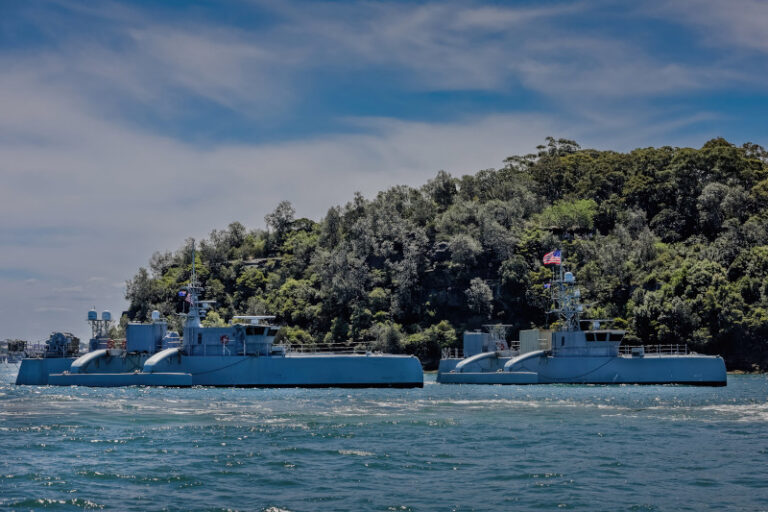
Perhaps the most visible innovation is the use of autonomous surface vessels. The concept is simple: delivering „beans, bullets, and bandages” without putting sailors’ lives at risk. Autonomous platforms, such as the already-tested Sea Hunter and Seahawk, have demonstrated they can travel thousands of nautical miles, from California to Australia, operating completely independently.
These vessels are not just experimental prototypes; they have already been integrated into strike groups and major multinational exercises. By converting existing commercial vessels into maritime drones, the fleet can be expanded rapidly, providing asymmetric resilience against enemy threats.
Deep alliances: The unstoppable network
Successful logistics in the Pacific relies on a „defense-in-depth” strategy. A massive logistics alliance, consisting of over 70 companies and 14,000 specialists, is already positioned in the region. This network ensures multiple providers for the same mission, guaranteeing that supply lines continue even if one node of the chain is attacked.
Experience gained in difficult theaters, from operations in Afghanistan to supporting bases in Antarctica, proves a fundamental historical truth: logistics wins wars. In the Pacific, the operational advantage belongs to whoever can move fuel and ammunition faster and more securely than the enemy can intercept them.