The proliferation of mass-produced drones on the battlefields of Ukraine demonstrates the profound impact these platforms have on today’s asymmetric warfare operations. From intelligence collection and surveillance to reconnaissance and direct payload attacks, the evolving tactics of drone warfare are reshaping the future of combat.
While the spotlight is on the war in Ukraine and its high-profile use of Unmanned Aerial Systems (UAS), it is essential to expand our strategy to counter these threats by also considering the growing use of Unmanned Surface Vessel (USV) and Unmanned Ground Vehicle (UGV) platforms. This evolving threat landscape is not confined to the EUCOM theater; it is also increasingly present in operational areas across AFRICOM, CENTCOM, INDOPACOM, and SOUTHCOM.
The Army’s Joint Counter-small Unmanned Aircraft Systems Office (JCO) and several key Program Offices acknowledge this reality. Last fall, JCO director Maj. Gen. Sean A. Gainey reiterated his call for every service member to become a drone-fighter.
To achieve this, there is a pressing need to deliver user-friendly and cost-effective counter-unmanned systems technology on a large scale. DroneShield is dedicated to assisting the Department of Defense (DoD) in accomplishing this goal.
Founded in Virginia in 2014, DroneShield has evolved through a decade of continuous innovation into a $590 million company, with no signs of slowing down.
The company’s systems are available in dozens of countries worldwide, with the United States representing its largest market, having secured approximately $49 million in DoD and government contracts since 2023. DroneShield is on a trajectory of accelerated growth with a contract backlog of $27 million and a pipeline exceeding $700 million.
DroneShield’s success is rooted in a commitment to advanced technology, developing systems that empower warfighters to address not only current but also future unmanned systems threats.
Key attributes of DroneShield’s product line include efficacy, ease of use, and cost-effectiveness. The company’s highly portable systems provide effective, real-time situational awareness and enhanced survivability at the brigade level and below.
Counter-UxS technology has quickly become a crucial requirement in modern combat environments; however, operators often have to manage a wide range of responsibilities during operations. Therefore, it is vital that any C-UxS technology adopted enhances an operator’s overall effectiveness without introducing unnecessary complexity. DroneShield offers a straightforward and readily deployable C-UxS capability, enabling decisive action.
The high speed, maneuverability, compact size, and extremely low noise signature of drones, especially First Person View (FPV) drones, make detection challenging. Drones can appear as tiny specks on the horizon, often only a couple of kilometers or several hundred meters away, giving little time for identification or protective measures. Early warning and effective countermeasures are critical for soldier survival.
Most small UAS depend on some form of radio frequency (RF) link for command and control, satellite guidance, or communication with a remote pilot. Drones transmit location data, video, and other telemetry back to their controllers while emitting their own electronic signals.
These unique signal characteristics can be detected and classified by advanced RF detection systems that differentiate them from other devices (like Wi-Fi routers or Bluetooth communications) that may use similar frequencies.
Effective RF detection systems must be capable of accommodating an increasing variety of new signals, frequencies, and platforms on the battlefield, as evidenced in Ukraine.
DroneShield has tackled this issue by developing a software-defined detection capability. This approach utilizes an advanced artificial intelligence engine that constantly scans and processes signal data against a trained algorithm. This AI-based method provides real-time situational awareness of drone activity while allowing users to maintain focus on operational objectives.
The speed of detection and a higher degree of accuracy are significant benefits of DroneShield’s AI detection approach. High-performance C-UAS technology is crucial in congested RF environments, where less sophisticated systems may struggle, leading to false detections or potentially dangerous delays in alerts. One of the systems employing the company’s advanced detection capability is the handheld RfPatrol Mk2.
Weighing just 2.6 pounds, the RfPatrol is a lightweight, entirely passive/non-emitting C-UAS detection system. It offers real-time drone signal detection, identification, and classification, informing users through visual, haptic, or audible alerts.
The system uses standard batteries with alternate power options, suitable for both mobile and stationary applications. Simple controls and interoperability with ATAK and MANET radio systems allow operators to share real-time alerts with allied forces for enhanced situational awareness. A complete suite of multi-mission tools, including a spectrum viewer, signal recording, and advanced filtering, further enhances field capabilities.
Regular quarterly updates of the threat database ensure that RfPatrol’s software-defined RF detection remains up-to-date with the latest drone signatures. This is part of DroneShield’s commitment to helping users keep pace with the ever-evolving drone landscape.
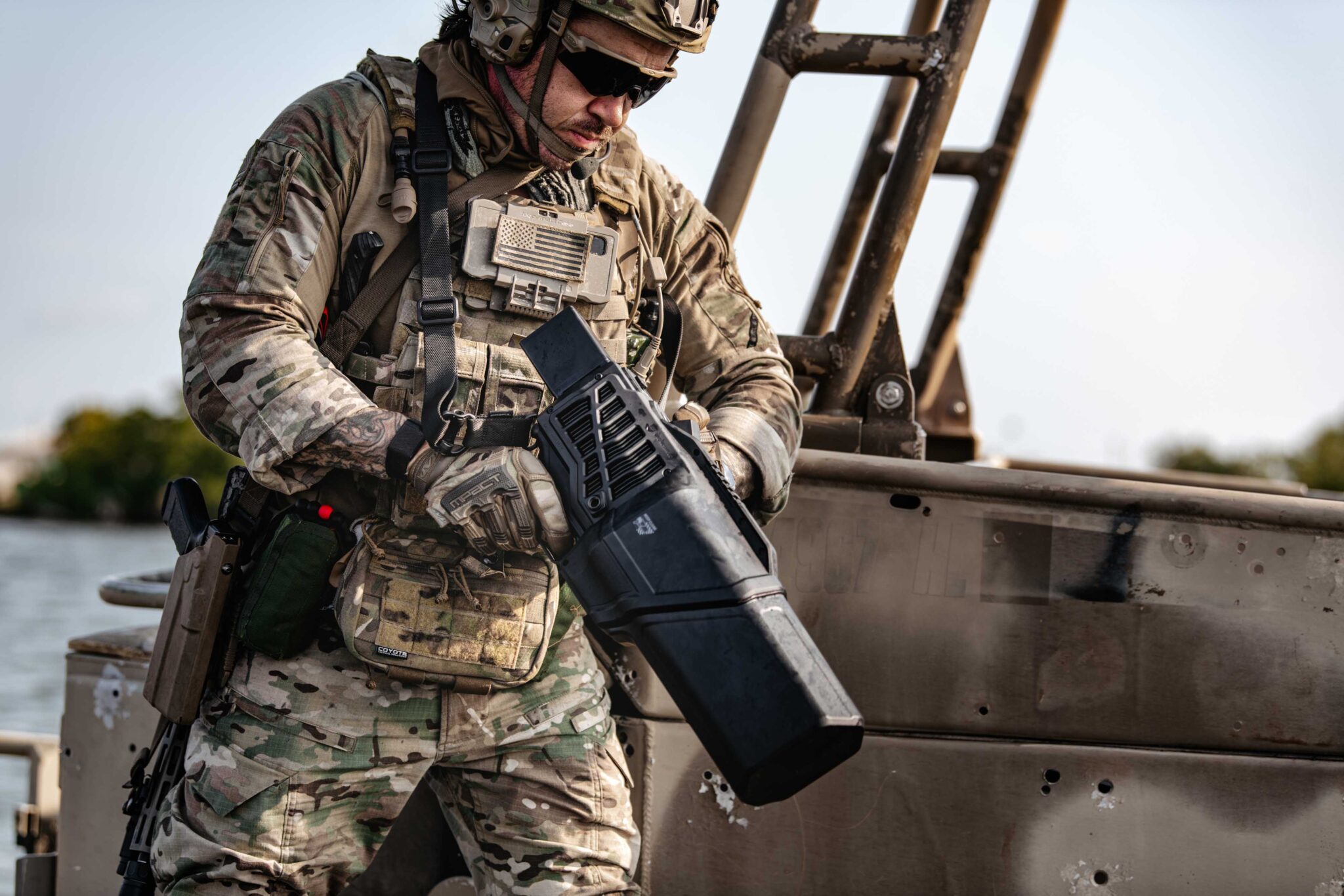
Complementing the RfPatrol is the DroneGun Mk4, a ruggedized handheld countermeasure that provides a directed mitigation capability for protecting against incoming drones.
The DroneGun Mk4 features a design reminiscent of a soldier’s primary weapon system. The common grip, trigger assembly, and safety selector allow established muscle memory from firearms training to transition seamlessly. Its intuitive interface allows users to quickly select the appropriate disruption mode to jam command and control, video, or GNSS links at significant ranges. The simple point-and-shoot design negates the necessity for specialized training or dedicated military occupational specialties (MOS) to operate. This design ensures that soldiers with varying levels of technical expertise can be quickly equipped and fully operational.
The DroneGun Mk4’s jamming typically forces a drone to a controlled landing on the spot or causes it to return to its operator/controller or starting point. Interrupting live video streaming (or FPV) to a remote controller halts the collection of footage and intelligence by the drone operator.
The DroneGun Mk4 presents a cost-effective countermeasure, increasing user independence and self-sufficiency at the edge and on the individual soldier level. With its electronic countermeasure capabilities and battery-powered aspects, DroneGun Mk4 is a highly favorable cost-per-shot defeat solution.
With both the RfPatrol and DroneGun Mk4, DroneShield provides RF detection and defeat capabilities—the most effective standalone C-UAS solution—accessible to forces at every level and echelon. The form factor, functionality, and unit cost present an opportunity to equip units across the board with the ability to detect and effectively neutralize drones or swarms of drones.
Tom Branstetter, Director of Business Development at DroneShield, remarked, “The counter-UxS landscape requires continual development. Our solutions are effective, intuitive, and, most importantly, built for the Warfighter.”
These easily adoptable technologies can help fulfill the DoD’s vision of turning every service member into a drone-fighter into reality.