As the United Arab Emirates grapples with a disproportionate number of attacks from Iran, the small Gulf nation, strategically positioned just south of its aggressor, appears to be sharing significantly less information about the success rates of its air defense systems in recent days.
A Striking Shift in Disclosure Policy
In the initial ten days of the conflict, the UAE distinguished itself by providing meticulous figures on the missiles and drones targeting its airspace, alongside detailed accounts of successful interceptions. For instance, the Ministry of Defense reported that as of March 8, a staggering 1,422 unmanned aerial vehicles (UAVs) had been detected, with 1,342 successfully neutralized. All eight threatening cruise missiles were also reportedly taken out.
However, over the past two days, the Emirati government seems to have altered its communication strategy. Public statements now merely indicate the number of missiles and drones it has „engaged” on any given day, without differentiating between detected and intercepted threats. Amidst this shift, the MoD did confirm that the attacks have, regrettably, resulted in six fatalities. A request for comment regarding this change in reporting policy has not yet received an immediate response.
Why the Secrecy? Expert Perspectives Emerge
This abrupt lack of granular detail has fueled speculation among defense analysts. Jean Loup Samaan, a senior research fellow at the Middle East Institute of the National University of Singapore, offers a potential explanation: „It’s hard to speculate why the UAE is releasing fewer details. But I imagine that as we are almost two weeks into this war, air defense capabilities of most Gulf states are struggling in terms of depletion.”
Brian Carter, research manager and fellow at the American Enterprise Institute (AEI), echoed this sentiment on X, suggesting that the UAE „likely stopped differentiating between ‘detected’ and ‘intercepted’ munitions because publicly advertising that information affects operational security. Each ‘intercepted’ munition means one less interceptor for Iran to worry about.” This implies a tactical decision to withhold sensitive information that could benefit Iran’s planning.
UAE’s High-Tech Shield: An Arsenal Under Fire
The UAE’s sophisticated air defense arsenal includes formidable American-made systems such as the Terminal High Altitude Area Defense (THAAD) and Patriot, in addition to the South Korean Cheongung-II medium-range KM-SAM.
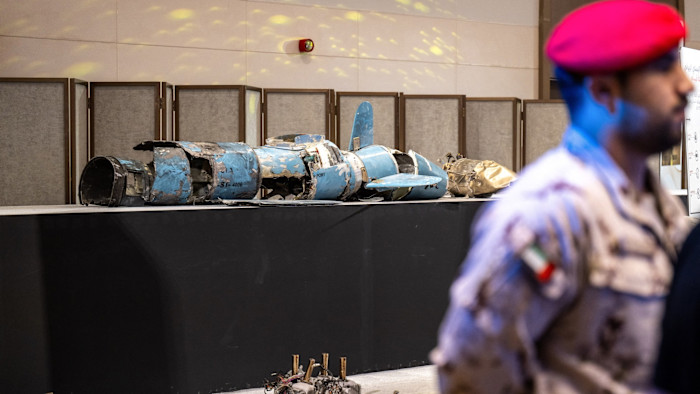
These cutting-edge systems have been put to the ultimate test during Iran’s relentless strikes on the UAE, which, at its closest point, lies approximately 60 miles from Iran’s southern coast. The sheer volume of attacks on the UAE is starkly disproportionate: it has been targeted by more than half of the drones Iran has launched against all other Arab states combined — 1,514 drones aimed at the UAE out of a total of 2,491 drones targeting Saudi Arabia, Kuwait, Qatar, Jordan, and Bahrain. Furthermore, the UAE has faced the largest concentration of missile threats, with 283 missiles in total, compared to the 831 missiles distributed among Kuwait, Bahrain, Qatar, and Jordan. An estimated 48 percent of all projectiles launched from Iran have specifically targeted the UAE.
Ground Zero: A Nexus of Geography and Geopolitics
The confluence of several factors explains why the UAE has become Iran’s primary target. Marwa Maziad, an assistant professor of international relations at the Gildenhorn Institute for Israel Studies at the University of Maryland, states that „The UAE is being hit more frequently because Iran sees it as the Gulf state most strategically aligned with Israel. Normalization and deep security coordination create the perception of involvement, even if the UAE is not launching attacks [on Iran] itself.”
Defense and security expert David Des Roches points to simpler geographic realities: „They are closest, and the fact that Iran’s missile inventory of short-range missiles were not touched during the 12-day war, they have an intact inventory there, so they have a lot of missile inventory that can’t reach Israel that they decided to launch at UAE.”
Mohammed Soliman, a senior fellow at the Middle East Institute, adds a compelling economic dimension, arguing that Dubai represents something profoundly threatening to Iran: „an open, globally connected economy thriving just across the Arabian Gulf. It’s not only about American bases. The UAE has built a model based on tourism, finance, technology, and logistics. Striking that model sends a message. Iran wants to damage Dubai’s reputation as a safe global hub, which, for Tehran, carries far greater strategic weight.”
The Drone Dilemma: Why Some Still Penetrate Defenses
Despite advanced air defense capabilities, reports and figures from Arab states indicate that drones have had a higher success rate in penetrating airspace than missiles. Analysts attribute this to their inherent stealth capabilities and the prioritization strategies employed by air defense systems.
Samaan explains, „The issue with UAV relates to detection: they fly at lower altitude and their trajectory can easily change so it makes it difficult for radars to detect them. Then intercepting it is also difficult, most defense systems operated in the Gulf are designed against missile and rocket threats, drones remain hard to intercept because of their maneuverability.”
Andreas Krieg, a senior lecturer at the School of Security Studies at King’s College London, also notes that some early victims of Iran’s attacks included air defense early warning radars, thereby facilitating the access of certain drones to their targets. However, he also suggests that there „seems to be a rationing of intercepting missiles at the moment,” with „Interceptor missiles are prioritized against ballistic missiles.” He concludes that „There is a preference for air-to-air missiles intercepting them” when it comes to drones, indicating a nuanced approach to managing critical and finite interceptor resources.