The wars in Ukraine and Iran provide important insights into modern warfare. They highlight, among other issues, the balance between offense and defense and the competition between interceptors and one-way attack drones.
However, these conflicts lack one feature that could become central in a potential war between the United States and China: sustained aerial combat between two modern air forces.
Protecting airborne early-warning and tanker aircraft
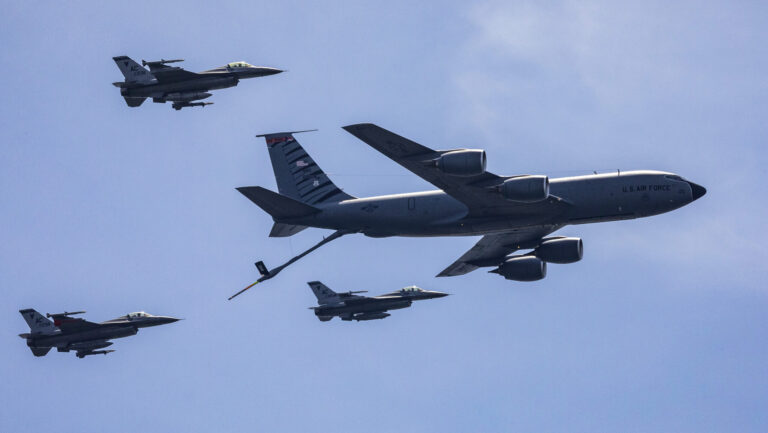
In a conflict in the Western Pacific, establishing temporary U.S. air superiority would require more than advanced fighters and weapons. Modern air operations depend heavily on airborne early-warning and control aircraft, known as AEW platforms, as well as aerial refueling tankers.
These high-value airborne assets, or HVAAs, provide:
- information on the enemy’s location and movements;
- air-battle management and coordination;
- data links for information sharing;
- fuel that extends fighter range and endurance.
The problem is that HVAA aircraft are large, detectable, and equipped with relatively limited self-defense systems. China has devoted considerable effort to developing capabilities designed to attack them, including very long-range air-to-air missiles such as the PL-17.
Destroying these aircraft could deny U.S. fighters the “first-look” and “first-shot” advantages, as well as the range needed for long-distance air operations.
The firepower-versus-protection dilemma
The U.S. Air Force has traditionally pursued air superiority by developing superior aircraft, missiles, and sensor systems.
Current efforts include:
- F-35 Lightning II fighters;
- first-increment Collaborative Combat Aircraft;
- the future sixth-generation F-47 fighter;
- increasingly long-range air-to-air missiles.
China’s growing air-force size and capabilities, however, make a strategy based solely on the qualitative superiority of U.S. fighters increasingly difficult.
Although the F-47 may outperform the current J-20, China is already developing new prototypes, including the J-36 and J-50/XDS. The United States plans to purchase approximately 187 F-47s, while China already operates at least 300 J-20s and could field an unknown number of next-generation aircraft.
The United States could therefore face a numerical disadvantage even if its individual aircraft were more capable.
The “protection tax”
To defend tankers and AEW aircraft, the United States might have to assign fighter aircraft to escort missions.
This creates what the article calls a “protection tax”:
- fighters assigned to escort missions are unavailable for offensive operations;
- fewer aircraft remain available to attack Chinese forces;
- pressure on the Chinese air force and its attrition rate decline;
- abandoning HVAA protection, however, could collapse the entire U.S. long-range kill chain.
Using rough estimates of U.S. and Chinese fighter inventories, assigning 400 U.S. fighters to protect 100 HVAA orbits could leave the United States with significantly fewer aircraft for offensive missions.
In such a scenario, China could gain a substantial numerical advantage in direct fighter combat.
A new role for Collaborative Combat Aircraft
The article proposes that the second increment of the Collaborative Combat Aircraft program should include a platform specifically designed to protect HVAA aircraft.
Unlike a traditional fighter, this platform would not necessarily need to be extremely fast, highly maneuverable, or equipped with the highest possible level of stealth.
Its priorities would be:
- long endurance;
- extended range;
- the ability to carry more missiles;
- resilient communications and datalinks;
- semi-autonomous engagement capabilities;
- lower costs than those of an advanced fighter;
- the ability to intercept missiles launched against protected aircraft.
A larger CCA optimized for long-duration missions and equipped with a substantial missile payload could be more effective than using conventional fighters as escorts.
Increasing firepower
The number of missiles carried by each platform is critical in modern air combat, particularly in beyond-visual-range engagements.
According to the article, first-increment CCAs may carry approximately two AIM-120 missiles. A variant designed to protect HVAA aircraft could instead carry four to six long-range air-to-air missiles.
A force of 150 such CCAs could provide:
- 600–900 additional missile rails;
- up to approximately 450 engagements, assuming two missiles are allocated to each target.
In a larger force structure, 400 specialized CCAs could replace approximately 400 fighters assigned to protection missions. Manned U.S. fighters could then be released for offensive operations, reducing the numerical disadvantage against China.
Active missile defense
A more advanced version of the CCA could include an active missile-defense system. The platform would attempt to destroy air-to-air missiles launched against itself or the aircraft it is protecting, particularly when avoiding the engagement is no longer possible.
The same technology could potentially be used against Chinese long-range air-defense systems such as the HQ-9.
A CCA capable of creating a localized “protection bubble” could also escort other vulnerable aircraft, including:
- electronic-attack aircraft;
- strike aircraft;
- airlift platforms;
- logistical support aircraft.
This could reduce the vulnerability of U.S. operations inside areas defended by integrated air-defense systems.
Conclusion
Air superiority depends on more than fighter performance. It depends on the survival of the entire operational chain: sensors, communications, refueling, command and control, and long-range weapons.
Specialized CCA aircraft designed to protect HVAA platforms could help resolve the offensive-versus-defensive dilemma. They would protect tankers and AEW aircraft, add substantial missile capacity, and allow manned fighters to focus on offensive missions.
The concept remains hypothetical, and its effectiveness would depend on jam-resistant communications, missile performance, autonomy, electronic warfare, and the ability to operate in a highly contested environment.
Nevertheless, the proposal changes how CCAs might be understood: not merely as cheaper substitutes for fighters, but as dedicated force-protection and missile-carrying platforms designed to preserve U.S. long-range air-combat networks in the Pacific.