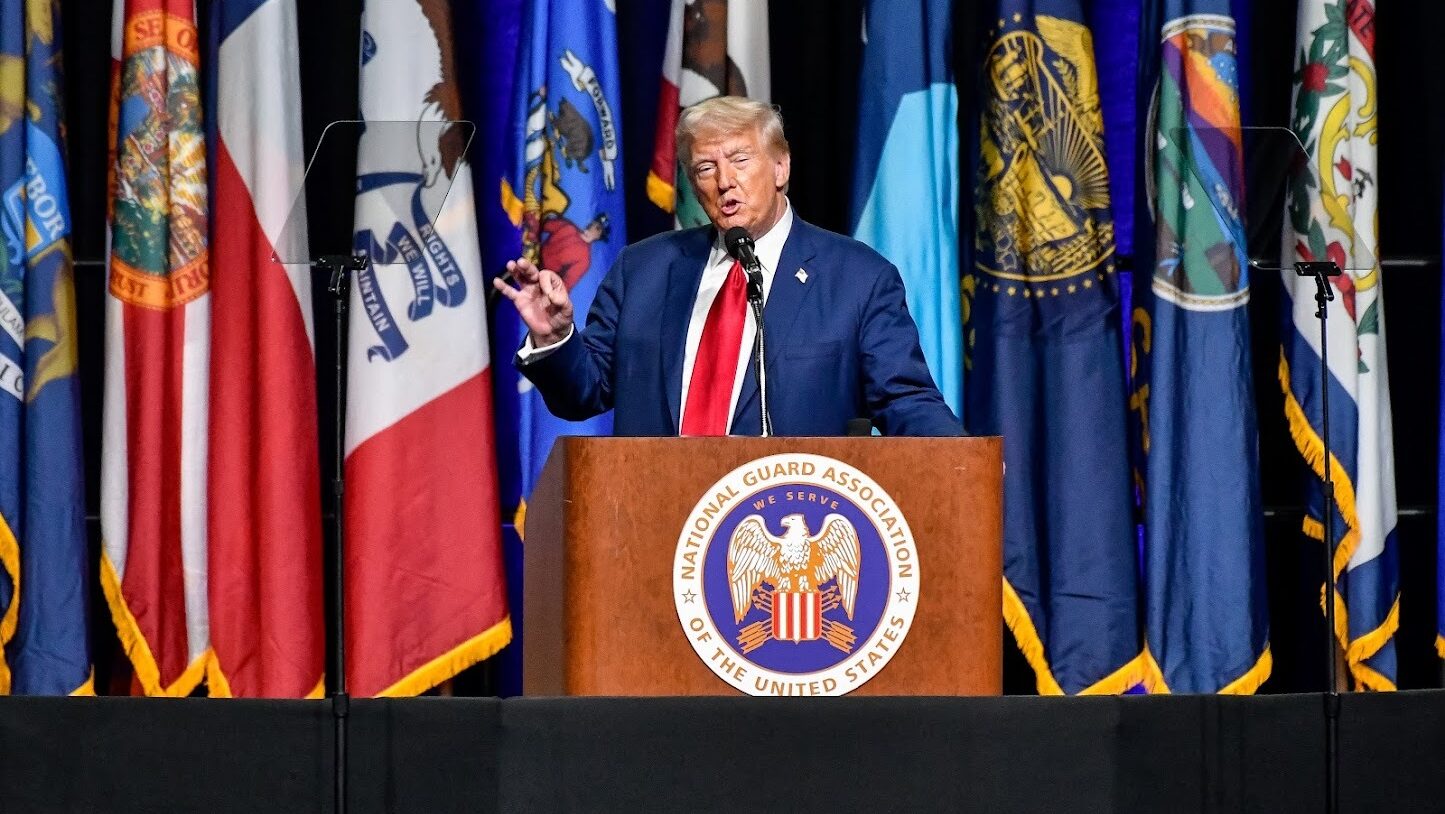
Republican presidential candidate Donald Trump today pledged to create a Space National Guard if he is elected for another term as president in November—a move that would reverse the Biden administration’s current plans, which involve transferring Air National Guard members with space backgrounds into the Space Force.
“Now that Space Force is up and running, I agree with your leadership—you want this very badly, but I agree—that the time has come to create a space National Guard as the primary combat reserve of the US Space Force,” Trump told the National Guard Association (NGAUS) during the organization’s annual conference in Detroit.
NGAUS has a long tradition of inviting presidential contenders to speak at the event; the organization also invited Trump’s Democratic rival Kamala Harris, who did not accept the invitation, according to the group’s website.
The organization, along with top National Guard officials, has strongly opposed the current Air Force proposal to effectively absorb the approximately 1,000 Air National Guard personnel with space-focused units—who come from seven states—into the active-duty Space Force. The goal is to create a flexible system that allows Guard members to transition between full- and part-time service. The plan has also faced criticism from all 50 state governors and those from five US territories.
Air Force Secretary Frank Kendall has countered the opposition, calling the service’s legislative proposal essential for making the Space Force effective and describing the Guard’s negative reaction as “over the top.”
Taking credit for the establishment of the Space Force in 2019, Trump called the newest military service “a big deal” and “one of my proudest achievements of my first term.” (Trump served as president from 2017 to 2021.) He vowed to sign “historic legislation” to create a Space National Guard, emphasizing that the initiative has the support of Sen. Marco Rubio, R-Fla.
Rubio was one of ten senators from both parties who introduced legislation earlier this year to create a Space National Guard, but Congress remains divided on the issue.
During his hour-long speech, Trump also criticized European allies for not “paying up” to adequately support NATO—a claim he has continuously reiterated over the years, along with the assertion that allies “owe” the US for its contributions to mutual defense. (NATO nations do not compensate the US for defense; instead, they fund their own militaries independently.)
Furthermore, he pledged to demand that NATO allies increase their national defense budgets to equal 3 percent of their annual Gross Domestic Product (GDP).
“I’ll insist that every NATO nation must spend at least 3 percent. You have to go up to 3 percent—2 percent is the steal of the century, especially as we’re paying for it. You know, we pay for them. It’s just not even believable. For most NATO countries, this will represent a defense budget increase of about 30 percent,” he told the NGAUS meeting.
At their July 2023 summit in Vilnius, Lithuania, NATO leaders agreed to a pledge to invest “at least” 2 percent of GDP annually for national defense. “We affirm that in many cases, expenditure beyond 2 percent of GDP will be needed in order to remedy existing shortfalls and meet the requirements across all domains arising from a more contested security order,” the summit communique added.