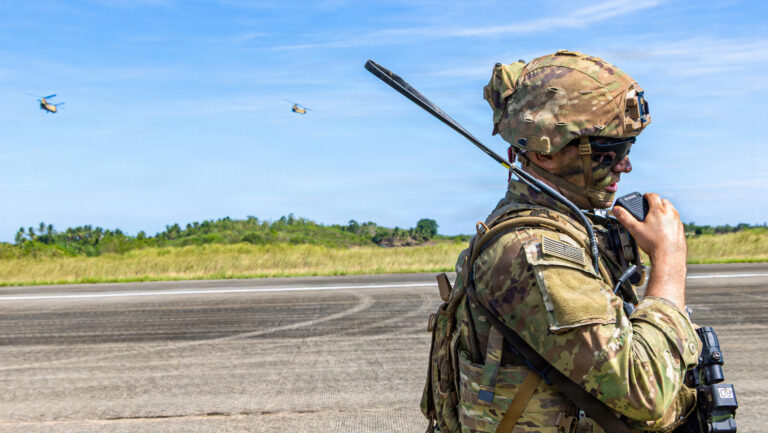
The U.S. Army is exploring new ways to preserve battlefield communications as electronic warfare increasingly threatens conventional command-and-control systems.
Instead of relying on sequential contingency plans, military officials are considering communications networks that are distributed, adaptive and difficult to detect — an approach compared to a form of “electromagnetic camouflage.”
Lt. Gen. Matthew McFarlane, commander of I Corps, said traditional PACE plans — primary, alternate, contingency and emergency communications methods — are no longer sufficient against simultaneous jamming across multiple frequency bands.
The Traditional PACE Model Is Struggling Against Modern Jamming
During a conventional military exercise, a PACE plan might designate secure FM radio as the primary communications method, satellite calls as the alternate, high-frequency radio as the contingency option and an infrared strobe or human courier for emergencies.
The system assumes that soldiers will move from one communications method to the next after a failure occurs. However, adversaries equipped with advanced electronic warfare systems can detect and disrupt several communications channels at the same time.
Under those conditions, a linear plan built around manual, step-by-step actions could become ineffective before operators are able to activate the next option.
Every Transmission Can Become a Target
On the modern battlefield, transmitting a signal can reveal a unit’s position. Enemy systems may intercept radio emissions, locate their source and turn the area into a target.
The Army’s emerging approach is therefore designed to reduce reliance on transmitters and fixed nodes while eliminating single points of failure.
Data would be divided, encrypted and distributed across several communications paths at the same time, ensuring that the loss of one network does not bring down the entire command system.
Polymorphic Networks Could Transform Battlefield Communications
The proposed model centers on a “polymorphic” command-and-control mesh — a highly diversified, decentralized network capable of changing its configuration dynamically.
Unlike traditional nodes that follow a fixed PACE sequence, a polymorphic mesh could:
- automatically fragment data;
- encrypt information;
- transmit it simultaneously across multiple physical mediums;
- alter communications routes in response to threats;
- avoid dependence on a single node or channel.
By distributing traffic in this way, the network becomes more difficult to intercept or jam because an adversary no longer has one obvious point at which to focus its attack.
Satellites, Commercial Infrastructure and Tactical Mesh Networks
The new approach combines multiple technologies and infrastructures. Options include decentralized tactical radios, the use of commercial infrastructure to conceal military network traffic and access to Low-Earth Orbit satellite constellations.
The Army is also examining low-power mobile ad-hoc networks and mesh systems, in which devices communicate directly with one another and automatically reroute data when individual links are disrupted.
Such an architecture reduces dependence on fixed infrastructure and could preserve connections between command posts even in heavily jammed environments or areas where conventional networks have been destroyed.
Command and Control Must Survive Without Fixed Infrastructure
The ultimate objective is to keep command teams and headquarters connected without relying on easily identifiable and vulnerable towers, relay stations or fixed network nodes.
By combining multiple communications methods, the network could continue operating even after some of its components have been disabled.
For the U.S. Army, the shift represents a move away from a system based on “the next available option” toward an architecture that uses multiple paths at once, adapts automatically and seeks to remain difficult to detect in a contested electromagnetic environment.