The U.S. Army is developing the artificial intelligence component of its Next Generation Command and Control architecture, known as NGC2, in partnership with software and technology company Striveworks, Army officials said.
The announcement comes as the service prepares to expand NGC2 to the corps level next year, with a particular focus on operations in the Indo-Pacific region.
Larger Data Volumes Will Put New Pressure on Command Structures
Moving from division-level testing to corps-level operations will require the processing of substantially greater volumes of information generated by software systems, sensors and operational feeds.
Joseph Welch, the Army’s portfolio acquisition executive for command and control and counter-command and control, said the increased scale of operations would make artificial intelligence tools more important.
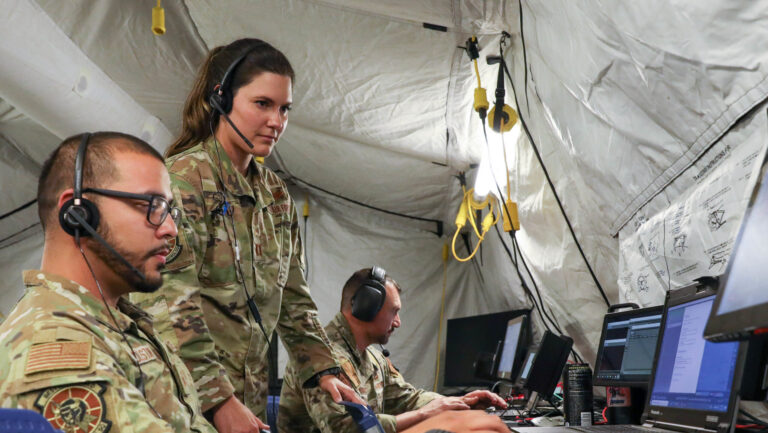
The systems are expected to help process information more efficiently and support commanders who must make decisions in an environment dominated by fast-moving, real-time data.
Striveworks to Develop NGC2’s AI Foundation
In June, the Army announced that Anduril would establish the baseline data layer for NGC2. That layer is viewed as the foundation of the architecture because it provides a common framework for integrating software applications and services.
Striveworks will build the artificial intelligence layer on top of that infrastructure. The Austin, Texas-based company specializes in AI operations and the management of models used to analyze large and complex data sets.
The goal is to convert the massive amount of battlefield information collected by NGC2 into actionable intelligence. According to Striveworks CEO Jim Rebesco, tasks that currently require hours of staff work could eventually be completed in seconds.
From Drones and Sensors to Operational Decisions
NGC2 is designed to bring together data from drones, sensors and other battlefield sources. However, the volume of information generated by these systems is too great for military personnel to process manually at the speed required by modern operations.
The data layer is intended to prevent information from remaining isolated in separate systems. The AI component will then match the most suitable model with the relevant data and the specific requirements of a mission.
The architecture will also retain human oversight and governance mechanisms. This is intended to ensure that algorithmic results can be evaluated, monitored and used with an appropriate level of operational confidence.
Division-Level Prototypes Will Be Expanded Across the Region
NGC2 prototypes have already been tested by the 4th and 25th Infantry Divisions. The next phase will involve adapting the architecture for corps-level operations, where data volumes and mission complexity will be significantly greater.
During fiscal year 2027, the Army plans to field and scale the system within I Corps, headquartered at Joint Base Lewis-McChord in Washington state. The corps oversees Army units operating across the Asia-Pacific region.
A Common Repository for AI Models and Algorithms
Striveworks will provide several core functions for the artificial intelligence layer, including a model registry, validation tools, deployment capabilities and monitoring systems.
The infrastructure will support the management of AI models throughout their operational life cycle — from development and testing to deployment and performance monitoring.
It will also create a shared repository for algorithms developed by soldiers and other organizations to address specific operational needs. Instead of remaining available only to the unit that created them, those models could be accessed and adapted by other users across the NGC2 ecosystem.
Shortening the Path from Development to Deployment
By establishing common standards, the new AI layer should make it easier to integrate technologies developed by industry or military organizations.
The system is intended to reduce the time between the creation of a new capability and its practical use in the field. Rather than taking months or years to adopt an algorithm, units could gain access to new tools much faster, provided those tools are validated and compatible with the shared architecture.
NGC2 is therefore being developed as a digital framework designed to unify battlefield communications, eliminate barriers between information systems and accelerate decision-making at the tactical and operational levels.