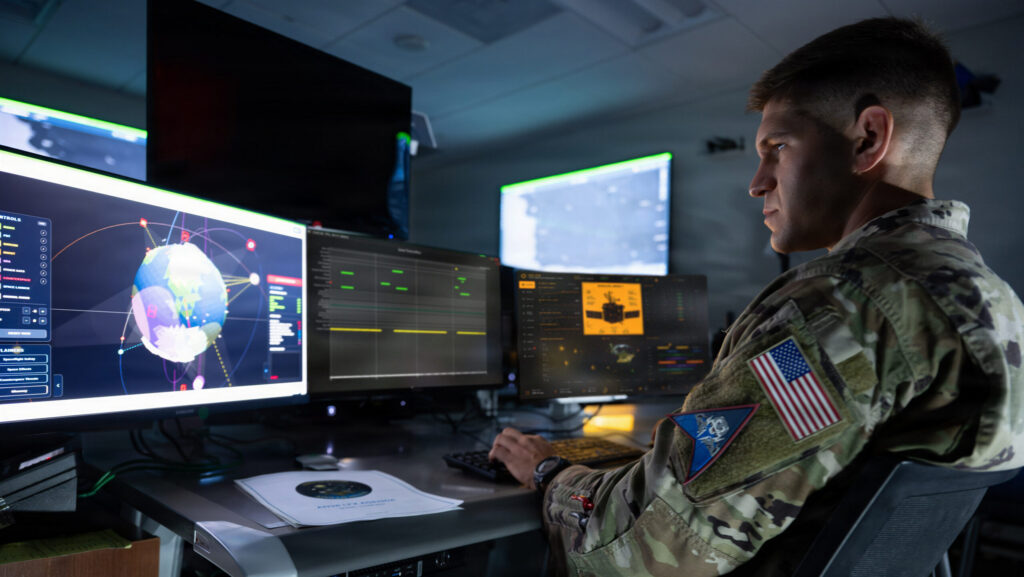
The United States Space Force is increasing its efforts to acquire commercial technology, products and data, but service officials acknowledge that integrating those capabilities into daily operations remains a major challenge.
The difficulties are concentrated in three areas: defining requirements, managing classification issues and integrating commercial systems into operational missions.
Three barriers slowing modernization
Col. Tim Trimailo, head of the Commercial Space Office at Space Systems Command, said the service repeatedly encounters three obstacles when attempting to introduce privately developed solutions.
The Commercial Space Office, known as COMSO, is responsible for identifying commercial capabilities that could benefit the Space Force and helping accelerate their deployment.
The first challenge involves requirements. It is not always clear what a commercial system must deliver to meet military needs. The second concerns the classification of information and data. The third is the practical integration of newly acquired capabilities into operational procedures and concepts.
Officials hesitate because of costs and restrictions
A report released by the Government Accountability Office found significant hesitation within the Space Force regarding the purchase and use of commercial space data.
Officials in several major organizations, including the service’s Combat Forces Command, which provides trained operators to U.S. Space Command, said they were reluctant to rely on private-sector providers.
Their concerns include:
- licensing costs;
- restrictions on data use;
- uncertainty about long-term access;
- the possibility that services could become unavailable or unaffordable.
Those reservations persist despite the work of the Joint Commercial Operations Cell, the main organization responsible for purchasing commercial data and services for the Space Force.
Commercial space data purchases reach tens of millions of dollars
The Joint Commercial Operations Cell purchases products and services not only for the Space Force but also for U.S. combatant commands and several other government agencies.
The acquisitions are made through the contractor-operated Global Data Marketplace. The portfolio currently focuses on data and services supporting space domain awareness as well as tactical surveillance, reconnaissance and tracking missions.
According to the audit report, the office spent $76.8 million through the marketplace between January 2023 and September 2025.
The organization also coordinates an interagency group focused on sharing commercial space data. Participants include representatives of several agencies, including the National Reconnaissance Office and the National Geospatial-Intelligence Agency.
Lack of communication prevents the use of available technology
The report’s central conclusion is straightforward: the problem is not necessarily a lack of technology, but insufficient communication between the organizations that acquire commercial capabilities and the units expected to use them.
The working group meets monthly and coordinates purchases of commercial space data. However, auditors found that many of the problems reported by Space Force officials could have been resolved through participation in those discussions.
The officials facing integration challenges were not members of the working group, and information about its existence and activities was not widely available across the service.
Several Space Force representatives described the situation as part of a long-standing divide between acquisition organizations and operational units.
“They simply do not communicate with each other,” one official said on condition of anonymity.
Budgetary pressure makes coordination problems worse
The coordination gap has widened as the Space Force moves to obligate its fiscal 2026 investment budget of $18.8 billion.
That amount is supplemented by another $5.9 billion provided through the fiscal 2025 budget reconciliation package. At the same time, the service is preparing for the possibility of receiving additional funding in the fiscal 2027 budget.
In its rush to spend available funds, the Space Force has at times purchased new equipment and commercial capabilities without adequately planning for the next stages.
Some acquisitions have not fully accounted for the funding required for training, maintenance and sustainment resources, or the operational concepts needed to determine how the new technology should be used.
Mission Deltas seek to connect acquisition and operations
Trimailo acknowledged that the divide between acquisition professionals and operators remains, but said efforts are underway to reduce it.
One such initiative is the creation of Mission Deltas, launched in 2024. The structures are intended to integrate professionals responsible for maintenance and sustainment into the Space Force’s operational units.
Mission Deltas serve as the Space Force equivalent of Air Force wings and are designed to create a more direct link between those who develop and acquire systems and the personnel who operate them.
Apollo Insight exercises test cooperation with industry
Another initiative involves Apollo Insight tabletop exercises organized by U.S. Space Command.
The simulations are intended to improve communication between operational organizations and acquisition offices. They also allow commercial companies to demonstrate their technologies directly and show how their capabilities could be used during real-world missions.
The first exercise in the planned series was held in March.
The team developing the Commercial Augmentation Space Reserve plan is participating in the exercises. The initiative is intended to create a form of civilian reserve for space operations by mobilizing commercial capabilities when needed.
Trimailo said joint exercises bringing together military operators, acquisition professionals and industry representatives should become a permanent model for cooperation.
Future of commercial office remains uncertain
The future position of COMSO within the Space Force’s reorganized acquisition structure has not yet been determined.
The service is restructuring its acquisition organizations into Portfolio Acquisition Executive offices, while the Commercial Space Office’s responsibilities cut across several mission areas.
Trimailo said the office will most likely be placed under the organization responsible for infrastructure. The final decision will help determine whether the Space Force can close the gap between commercially available technology and its effective use in operational environments.