Japan is preparing another record defense budget as it seeks to strengthen its deterrence capabilities amid a steadily deteriorating security environment in the Indo-Pacific.
The Japanese Ministry of Defense has requested 8.89 trillion yen, equivalent to approximately $55.6 billion, for the fiscal year beginning in April. If approved, the proposal would mark another year of defense spending growth and confirm Tokyo’s accelerated military modernization plans.
Key priorities include long-range missiles, unmanned aircraft, artificial intelligence and systems capable of striking targets from outside the immediate launch area.
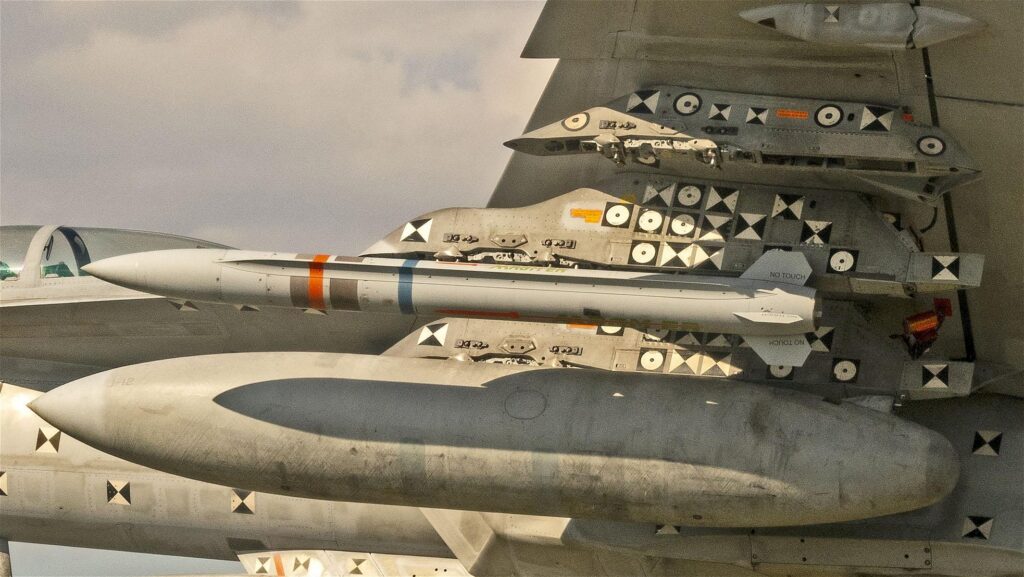
AARGM-ER would mark a major shift in Japan’s defense posture
For the first time, Japan has officially indicated that it intends to acquire a weapon specifically designed to destroy enemy radar systems.
The missile is Northrop Grumman’s AGM-88G Advanced Anti-Radiation Guided Missile-Extended Range. The AARGM-ER is designed to locate and attack radar systems supporting an opponent’s air defenses, including systems that relocate or shut down their emissions.
Acquiring the missile would give Japanese aircraft an important suppression-of-enemy-air-defenses capability and represent a significant development beyond Tokyo’s traditional emphasis on defending national territory.
Tokyo increases its investment in stand-off weapons
The budget proposal also includes low-cost cruise missiles whose specific models have not yet been identified. Japan plans to combine foreign-acquired systems with the later development of a domestic equivalent.
The plans also include a submarine-launched guided missile, supported by 16.3 billion yen in funding. In parallel, the Ministry of Defense wants to develop a stand-off missile launch module for unmanned underwater vehicles.
These programs reflect Japan’s growing focus on stand-off weapons, which allow targets to be engaged at long distances while reducing the exposure of launch platforms and crews.
ASM-3 could become a long-range air-to-air weapon
Japan plans to adapt its supersonic ASM-3 anti-ship missile into a long-range air-to-air weapon.
Such a system could be used against high-value aircraft, including airborne early warning and control platforms and tanker aircraft. These assets support long-range air operations, and destroying them could significantly weaken an adversary’s ability to coordinate and sustain missions.
Through the program, Japan is seeking to join the United States, China and Russia in developing weapons capable of attacking aircraft operating well behind the front line.
MQ-9B drones will strengthen maritime surveillance
Unmanned systems occupy a central position in the latest budget request. The Ministry of Defense is seeking 292.2 billion yen to acquire 17 additional General Atomics MQ-9B SeaGuardian drones.
The aircraft are medium-altitude, long-endurance systems intended primarily for maritime surveillance and reconnaissance missions. They would be operated by Japan’s Maritime Self-Defense Force.
The acquisition would expand Japan’s existing unmanned capabilities, including the three aircraft already operated by the Japan Coast Guard. A larger drone fleet would improve monitoring of territorial waters, maritime routes and military activity near the Japanese archipelago.
Tokyo is also seeking drones designed to intercept other drones
The proposal includes another 7.6 billion yen for interceptor drones. Although the document does not explicitly identify the system, the funding could be linked to TerraDrone’s Terra B1 interceptor.
Japan’s Acquisition, Technology and Logistics Agency selected the Terra B1 under a rapid-acquisition contract. The system is designed to track and neutralize hostile drones, providing a more flexible and potentially less expensive alternative to conventional missiles and other interceptors.
The need for such systems has grown as commercial and military drones become increasingly widespread and can be deployed in large numbers to overwhelm the defenses of a facility or naval vessel.
Artificial intelligence will support military decision-making
Japan wants to incorporate artificial intelligence into a future command-and-control system. The platform would rapidly combine and analyze data from multiple sources, giving commanders an advantage in the decision-making process.
The system is expected to support both target identification and situational awareness. By automating information processing, Japanese officials aim to shorten the time between detecting a threat and responding to it.
At a later stage, the platform will be moved to a classified, Japan-developed cloud-based system. The infrastructure is intended to resist attempts by adversaries to disrupt, block or compromise access to operational data.
Japan has not yet released all program figures
Unlike previous years, the budget request does not provide exact quantities or individual procurement costs for many of the listed programs.
The missing details are linked to the fact that Japan has not yet published three key national security documents: the National Security Strategy, the National Defense Strategy and the Defense Buildup Program.
Those documents are expected later this year and will establish procurement priorities and determine the scale of Japan’s military programs. As a result, the current proposal identifies targeted platforms without always specifying quantities or contract values.
The platforms mentioned include F-35 fighter aircraft, Boeing KC-46 tankers, Kawasaki C-2 transports, P-1 anti-submarine aircraft and upgraded Mogami-class frigates.
The budget now enters the approval process
The Ministry of Defense’s request will now be reviewed by Japan’s Ministry of Finance. Approval is expected later this year.
If adopted, the budget would accelerate the transformation of Japan’s armed forces into a force more heavily oriented toward long-range strike, persistent surveillance, autonomous operations and real-time data integration.