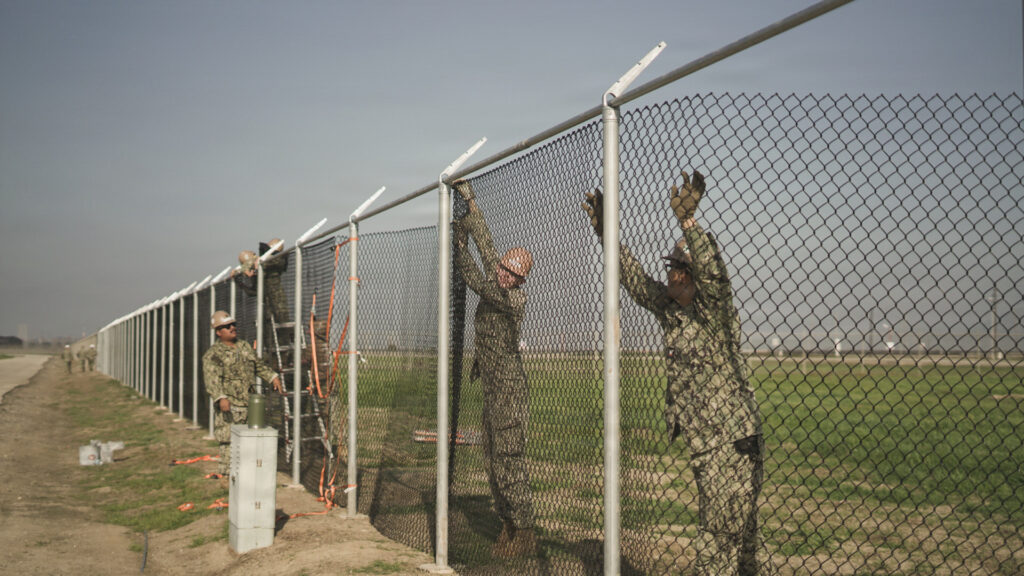
Protecting strategic facilities, both inside and outside the United States, is becoming increasingly difficult. The spread of inexpensive, readily available drones, the rise of artificial-intelligence-driven cyberattacks and the vulnerability of interconnected infrastructure have surpassed the traditional security model built around “gates, guards and guns.”
In the current threat environment, protecting a facility no longer means simply monitoring a perimeter fence. Organizations need systems that can detect threats at a distance, identify them accurately and coordinate a rapid response without overwhelming personnel with unmanageable amounts of data.
A radar blip could represent a flock of birds, a hobbyist flying a drone or an aircraft being used as part of a hostile operation. Distinguishing between those possibilities must be done quickly and with a high degree of confidence.
Modern threats come from every direction
Risks are no longer limited to a direct attack on a base or facility. An installation can also be affected through attacks on infrastructure located outside its perimeter, including data centers, power networks, communications facilities, water installations and other parts of the supply chain.
Today’s security environment is multidomain. Threats can emerge from the air, land, sea, space or cyberspace. Hostile actors may also be unidentified before an attack and may not operate from a clearly defined or predictable location.
This shift is forcing organizations to abandon the concept of static defense and adopt architectures capable of continuously adapting to changing circumstances.
Fifty-dollar drones can trigger million-dollar responses
Recent conflicts have highlighted a major economic problem. Commercial drones costing only a few dozen dollars may be countered with interceptors or munitions priced from $15,000 to as much as $4 million per round.
That imbalance complicates defense against swarming attacks. An adversary can launch large numbers of unmanned aircraft simultaneously in an effort to exhaust defensive resources and overwhelm protection systems.
The problem is not confined to active war zones. Military bases inside the United States can also be exposed. Repeated drone overflights at Barksdale Air Force Base demonstrated that facilities far from the front lines can face difficult-to-predict airborne threats.
Defense must extend beyond the perimeter fence
Building a taller fence will not solve the problem. When dealing with drones, threats must be detected well before they reach the edge of a protected site.
Because of their small size, maneuverability and widespread availability, commercial drones can be difficult to detect using conventional systems. They can fly at low altitudes, change direction quickly and operate without following established corridors or routes.
Critical infrastructure therefore requires drone detection and tracking systems, along with countermeasures suited to the specific threat. The goal is not merely to intercept an aircraft, but also to determine its intent as quickly as possible.
Accurate identification prevents costly and unnecessary reactions
Not every drone observed near a facility represents an attack. In populated areas, drones may be operated by hobbyists or by individuals conducting entirely lawful activities.
A drone that deviates from its course or comes too close to a secured perimeter can nevertheless trigger a security alert. Immediately activating counter-UAS systems may be not only expensive, but also dangerous or difficult to justify publicly.
Once a drone is identified as hostile, however, the economic calculation changes. The cost of interception becomes secondary to the value of the protected facility, the lives at risk and the potential consequences of an attack.
LEXSO connects sensors through a unified operating picture
LEXSO, short for “Layered Extended Security Operations,” is designed to integrate several categories of sensors, including radar and LIDAR systems. Its architecture is sensor-agnostic, allowing equipment from different manufacturers to be connected within a single operational network.
The system combines data into a unified picture and delivers it to operators in real time. Personnel can then assess incidents more quickly and determine whether intervention is required.
The platform is intended to reduce false alarms by correlating information from multiple sources. A radar detection can be verified through video imagery, acoustic data or other observation methods.
As a result, the operator receives more than an isolated alert. The system provides an assessment based on several layers of information, helping confirm genuine threats while preventing unjustified responses.
Attacks on supporting infrastructure can cripple an entire facility
Securing one facility is no longer enough. Modern installations depend on external power networks, communications systems and data-processing infrastructure. Those supporting elements can become attractive targets for an adversary.
During the recent conflict in the Middle East, two Amazon Web Services data centers in the United Arab Emirates were targeted, illustrating the vulnerability of digital infrastructure located outside a military facility.
An attack on a data center, power station or water-supply facility could indirectly undermine a base’s or institution’s ability to operate. Risk assessments must therefore include the entire network of suppliers and supporting infrastructure.
Security must be coordinated across every department
Protecting a facility cannot remain the sole responsibility of security guards. Depending on the site, crisis management may require security personnel, firefighters, search-and-rescue teams, information-technology specialists and infrastructure managers to work together.
At a facility located near a body of water, for example, search-and-rescue operations may become as important as perimeter protection. At the same time, a cyber breach could disrupt surveillance systems, communications or the ability to coordinate an emergency response.
All stakeholders must operate from the same common operating picture. If every department relies on separate data and its own assessment of the situation, the response may become slow, contradictory or ineffective.
Artificial intelligence turns data overload into a decision-making tool
Adding more sensors does not automatically produce better security. If operators are flooded with alerts and data streams, their ability to make rapid decisions may actually decline.
Artificial intelligence can filter that information and present it in a form that is easier to interpret. AI-enabled systems can compare data from multiple sensors, analyze the history of previous incidents and calculate confidence levels for individual assessments.
For example, a radar detection can be confirmed by a video camera and an acoustic sensor. Correlating those inputs makes it easier to determine whether the object is a person, an unmanned aircraft or a potential threat.
The final decision should remain with a human operator, but that operator can benefit from an assessment that has already been structured and cross-checked through several sources.
The traditional security model must be rethought
Protecting critical infrastructure now requires far more than guards at gates and patrols around a fence. It demands integrated sensors, real-time data processing, counter-drone capabilities and coordination among every organization involved in security and emergency response.
Organizations must also invest in training, maintenance and planning. Acquiring advanced technology without a clear concept of operations or sufficient resources to sustain it can create new vulnerabilities instead of reducing existing ones.
Security must be treated as a dynamic, holistic process rather than a static operation. Threats evolve, and infrastructure must evolve with them.
LEXSO is designed to address this requirement through a flexible architecture that can work with different devices and sensors and adapt to the needs of individual customers. By combining sensor data, artificial intelligence and human decision-making, the system aims to provide a faster and more effective way to strengthen facility security.