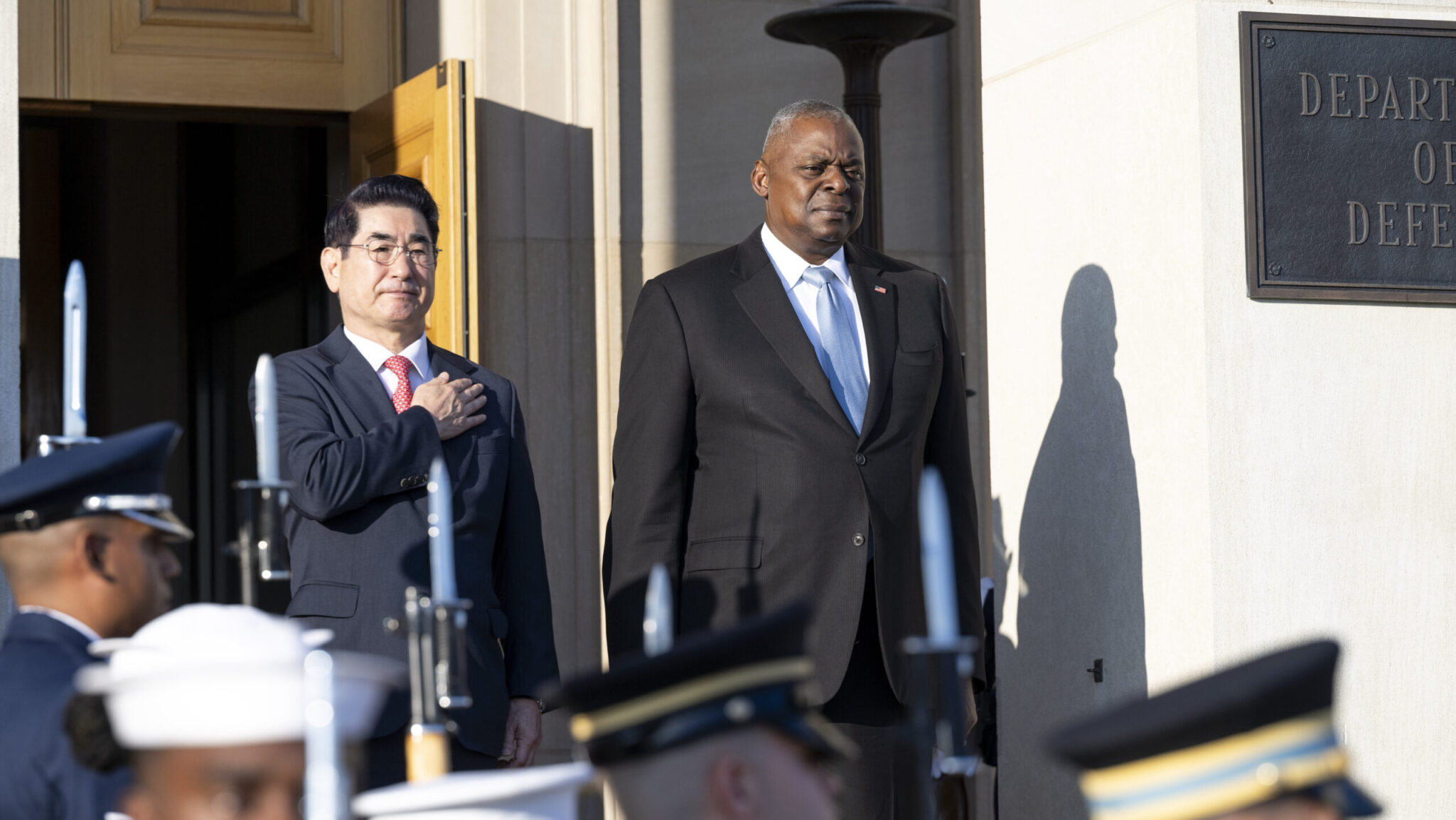
During a meeting today, the defense ministers of the United States and South Korea announced the establishment of a new joint defense science and technology executive committee. This committee will specifically explore the potential for South Korea’s contributions to AUKUS Pillar II.
South Korean Defense Minister Kim Yong Hyun revealed that the vice-minister level committee is set to be established within this year, aiming to advance the integration of cutting-edge science and technology in the defense sector. This initiative also includes cooperation on AUKUS Pillar II, which focuses on collaborative technological advancements. Kim made his comments during a press briefing at the Pentagon, coinciding with the US-Republic of Korea security consultative meeting attended by US Defense Secretary Lloyd Austin. The two ministers are scheduled to participate in a 2+2 meeting tomorrow alongside Secretary of State Antony Blinken and ROK Minister of Foreign Affairs Cho Tae-yul.
As North Korea’s reported deployment of more than 10,000 troops to Russia raises concerns, the Pentagon has reiterated that the expansion of science and technology (S&T) cooperation remains a priority. This will particularly emphasize autonomous systems, artificial intelligence, and quantum technologies, aligning with the six key technology areas identified under AUKUS Pillar II, which include undersea capabilities, quantum tech, AI and autonomy, cyber, hypersonics, and electronic warfare.
A key aspect of AUKUS has been whether additional countries would be welcomed into the framework. Notably, Pillar I—focused on nuclear submarine technology and military collaboration among the US, UK, and Australia—is considered closed to new entrants. In contrast, Pillar II offers avenues for other nations to engage in collaborative technological projects developed by the AUKUS trio.
This distinction has created some confusion regarding the nature of foreign participation in Pillar II. Pentagon officials now emphasize that the focus is less on other countries formally „joining” Pillar II, but rather on allowing external partners to collaborate on specific technological initiatives.
Speaking to Breaking Defense in August, Australian Defense Minister Richard Marles mentioned that while he anticipates Pillar II’s growth, it is crucial to solidify collaboration among the core members. “We need to get this better down amongst the three of us first so that we really know what the architecture of our collaboration looks like, and what the specific projects are,” he stated.
Japan has already been formally linked to Pillar II, as announced in April, as the AUKUS nations consider cooperation on advanced capability projects with the country. However, following this announcement, Australian Prime Minister Scott Morrison clarified that there are no plans to expand AUKUS membership.
Discussions regarding potential involvement in Pillar II have taken place with officials from New Zealand, with the country’s defense minister confirming preliminary talks earlier this year. There have also been calls for Canada’s participation, given that both New Zealand and Canada are non-AUKUS members of the 5 Eyes intelligence-sharing network and maintain close ties to AUKUS partners.