M1 Support Services Takes the Lead: A New Era for Army Flight Training
The US Army has selected M1 Support Services, a Texas-based aviation training specialist, to lead its Flight School Next initiative, the flagship program for training the next generation of helicopter pilots. The deal comes in the form of an indefinite-delivery/indefinite-quantity (IDIQ) contract worth up to $10 billion over roughly three decades.
Maj. Gen. Clair Gill, commanding general of the Army Aviation Center of Excellence, stressed that the revamped Initial Entry Rotary Wing Training model is designed to produce new military helicopter pilots with far stronger foundational skills than the current system.
What the Army Is Buying: Turnkey Training Under Military Oversight
According to the Army announcement, M1 will be responsible for delivering a full-spectrum training solution:
- Training aircraft
- Fleet maintenance
- Flight simulators
- Flight and academic instruction
- Associated support services
All of this will be provided while the Army retains oversight of training standards, safety requirements and operational outcomes.
The contract includes a performance period of up to 26 years, with the first task order covering three to four years, primarily focused on transitioning to the new training construct.
The “Simple” Trainer the Army Wanted: R‑66 Steps Into the Spotlight
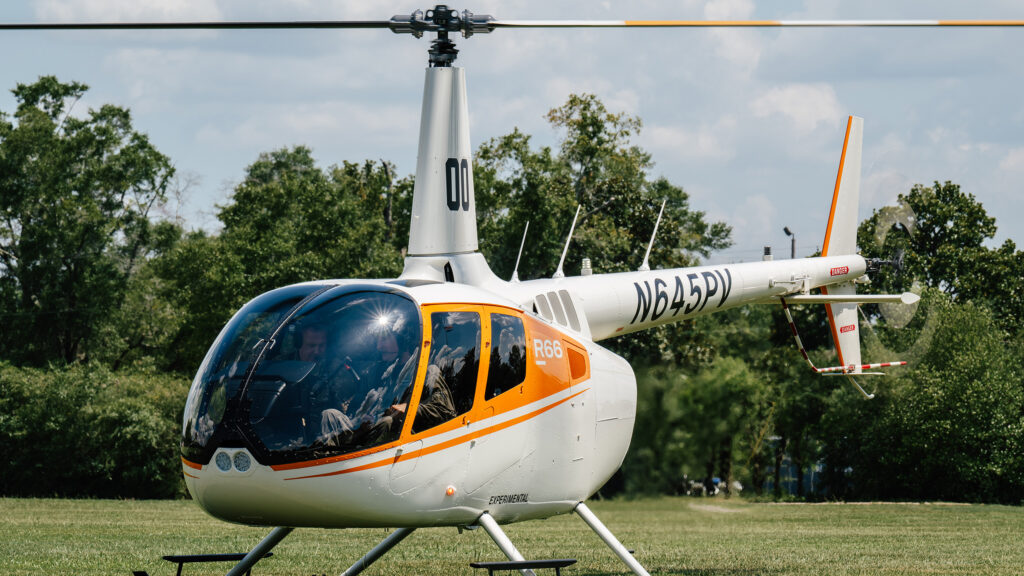
While the Army’s public announcement did not identify the chosen aircraft, an M1 spokesperson said the company plans to use the R‑66 helicopter built by Robinson Helicopter, which participated as a subcontractor in the competition. Robinson declined to comment publicly, and Fort Rucker – the Army’s primary helicopter training hub – did not immediately respond to requests for clarification.
In earlier solicitations, the Army outlined numerous requirements for the training aircraft, but three stood out as most critical:
- A single turbine engine
- A counterclockwise-rotating main rotor
- Instrument Flight Rules (IFR) certification
The UH‑72 Lakota, currently used for training and supplied by Airbus, has a counterclockwise rotor and is IFR-certified, but it is twin-engine, which runs counter to the push for simplification.
By contrast, the R‑66 features a single turbine engine and a counterclockwise-rotating rotor system, but was not IFR-certified as of last fall, and its current certification status remains unclear.
From Lakota to R‑66: Back to Stick-and-Rudder Basics
Today, Airbus provides both the curriculum and the UH‑72 Lakota airframe for pilot training at Fort Rucker. The Lakota is seen as a modern, reliable platform, with advanced avionics and a high degree of automation.
Army officials and instructors, however, have warned that such sophisticated automation can become a crutch for novice pilots. Their argument: before relying on advanced systems, student aviators should first master fundamental stick-and-rudder skills on a simpler helicopter.
Amid growing concern on Capitol Hill and within the Army over helicopter mishaps, service leaders decided to reset the training model and return to basic flying skills, emphasizing a more forgiving, less complex platform for entry-level training.
A Broader Team Behind the Transformation
M1 will not be executing the Flight School Next transformation alone. For the competition, the company announced partnerships with:
- General Dynamics Information Technology
- Quantum Helicopters
- University of North Dakota Aerospace Foundation
- Robinson Helicopter
Together, they bring expertise in training, operations, maintenance and curriculum development, underscoring that Flight School Next is not just an aircraft swap but a comprehensive redesign of how the Army produces helicopter pilots.
COCO Model in Action: When the Contractor Owns and Operates the Fleet
One of the most significant structural changes introduced by Flight School Next concerns the acquisition and operating model. The program is structured as contractor-owned, contractor-operated (COCO), under which:
- The aircraft are owned by the contractor, not the government
- The training infrastructure and operations are managed by M1
- The Army focuses on defining standards, overseeing safety, and assessing outcomes
This arrangement aims to provide greater flexibility for modernization, fleet refresh and curriculum adaptation, while shifting a substantial portion of the investment and logistical burden to the contractor.
The End State: Better Pilots, Faster, On Simpler Machines
With Flight School Next, the Army is trying to tackle several challenges at once:
- Reducing helicopter accidents and improving overall safety
- Training pilots more efficiently and effectively
- Re-emphasizing basic flying skills before transitioning students to complex platforms
- Optimizing lifecycle costs through a simpler trainer and a COCO model
If the transition unfolds as planned, the new system could become the benchmark for military helicopter pilot training for decades to come.