Floating Cache Under Review as Indo-Pacific Focus Intensifies
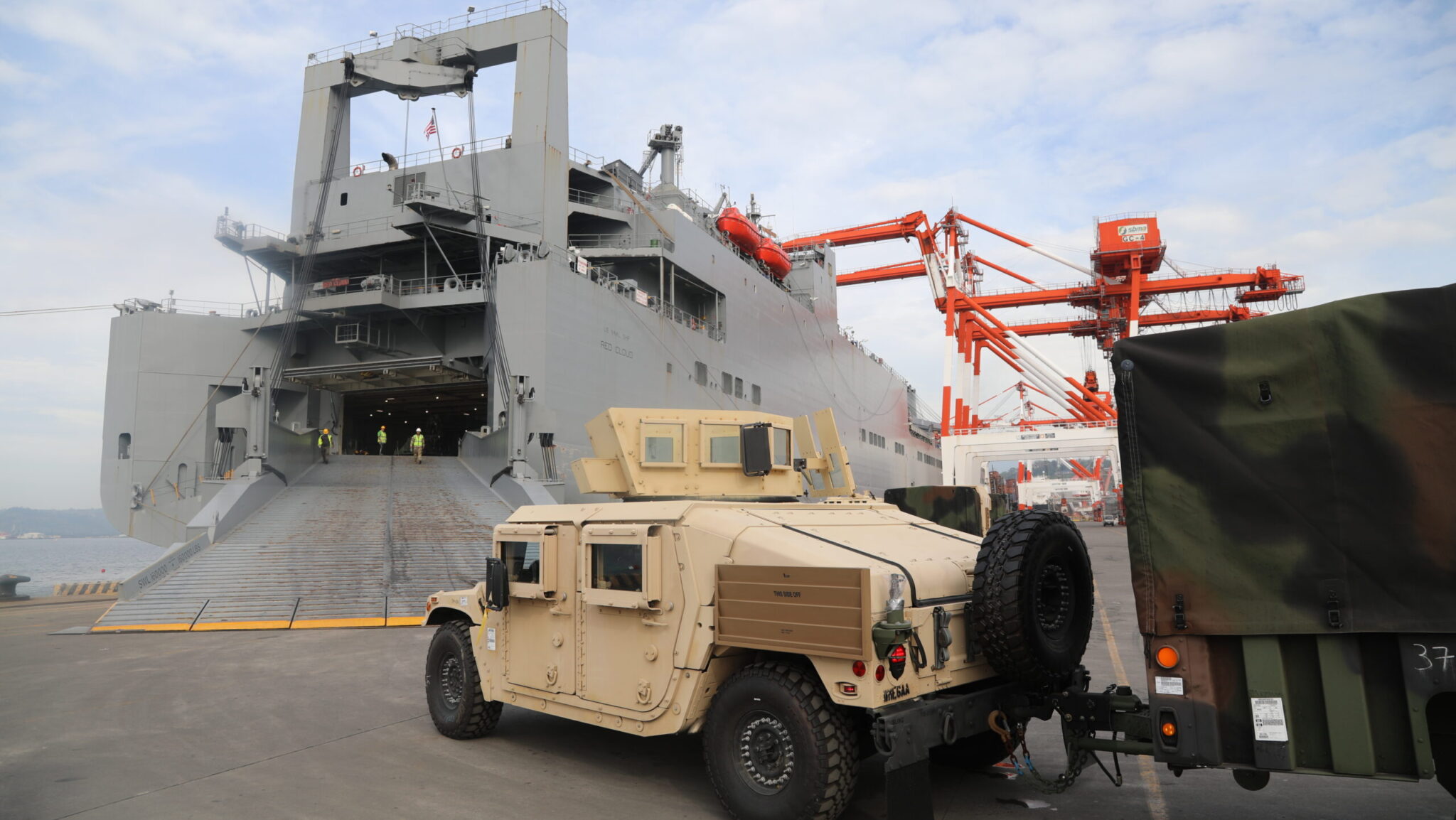
The US Army is critically evaluating its global prepositioned stocks (APS) strategy, considering the potential elimination of its only mobile floating cache in favor of establishing arms and equipment in friendly nations across the Indo-Pacific region. This was stated by Lt. Gen. Christopher Mohan, acting commanding general of Army Materiel Command, in an interview with Breaking Defense on Wednesday.
Building on Lessons from Ukraine and Regional Insights
“This discussion is still in the preliminary stages,” emphasized Mohan, highlighting the Army’s commitment to reassessing its approach to APS. The Army is focusing attention on the Indo-Pacific Command (INDOPACOM) and analyzing lessons learned from the utilization of APS in Ukraine. Currently, there are seven APS setup worldwide, including APS-4 for Northeast Asia and APS-5 for Southwest Asia. However, the floating APS-3—comprised of seven ships loaded with equipment ready for deployment to Europe, the Middle East, or the Indo-Pacific—is now under scrutiny.
Mohan indicated that the overhaul of the APS strategy is being spearheaded by the Army’s Deputy Chief of Staff for Operations, Plans, and Training (G-3), with input from his team.
Potential Transition to Land-Based Stockpiling
Should Pentagon leadership decide to discontinue the floating APS, plans are already in motion to distribute the equipment throughout the Indo-Pacific region. This effort will include identifying suitable countries for housing the distributed sets and negotiating agreements with those nations. Mohan noted, “[It’s] more challenging in INDOPACOM, because it’s bilateral versus having an alliance,” contrasting the easier logistics of positioning APS in regions like Germany.
Logistics Lessons from Recent Exercises
In recent years, Army leaders have evaluated logistics frameworks for the afloat APS during various exercises, such as Talisman Sabre 2023 in Australia. During this liaison, the Army utilized five unit sets of equipment, equivalent to roughly one-third of a ship’s capacity. However, transferring the ships to a pier is not a straightforward endeavor due to Australia’s stringent agricultural inspection laws, which necessitate a thorough inspection of all military equipment for pests.
Maj. Gen. Jered Helwig, who led the 8th Theater Sustainment Command during the exercise and is now the deputy commander for US Transportation Command, outlined the extensive preparations required. Army Abrams tanks and related equipment from APS-3 first had to be deep cleaned in Hawaii before being shipped back to the vessel. An agricultural inspector, equipped with pesticides, accompanied the equipment to ensure adherence to ecological precautions, highlighting the challenges inherent in international military logistics.
As the Army looks to refine its APS strategy, these lessons will be essential in shaping future deployments and operations in the increasingly strategic Indo-Pacific theatre.