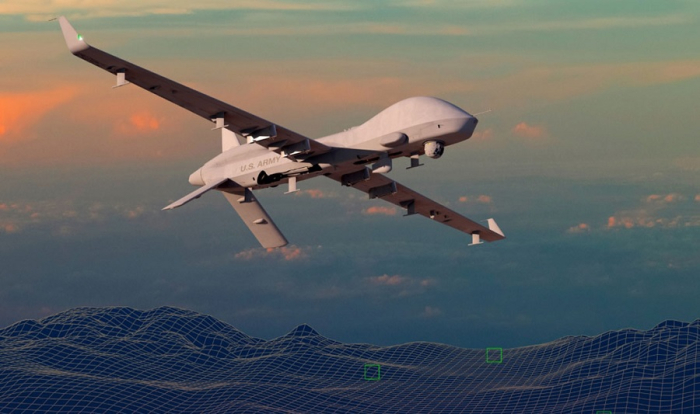
The United States Army has officially launched its search for a replacement for its iconic Gray Eagle large drone, shifting its focus towards Short/Vertical Takeoff and Landing (S/VTOL) Uncrewed Aircraft Systems (UAS). This initiative, communicated to the industry through a Request for Information (RFI), marks a decisive step towards increased mobility and adaptability on the modern battlefield.
Strategic Imperatives: No Runways, No Compromises
The Army’s solicitation emphasizes a „pressing need for reducing runway dependency,” which is essential for critical weapon systems to meet the challenges of an evolving battlefield. Service leaders are seeking Group 4 or above aircraft – weighing at least 1,320 pounds – that can provide division formations with an organic, runway-independent UAS capability. The focus is on „increased Size, Weight, Power, and Cost (SWaP-C), modularity, and interoperability.” The goal is a „long-endurance, multi-mission payload system” capable of supporting large-scale combat operations.
Transition from Gray Eagle: A Long-Term Vision
This action comes in the context of the Army’s „Continuous Transformation Initiative,” announced earlier this year, which decided to halt future buys of the General Atomics-made Gray Eagle. The primary reason cited was concern that current sensors are outdated. Officials have confirmed that newer Gray Eagle drones will remain in inventory and undergo upgrades, while older versions are slated for phasing out around 2028. To fill the gap left by fewer Gray Eagles, the Army is targeting Group 4 or larger S/VTOL drones.
Advanced Capabilities: From Sensors to High-Energy Lasers
The new systems must meet a range of cutting-edge characteristics and capabilities, including:
- Advanced sensors: With atmospheric sensing and electro-optical infrared capabilities.
- Autonomous operations: Including collision avoidance and increased sensor and computing dependency.
- Mission software architecture: Featuring survivability systems and electronic countermeasures, based on an open systems architecture.
- Cybersecurity: Adhering to Cybersecurity Maturity Model Certification (CMMC) Level 2.
- Government Furnished Equipment: Components classified as property possessed or acquired by the government, and furnished to the contractor for contract performance.
While not explicitly included in the recent RFI, there are plans to ask the industry to incorporate at least some of these large drones with high-energy lasers, opening new horizons for offensive and defensive capabilities.
Opportunity for Innovators: Who Will Take the Baton?
It remains to be seen which defense firms will enter the competition to have their drone offerings adopted by the US Army. Potential candidates include General Atomics, the current Gray Eagle manufacturer, who might seek to reclaim the contract with its Mojave demonstrator. Companies interested in participating in this S/VTOL challenge must respond to the RFI by January 8. Details regarding the execution of the challenge have not yet been made public.