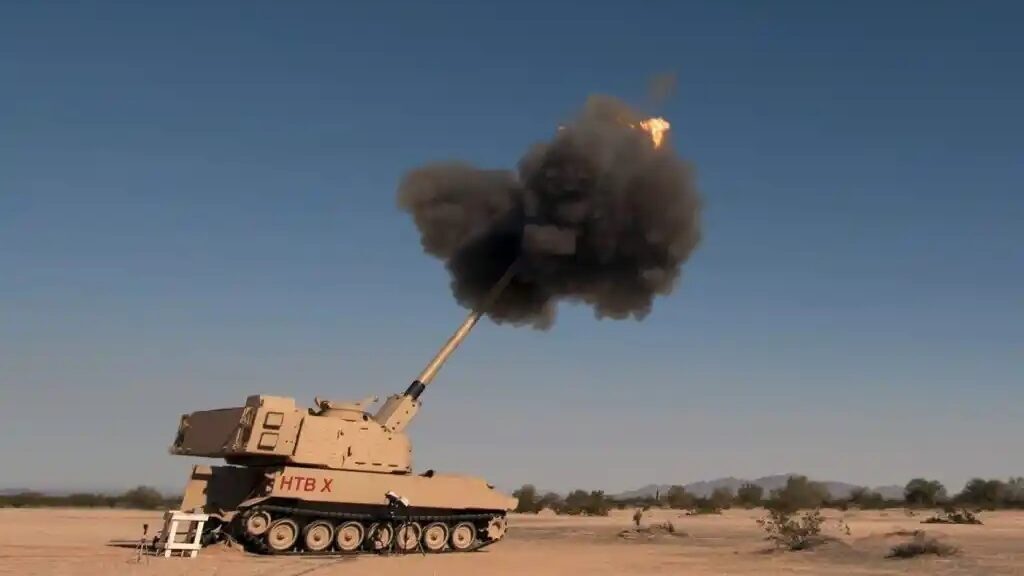
The US Army has released its formal requirements for the next generation of self-propelled howitzer, emphasizing domestic production, robust armor, and compatibility with US ammunition, according to a document obtained by Breaking Defense.
Demands for Dominant Fire Support
The directed requirement document outlines the need for „robust and organic fire support with rapid emplacement and displacement, ever increasing range, rate of fire, and reduced sustainment to deliver dominant long-range, massed, and precision fires” on a modern battlefield. The Army aims to equip two Transformation in Contact (TiC) units with advanced weapon systems, including firing platforms and substantial resupply capabilities from available manufacturers.
Domestic Production a Key Requirement
This document, dated Oct. 20, supports a recent request for information (RFI) for a self-propelled howitzer. An industry source noted that the new requirements document largely mirrors an earlier version, but with two key additions: a „domestic production” clause for both the howitzer and its resupply vehicle, and a requirement that the howitzer must be able to fire US ammunition.
Implications for International Bidders
These stipulations could impact foreign competitors such as Israel’s Elbit Systems, South Korea’s Hanwha, Germany’s Rheinmetall, and the team of US-based Leonardo DRS and European land defense specialist KNDS. US prime contractor General Dynamics and British BAE Systems, through its American subsidiary, are also expected to compete.
Hanwha’s Commitment to US Production
Despite the domestic production requirement, Hanwha’s defense head, Mike Coulter, expressed confidence, stating that the company intends to „create capacity, build them here.”
Armor and Mobility Trade-offs
The requirements document also calls for the new howitzer to possess armor equivalent to the M109A7 while maintaining increased „mobility & transportability.” Achieving this balance could prove challenging, as heavy armor is typically associated with tracked vehicles, while wheeled vehicles generally offer greater speed and mobility on roads. The reference to M109A7-level armor suggests a potential preference for a tracked system.
Key Requirements Summary
- Sustainment: High reliability, availability, and maintainability to minimize logistical burden.
- Mobility: Air/sea/rail/road transport capability and on/off-road mobility performance comparable to HIMARS.
- Range: „Max range massed lethal effects” up to 58km (36 miles) and precision fires up to 70km (43.5 miles), with a minimum range of 4km (2.5 miles).
- Rate of Fire: Ability to store more than three precision rounds (e.g., Excalibur) and fire at least six rounds per minute unguided and three rounds per minute guided.
From ERCA to Off-the-Shelf Solutions
After abandoning its internal development of the Extended Range Cannon Artillery (ERCA) platform, the Army sought existing self-propelled howitzers from various companies, including BAE Systems, Elbit Systems, General Dynamics, Hanwha, and Rheinmetall. The Army initially planned a competition to select an existing platform but temporarily paused the effort as part of the Army Transformation Initiative. The recently released RFI signals a renewed push to find a suitable off-the-shelf solution.
Transformation in Contact
The RFI invites vendors to provide their howitzer systems to brigades participating in the Army’s Transformation in Contact (TiC) initiative, which aims to rapidly test new equipment in real-world environments.